


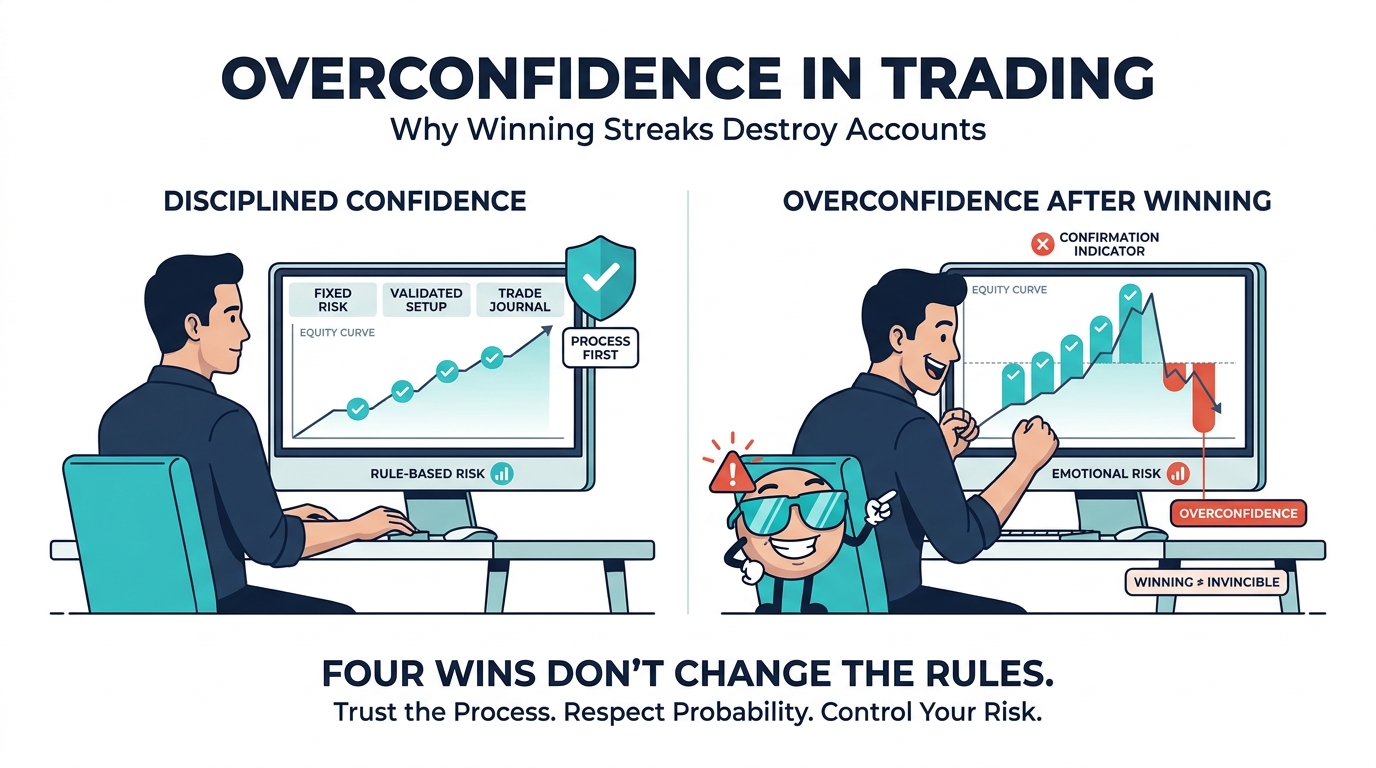
Confidence is necessary to trade. Being too sure of yourself can wreck your account in no time
In trading, it’s tricky to spot, and most traders don’t catch it until it’s too late, after they’ve already messed up. Overconfidence in Trading tends to pop up after we win, not after we lose, making it a real hazard.
A trader doesn’t usually go under after a rough day. They tend to explode after a solid week, then one big blunder
This lesson breaks down:
- Confidence can sometimes tip over into overconfidence in trading.
- Why winning streaks can be more dangerous than losing streaks.
- The psychological biases that lead to overconfidence in trading.
- Some tips for keeping your cool without going overboard.
Confidence vs Overconfidence in Trading — Understanding teh True Distinction
Confidence is rule-based trust in a process. Overconfidence is outcome-based belief in yourself.
What Healthy Trading Confidence Looks Like
- Position sizing stays the same
- Expected losses are just part of probability thinking.
- No pressure to “make more” after winning.
- Journaling and review keep going even when things are going well
Trading confidence really comes from how you do things, not just the outcomes. That’s the same idea in What Is a Trading Edge?
What Overconfidence in Trading Looks Like
- Boosting your bets after a couple of wins.
- Ignoring confirmations since the setups seem self-evident.
- Taking trades outside the plan.
- Thinking you’ve cracked the market code.
- Cutting back on or skipping performance evaluations.
This is not skill improving. It is discipline eroding.
Why Overconfidence in Trading Is So Dangerous
Losses usually make traders cautious. Wins often make traders careless.
Overconfidence in Trading can lead to taking risks that aren’t evenly spread out tiny mistakes that cause huge problems. A trader might take a bit more risk, skip a confirmation step, or throw in an extra trade. Each one on its own doesn’t seem like much. Together, they mess with the risk discipline and how equity acts — a trend you can also see in Equity Curve Management.
The Illusion Of Control
After a few lucky wins, the brain starts thinking it’s all about skill, not just chance. Traders start thinking they can guess what’s going to happen, rather than just handling the risks
This illusion of control leads to:
- Disregarding less-than-ideal circumstances.
- Overestimating the power of the edge.
- Considering randomness as a form of skill.
- Ignoring small sample sizes.
Markets do not reward confidence. They punish misplaced certainty.
Overconfidence in Trading as a Behavioral Finance Bias
Being too sure of your trading skills isn’t just a personality issue; it’s actually a common behavioral finance bias.
Key Psychological Biases at Play
- Overconfidence bias — thinking you’re better at something than you actually are.
- Confirmation bias — paying attention only to information that supports what you already believe.
- Outcome bias — judging decisions only by how things turned out.
- Misattribution bias — attributing success to skill but blaming failure on bad luck.
Professional traders often assume they are wrong.
Overconfidence in trading is more than a psychological tendency; it can influence how frequently investors trade and how they assess their own abilities. Research published by the National Bureau of Economic Research (NBER) examines the relationship between overconfidence and trading activity, highlighting how excessive confidence can contribute to unnecessary transactions. This reinforces the importance of evaluating trading decisions objectively rather than relying on recent winning streaks.
Overconfident traders think they’re always right until they’re shown otherwise, often by a drawdown, which you can learn more about in the link Trading Losing Streaks Explained.
Why Winning Streaks Can Do More Harm Than Losing Streaks
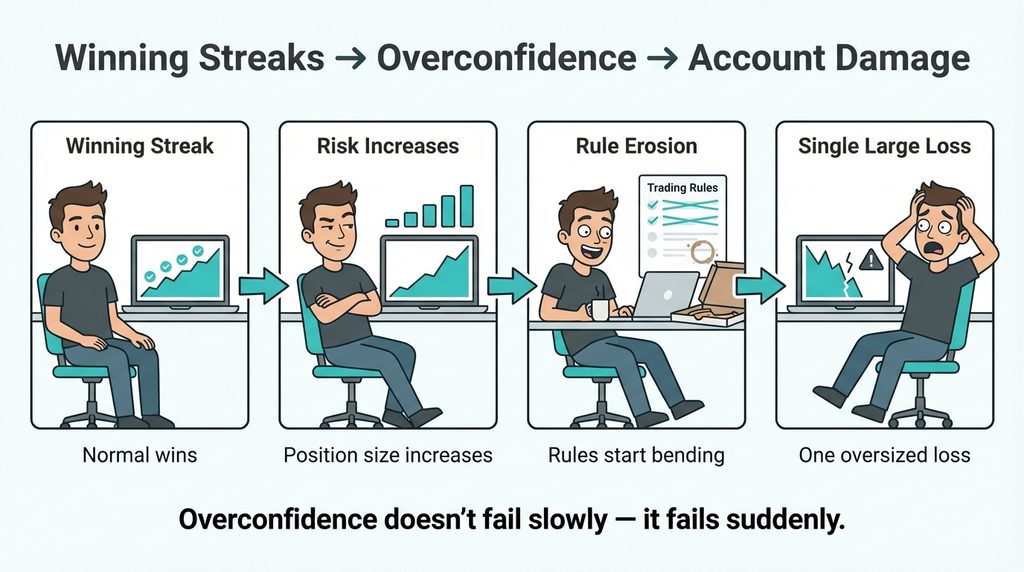
Losses trigger fear. Wins trigger entitlement. A losing streak usually makes traders cut back on their bets or take a break. A winning streak often pushes them to increase size and loosen rules.
A Common Overconfidence in Trading Scenario
- A trader wins four trades in a row.
- They increase lot size.
- They skip confirmation.
- They ignore context.
- One loss wipes out two weeks of gains.
- The damage does not come from the loss.
- It stems from teh shift in behavior prior to the loss.
Overconfidence in Trading vs Probability Thinking
Trading is not about being right. It’s all about expectancy when you’re dealing with a large sample size.
How Professionals Think
- A single trade might not pan out.
- Edges start showing up after a lot of trading.
- Professionals assess and set risk before they step in.
- That outcome doesn’t really count for much.
Overconfident traders often think they’re seeing a pattern where there isn’t one, treating every trade as a win. This way of thinking usually results in too much hustle the same kind of behavioral shift we talked about in the Reducing Risk Trading Strategy.
Clear Warning Signs You’re Trading with Overconfidence
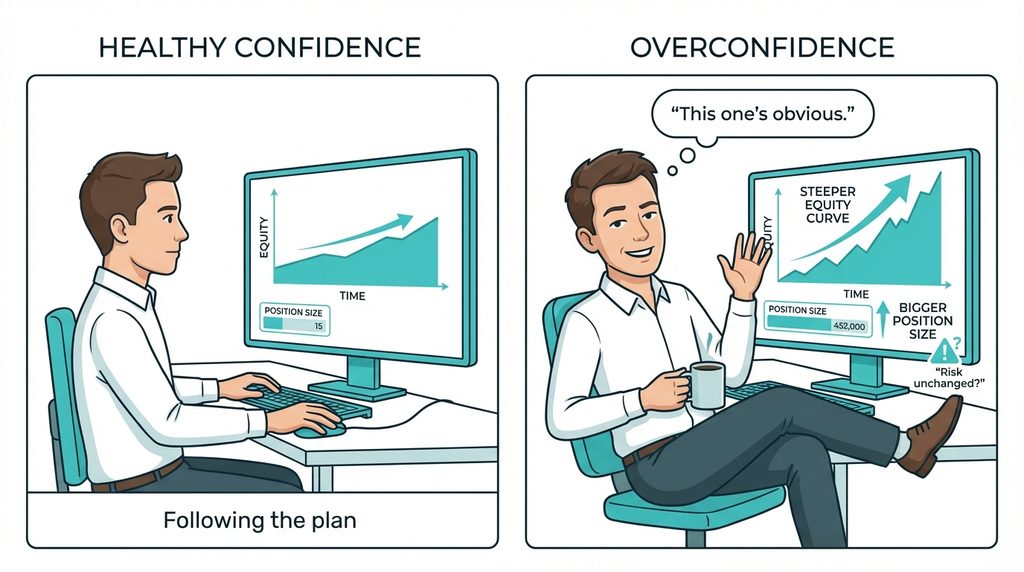
- Feeling pumped instead of just chill before entries.
- Justifying rule breaks instead of following the structure.
- Trading up after a win.
- Growing bigger without any solid data to back it up.
- Stopping journaling because “things are working.”
- Ignoring correlation or exposure overlap.
When you’re feeling all fired up after a win, it’s easy to let your risk discipline slide.
How to Stay Confident Without Becoming Overconfident
Confidence should be structural, not emotional. Rules should control behavior, not recent outcomes.
Practical Protection Rules
- Fixed risk per trade, never adjusted emotionally.
- Maximum daily or weekly risk limit.
- Predefined setups only.
- Required journaling following winning streaks.
- Systems stay the same even when things are going well.
- Trade slowed down after big victories.
Key Takeaway:
Trading confidence follows rules. Overconfidence in Trading breaks them.
Confidence Is Built Through Process, Not Results.
Consistent traders aren’t always teh ones with the most trading confidence:
- They are the most controlled.
- They do not trade harder after wins.
- They do not loosen rules when things go well.
- They see success as fleeting and discipline as a constant.
This mindset shelters them by keeping them from getting worn out and making rash moves, as the article discusses in Trader Burnout & Overtrading.
Conclusion: Overconfidence In Trading Quietly Wipes Out Your Profits
Overconfidence in Trading does not feel dangerous. That is why it works so effectively.
It pretends to be all about moving forward, getting better, and getting really good at stuff, but one big blunder can wipe out all that hard work in no time.
- True trading confidence is quiet.
- It does not need validation from wins.
- It does not change behavior after success.
If you’re aiming for a long life, you have to trust the game plan, the odds, and how you play it, not just what happened lately, using sound probability thinking and strong risk discipline.








