


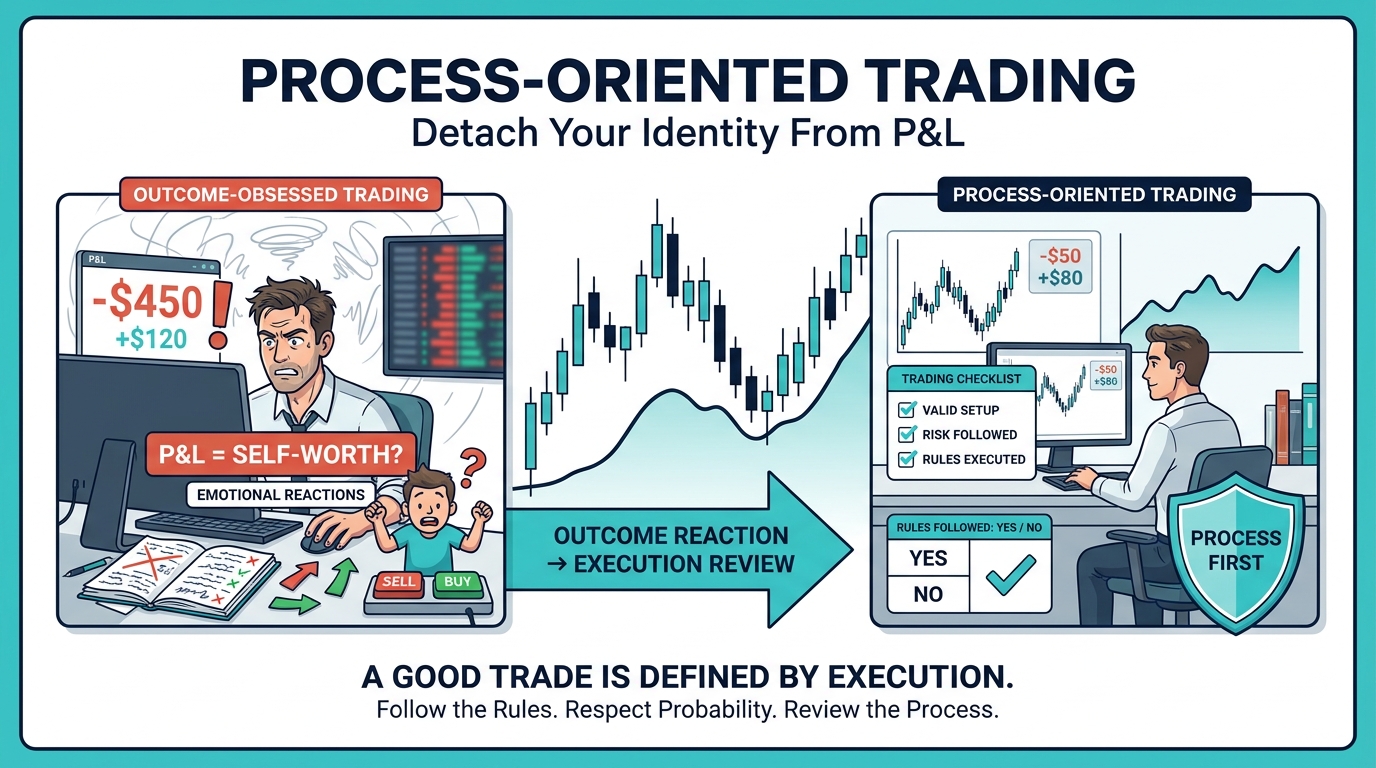
Most traders don’t tank because their game plan is flawed.
They fail because their self-worth fluctuates with their profits and losses. When profits feel like a pat on the back and losses feel like a personal failure, it’s like decision-making starts to fall apart. Process oriented trading is designed to address this problem. It steers the spotlight from quick wins to how well things are done, staying the same over time, and what we can expect in the long run
If you’re aiming for consistent results, you need to set aside emotional trading and stick to a set process. Consistency comes from actions, not just reacting emotionally to numbers
Why Attaching Identity to P&L Destroys Traders
When traders connect their self-worth to profit and loss (P&L), every winning trade can feel like proof of success, while every losing trade feels like a personal failure. This emotional attachment can lead to overconfidence, impulsive decisions, and unnecessary risk-taking.
The real challenge is separating trading performance from personal identity and evaluating decisions based on process rather than individual outcomes.
Trading decisions can be influenced by psychological biases, particularly when traders become emotionally attached to profits and losses. Research published by the CFA Institute Research Foundation on behavioural finance explores how behavioural factors can influence financial decisions. For traders, this reinforces the importance of evaluating decision quality, following predefined trading rules and separating individual trade outcomes from personal judgement.
P&L Is a Result, Not a Skill
Making money or losing it isn’t a sign of being intelligent or skilled
- A good trade can lose.
- A bad trade can win.
- When traders mix up results with talent, they keep doing the wrong things.
- They grow bigger after good luck and abandon structure after regular losses.
Key takeaway:
P&L measures results, not decision quality.
Decision quality is key to long-term success, and this point is also highlighted in the article Trading Expectancy Explained.
The Emotional Chain Reaction
When your identity’s tied to cash, every trade stirs up feelings; this is a classic example of trading psychology in action.
Loss → frustration → revenge trading
Win → confidence spike → overtrading
Drawdown → self-doubt → strategy hopping
This cycle is more about people’s actions than market trends. This psychological loop is also tackled in the article Psychology of Trading.
What Process-Oriented Trading Really Means
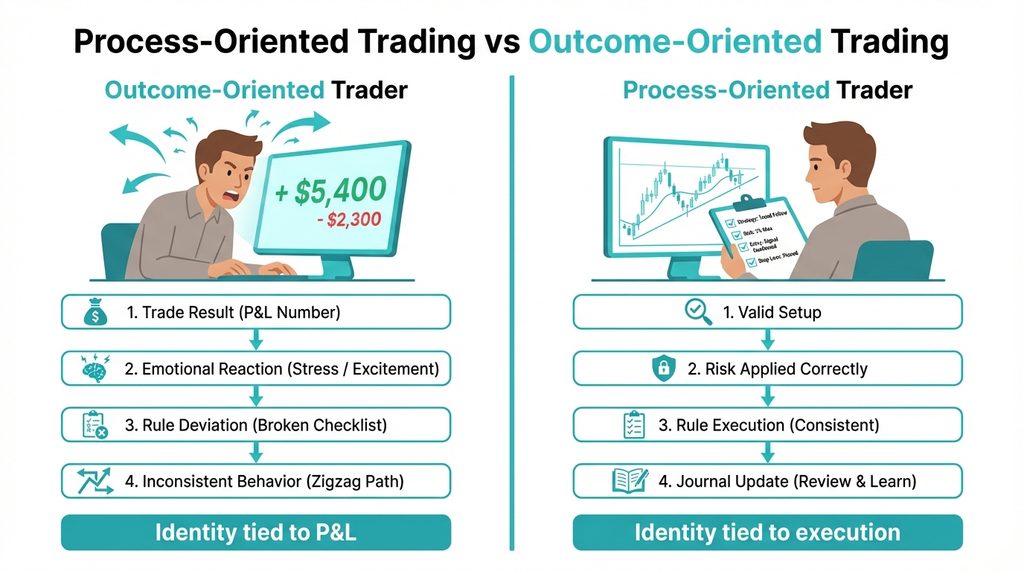
Process-oriented trading focuses on how traders make and execute decisions rather than the outcome of individual trades. Instead of measuring success solely by profit and loss, traders evaluate whether they followed their strategy, managed risk appropriately, and stayed disciplined.
This approach helps traders distinguish between good decisions and favorable outcomes, recognizing that a profitable trade isn't always well executed, and a losing trade isn't necessarily a mistake.
Outcome vs. process trading
Outcome-based trading asks:
“Did I make money?”
Process-Oriented Trading asks:
“Did I execute my rules correctly?”
Pro traders focus on execution, not just on how much money they make in a given day.
They understand that sticking to solid choices repeatedly, especially when you’ve many opportunities, is key.
The Core Rule of Process-Oriented Trading
- You are not paid for individual trades.
- You are paid for correct execution over time.
- A trader who follows rules perfectly and loses still did their job.
- A trader who breaks rules and wins did not.
This way of thinking reinforces execution-based trading and prevents sudden size jumps that can mess up the curve, a topic we covered in Equity Curve Management.
How Professionals Detach Identity From Results
Experienced traders aim to separate their personal identity from the outcome of individual trades. Rather than viewing every profit as proof of skill or every loss as a failure, they focus on decision quality, risk management, and consistent execution.
This approach helps traders evaluate performance more objectively, recognizing that a well-executed trade can still lose without necessarily being a poor decision.
Decision Quality Over Trade Outcome
On the trading floors, people go over deals with a set of questions
- Was the setup legit
- Assess the risk properly
- Was the execution in line with the plan
If the answers are yes, the trade’s a win no matter what the P&L says
Key takeaway:
Professionals judge systems, not single trades.
That’s why emotions stay steady, and discipline doesn’t waver, even when things aren’t going well, as explained in the link Trading Losing Streaks Explained.
Sample Size Changes Everything
One trade proves nothing.
Ten trades prove very little.
A hundred trades begin revealing truth.
Process-Oriented Trading only works when you respect teh odds and have enough data Emotions often get the better of us, focusing too much on immediate results this is the opposite of Overconfidence in Trading.
Practical Framework to Detach from P&L
Detaching from profit and loss (P&L) starts with shifting attention towards the decisions traders can control. Instead of measuring success by daily profits, traders can establish clear execution rules, predefined risk limits, and realistic performance goals.
A structured approach reduces emotional pressure, encourages consistent decision-making, and lets traders evaluate performance based on discipline rather than short-term financial outcomes.
Replace Profit Goals With Execution Goals
Instead of:
“I need to make $500 today.”
Use:
“I will only take A-grade setups.”
“I will follow my stop-loss rules.”
“I will not trade outside my plan.”
This quickly reduces emotional stress and helps you detach your identity from P&L.
Use a Binary Execution Score
After each trade, ask only one question:
Did I follow my rules? Yes / No.
Nothing else matters in that moment.
Over time, high scores indicate consistent execution without letting feelings get in the way. This strengthens execution-based trading and aligns with structured review routines discussed in the Trading Journal Guide.
A Real Example — Before vs. After
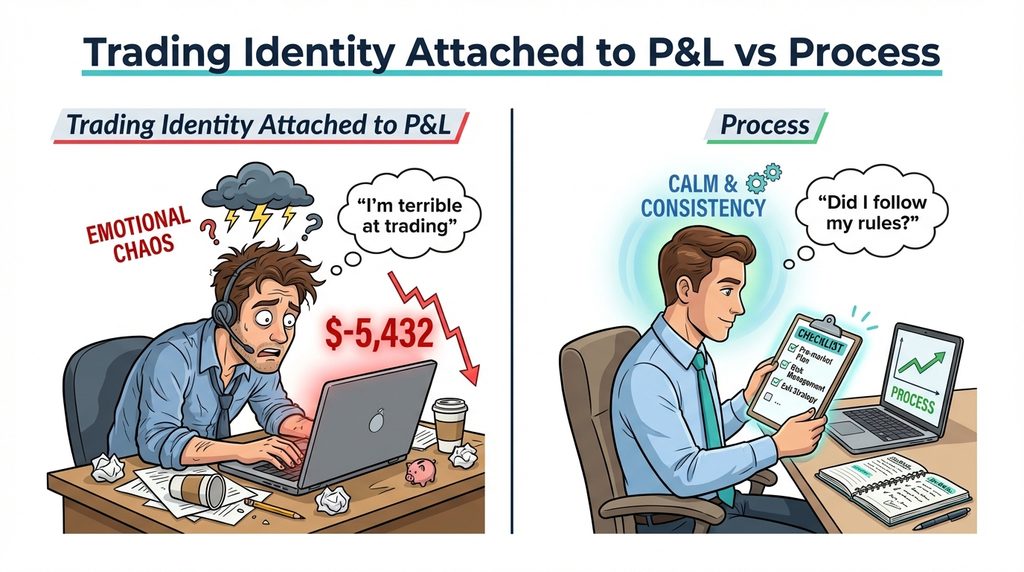
Before (Outcome-Focused Trader):
Three losing trades → “I am bad at trading” → forces a fourth trade → bigger loss → emotional spiral.
After (Process-Oriented Trader):
Three losing trades → rules followed → stops trading → journal updated → system intact.
- Same market.
- Same losses.
- Completely different long-term trajectory.
Common Mistakes Traders Make When Applying This
Applying process-oriented trading requires more than simply following a set of rules. Traders can sometimes misunderstand the approach by focusing entirely on execution while overlooking whether their strategy is actually effective.
The key is to balance disciplined decision-making with regular performance reviews, ensuring that a consistent trading process is also supported by measurable results over time.
Using “Process” as an Excuse
Process-Oriented Trading does not mean ignoring performance forever. It means separating evaluation timing from emotional reaction. You check results weekly or monthly, not after each trade.
Mixing Process With Hope
If rules are vague, emotional, or inconsistent, you don't have a process.
A real process is:
- Defined
- Measurable
- Repeatable
Without structure, “process” becomes a justification rather than a discipline.
How This Fits Into Long-Term Trading Success
Process-Oriented Trading directly strengthens:
- Trading expectancy
- Consistency
- Psychological resilience
- Risk control
- Equity stability
It also helps cut down on burnout, overtrading, and revenge actions — all rooted in Trader Burnout & Overtrading.
Conclusion — Trade the Process, Not Your Ego
Learning how to detach identity from P&L is not about becoming emotionless. It is about becoming professional.
When you measure yourself by how you trade rather than how much cash you have, your confidence grows, your discipline improves, and your performance becomes more consistent. Process-oriented trading isn’t just a nice-to-have; it’s essential to stay in the game.
If you’re aiming for steady outcomes, focus on how well you stuck to your game plan. Results come from actions. It’s not the other way around.








