


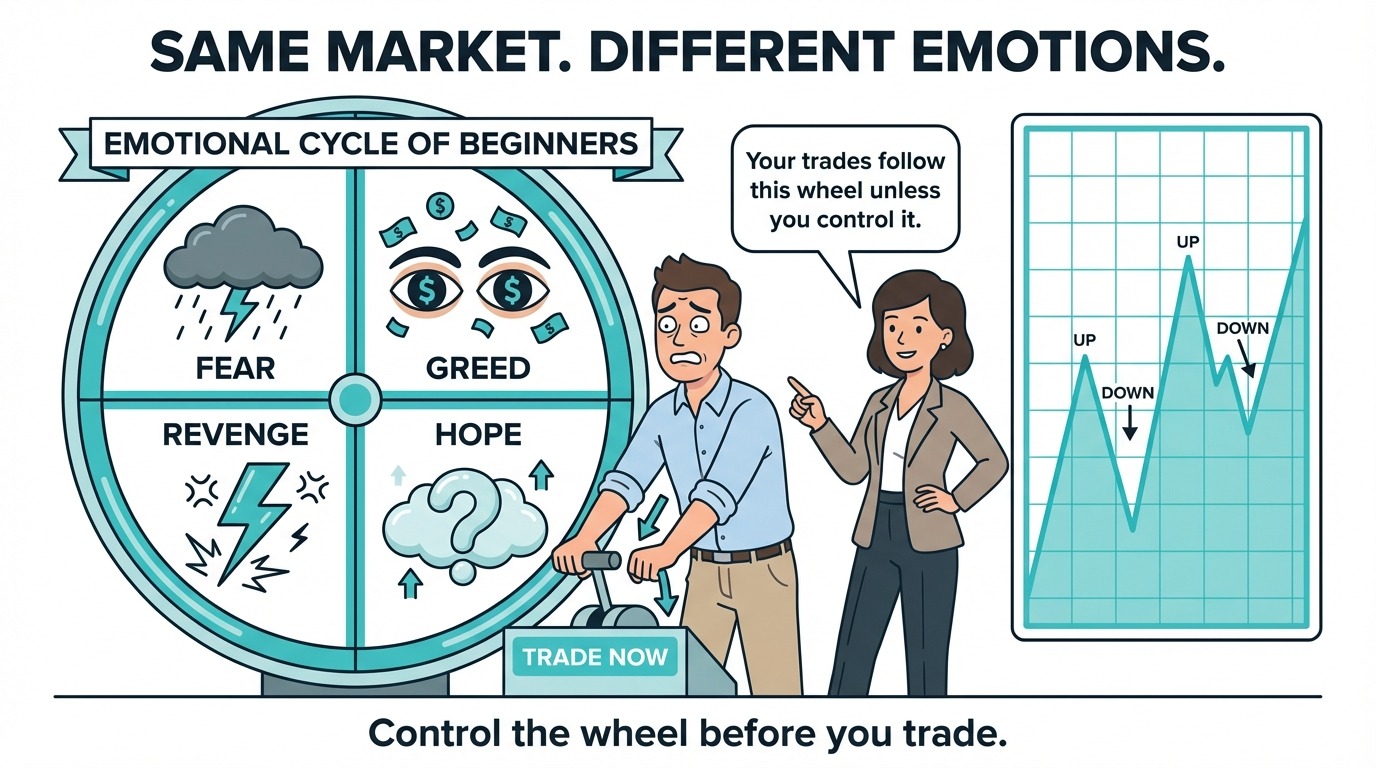
Common emotional mistakes beginners make in trading and investing can influence how individuals respond to market volatility, financial uncertainty, and potential losses.
Even when beginners understand basic investment concepts, emotions such as fear, greed, impatience and overconfidence may affect their decisions.
These reactions can contribute to impulsive trading, excessive financial exposure or decisions that no longer align with a considered investment plan.
However, not all financial losses result from emotional mistakes. Market conditions, investment risks, transaction costs and other factors also influence outcomes.
Recognising emotional patterns can help beginners develop greater awareness of their behaviour and approach financial decisions with more realistic expectations.
Common Emotional Mistakes Beginners Make in Financial Markets
Markets thrive on a bit of unpredictability. There is uncertainty about the future, and each decision carries a unique set of risks. Such an environment naturally sets off feelings like fear, excitement, and anxiety.
The emotional rollercoaster of not knowing what's next is laid out in What Does Investment Risk Really Mean?, where they say risk is all about the ups and downs, not just the scary stuff.
Mistake 1: Fear of Losing Money
Fear of financial loss can influence how beginners evaluate investment opportunities and respond to market movements.
How Fear Shows Up
Fear may lead investors to sell prematurely, hesitate when making decisions or avoid investments they previously considered appropriate.
Why Fear Is Dangerous
Excessive fear may encourage decisions based primarily on short-term market movements rather than financial objectives or relevant information.
However, caution is not inherently negative. Recognising potential losses and reassessing financial exposure are important parts of responsible risk management.
The objective is to distinguish between appropriate caution and impulsive reactions driven by uncertainty.
This emotional pattern plays a role in the explanation of how feelings can sway investment choices, as discussed in the article, Why Emotions Affect Investment Decisions?
Mistake 2: Greed After Small Wins
Profitable outcomes can sometimes encourage overconfidence and unrealistic expectations about future returns.
How Greed Shows Up
Greed may influence traders to increase position sizes, overlook potential losses or maintain exposure beyond their original plan.
Why Greed Is Dangerous
The desire for higher returns may encourage excessive risk-taking without sufficient consideration of financial circumstances or market conditions.
Previous gains do not guarantee future profits, and increasing exposure can magnify potential losses.
Recognising these behaviours can help beginners evaluate whether their decisions remain consistent with their financial objectives and risk tolerance.
Mistake 3: Revenge Trading
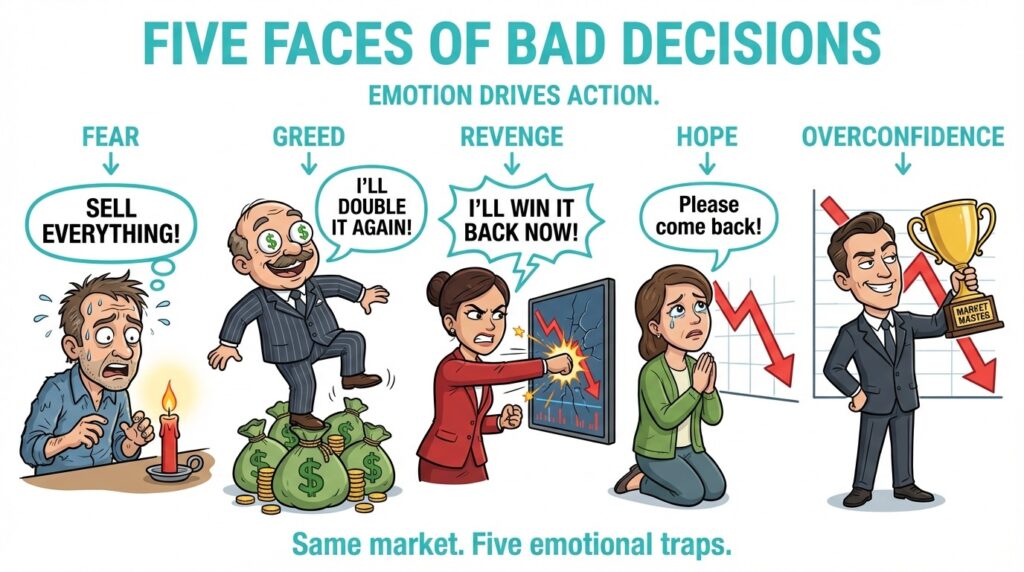
Revenge trading occurs when someone enters additional trades primarily to recover money lost on previous positions.
How Revenge Trading Shows Up
Common patterns may include:
- Entering new trades without sufficient analysis.
- Increasing position sizes after a loss.
- Trading repeatedly to recover previous losses quickly.
Why Revenge Trading Is Destructive
The urgency to recover losses may encourage decisions that do not align with the trader's original strategy or risk tolerance.
This behaviour can increase financial exposure and transaction costs without improving the likelihood of a favourable outcome.
Recognising the urge to recover losses immediately can help traders reassess their decisions before taking additional risks.
It takes the fun out and ups the danger factor, leading to increased emotional distress and poor decision-making in trading. This action is a key reason mentioned in the book How People Lose Money in Investing and How to Avoid It?
Mistake 4: Holding Losing Positions to Avoid Accepting a Loss
Some investors become reluctant to close an unsuccessful position because doing so would mean realising a financial loss.
Emotional Reason Behind It
This behaviour may be influenced by loss aversion, hope that prices will recover or reluctance to acknowledge an unsuccessful decision.
Why It Matters
Holding a declining investment without reassessing its underlying rationale may increase exposure to further losses.
However, maintaining a losing position is not automatically a mistake. The appropriate decision depends on market conditions, investment fundamentals and the investor's financial objectives.
Investors should evaluate positions using relevant information rather than relying solely on the hope of recovering previous losses.
Mistake 5: Overtrading from Boredom or Excitement
Overtrading occurs when someone places more trades than their strategy or circumstances reasonably justify.
How It Appears
- Entering trades without a clearly defined rationale.
- Trading primarily to remain active.
- Increasing trading frequency after profitable or unsuccessful outcomes.
Why It Matters
Excessive trading can increase transaction costs, financial exposure and the possibility of execution errors.
More frequent trading does not automatically improve investment outcomes.
A structured approach can help traders distinguish between opportunities supported by their analysis and decisions driven by boredom or excitement.
Mistake 6: Emotional Attachment to Trades
Emotional attachment occurs when traders become personally invested in a particular market prediction or position.
How Emotional Attachment Appears
- Refusing to reconsider an investment despite relevant new information.
- Focusing on evidence that supports an existing opinion while ignoring conflicting information.
- Treating an unsuccessful trade as a personal failure.
Why Emotional Attachment Can Be Risky
Financial markets do not move according to an individual's expectations.
Becoming attached to a particular outcome may prevent traders from reassessing market conditions and financial exposure objectively.
Recognising confirmation bias and remaining open to new information can support more informed decision-making.
Mistake 7: Confusing Confidence with Skill
Confidence can influence investment decisions, particularly after a series of profitable outcomes.
However, short-term success does not necessarily demonstrate a reliable investment strategy or an accurate understanding of financial risk.
How Overconfidence Appears
- Taking larger positions without reassessing potential losses.
- Underestimating market uncertainty.
- Assuming previous profits will continue.
- Overlooking transaction costs or the effects of leverage.
Why Overconfidence Can Be Risky
Overconfidence may encourage investors to take greater financial risks than their circumstances justify.
Reviewing investment decisions, understanding market limitations and maintaining realistic expectations can help beginners recognise the difference between confidence and demonstrated knowledge.
How Emotional Mistakes Connect to Trading Tools
Trading platforms and accounts provide information that can influence how traders respond to market movements.
For example, changes in unrealised profit and loss may encourage fear, excitement or overconfidence.
However, trading tools also provide important information about account equity, margin requirements and financial exposure.
Understanding these figures can help traders evaluate risks rather than interpreting account movements solely through an emotional perspective.
This topic connects directly to What Is a Trading Account? where feelings mix with fairness and equality.
How Beginners Can Reduce Emotional Mistakes
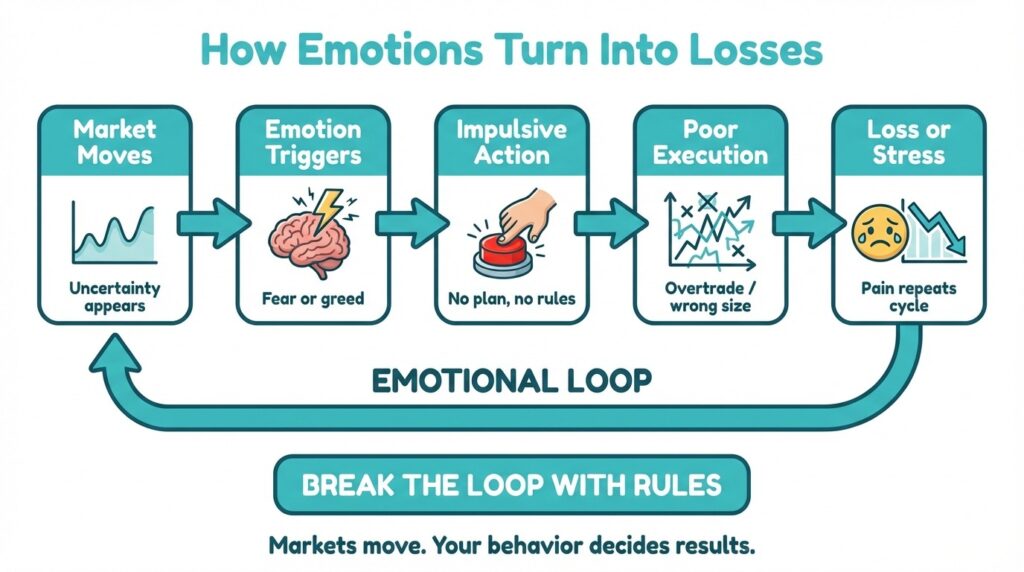
Recognising emotional reactions is an important step towards developing a more structured approach to trading and investing.
Establish Predefined Rules
Before making a financial decision, consider your objectives, risk tolerance, position size and the potential consequences of losses.
For active trading, this may also involve planning entry and exit conditions.
Understanding financial risk is an important part of avoiding emotional investment decisions. The Financial Conduct Authority (FCA) provides educational guidance on investment risks and returns, helping beginners understand why potential rewards should always be considered alongside the possibility of financial losses.
Smaller Position Sizes
Smaller positions generally involve less monetary exposure for a given price movement, assuming the same instrument and conditions.
However, reducing position size does not eliminate financial risk or guarantee emotional control.
Practise in a Simulated Environment
Demo trading can help beginners become familiar with order placement, platform features and decision-making processes using simulated funds.
However, demo trading does not fully reproduce the psychological pressure or execution conditions of real-money trading.
Develop Financial Knowledge
Structured education can help beginners understand investment risk, market behaviour and the psychological factors that influence financial decisions.
Explore VARIANSE Academy for further educational resources.
Conclusion: Emotional Mistakes In Trading
Emotional mistakes can influence how beginners approach trading and investing, particularly during periods of uncertainty or market volatility.
Fear, greed, impatience, loss aversion and overconfidence may contribute to impulsive decisions or unnecessary financial exposure.
Recognising these behaviours can help investors develop greater awareness of their decisions and establish more structured approaches to risk management.
However, emotional discipline cannot eliminate market risk or guarantee profitable outcomes.
For beginners, the objective is to combine financial education, realistic expectations and thoughtful decision-making while recognising that investment losses remain possible.








