


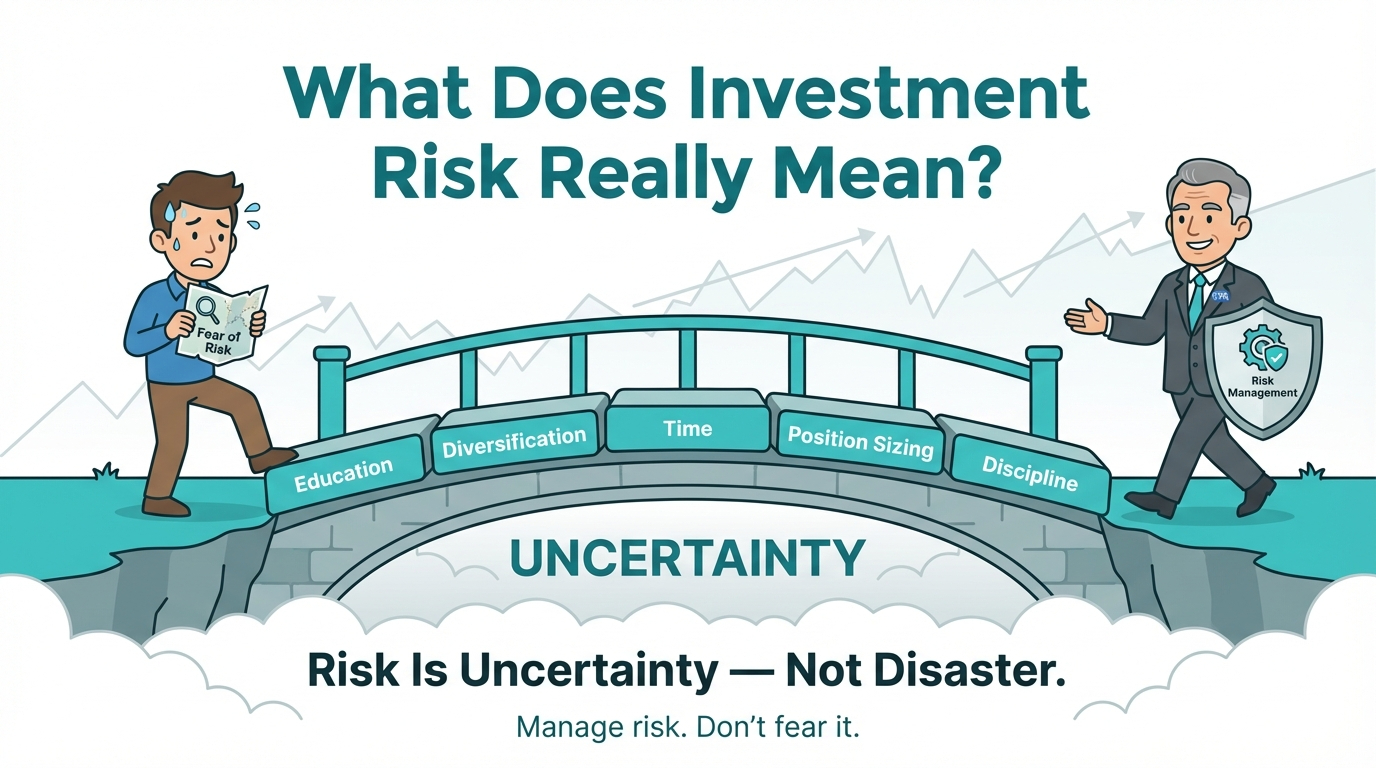
When beginners ask, ‘What is investment risk?’, they usually think about losing money. However, financial loss is only one aspect of investment risk. Investment risk isn't just about danger. Investment risk is fundamentally about uncertainty. It is the possibility that outcomes will differ from what you expect, both positively and negatively.
Economic changes, human behavior, global events, and shifting supply and demand influence markets and create risk. Investment opportunities involve varying degrees of risk, and higher potential returns generally come with greater uncertainty. Understanding risk isn't about avoiding investing. Rather than fearing risk, investors should approach financial markets with a clear plan, discipline, and an understanding of potential outcomes.
This article explains what investment risk truly means, why it exists, and how beginners can manage it intelligently.
What Risk Means in Investing (Beyond Losing Money)
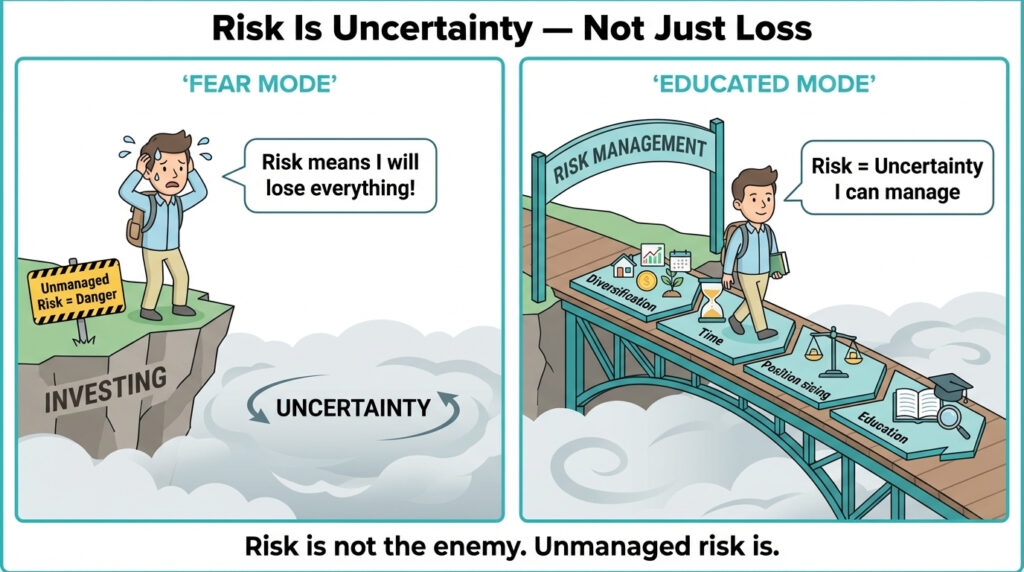
Investment risk is the possibility that actual investment outcomes will differ from expectations. It reflects the unpredictable nature of an investment's future value or income. Investment prices may fluctuate more than expected, and investors may not recover their initial capital, and we can't count on getting back what we put in.
Investing isn't just saving money. Savings primarily focus on ensuring financial stability. Investing involves uncertainty about potential growth. In Saving vs Investing, the article dives deeper into how risk drives wealth-building. Risk isn't just a blunder. Markets have this characteristic.
Why Risk Exists in Financial Markets
Risk exists because financial markets reflect real-world activity. Companies grow or fail, governments change policy, economies expand or contract, and global events reshape demand and supply.
Financial Market Foundations elucidates that Financial markets are dynamic systems influenced by economic activity, investor behavior, and changing conditions. Uncertainty arises because market participants have different objectives, expectations, and levels of information. Risk is simply the market’s way of expressing this uncertainty.
Risk and Reward Are Always Connected
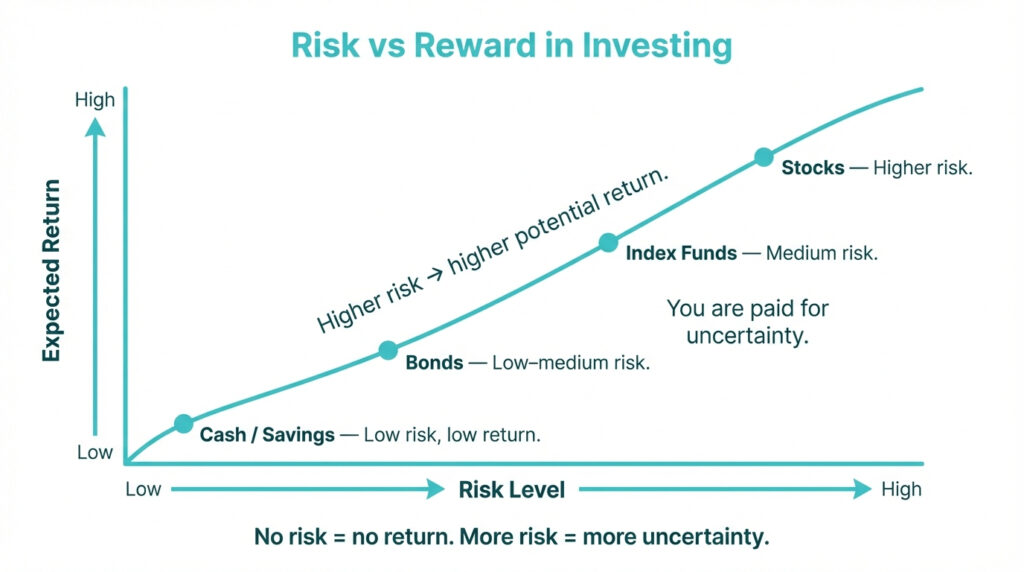
Investments offering higher potential returns generally involve greater risk. Lower-risk investments generally offer lower expected returns, although outcomes vary. This bond is central to finance.
The CFA Institute formally defines the risk-reward relationship, stating that investors are paid for taking on uncertainty in exchange for the chance to earn more. If there were no risks, there'd be no need for returns. Understanding this relationship can help beginners recognize unrealistic promises of high returns with little or no risk "safe high profits" that are just a myth.
Different Types of Investment Risk
- Risk isn't just one thing. It shows up in various ways
- Market risk arises from price fluctuations
- Inflation risk reduces purchasing power
- Liquidity risk makes it tough to sell assets quickly without losing value
- Emotional risk comes from fear and overconfidence
- Execution risk comes from poor timing and a lack of discipline
Understanding how prices fluctuate is a key part of Trade Mechanics & Execution Basics, where market behavior during trades is a fundamental element of market risk.
Why Beginners Often Misunderstand Risk
Many beginners believe they should avoid risk completely. In real life, uncontrolled risk is dangerous, but calculated risk is essential.
This mix-up is reinforced by myths in the article Common Investing Myths Beginners Should Know, where beginners sometimes confuse investing with gambling or assume that all investment decisions are speculative. Real investing means taking risks smartly, not gambling away your money.
Risk Is About Management, Not Elimination
Investing always comes with some risk. It's just something we've got to handle. Effective risk management rests on several key principles.
- Diversification
- Time horizon awareness
- Position sizing
- Emotional discipline
- Education before capital
- These principles turn risk into a helpful asset
Why Time Reduces Risk
Short-term price movements can be unpredictable. Market trends tend to be more consistent over time. This is why long-term investing is typically a safer approach than impulsive, quick trades.
Time has its own magic in the article How Investing Helps Grow Wealth Over Time?, showing how compounding and patience can lower your risk.
Risk, Inflation, and Purchasing Power
Holding cash also carries risks, particularly the potential loss of purchasing power due to inflation. Inflation quietly chips away at how much we can buy each year. Skipping investments altogether still comes with its set of risks. The IMF explains how inflation erodes the real worth of money, showing it weakens over time
So the real question isn't just about taking risks; it's about what kind of risks we're willing to take.
Why Practicing Before Investing Matters?
Investment risk also has a psychological dimension. Newbies usually don't realize how much pressure can affect their choices.
A smart way to get the hang of risk is to use a demo setup on the VARIANSE trading account page, where you can see how the market moves without risking real capital.
This can help beginners become familiar with trading decisions before committing real capital.
Education as the First Layer of Risk Protection
Knowledge helps reduce risk. Grasping how markets work, how prices fluctuate, and how people's actions influence choices helps keep things steady.
VARIANSE Academy provides structured educational resources designed to help beginners understand financial markets and investment risk
Risk Is What Makes Investing Possible
Investing wouldn't happen without taking some chances. Risk provides opportunities for growth, value shifts, and expansion. The goal isn't to fear risk, but to acknowledge it and manage it responsibly.
Investors who understand and manage risk are better equipped to make disciplined decisions. People who fear taking chances often make emotional decisions.
Conclusion: What Does Investment Risk Really Mean?
What does investment risk really mean? Risk is not the enemy of investing. Uncontrolled risk is.
Investing involves uncertainty, making informed decision-making and effective risk management essential. It's about getting involved in the actual buying and selling.
Risk isn't the enemy in investing. Uncontrolled risk occurs when you don't manage and quantify it effectively. Effective risk management supports more disciplined investment decisions, but it cannot guarantee financial growth. Investing isn't about dodging uncertainty. You need to learn how to navigate it wisely.








