
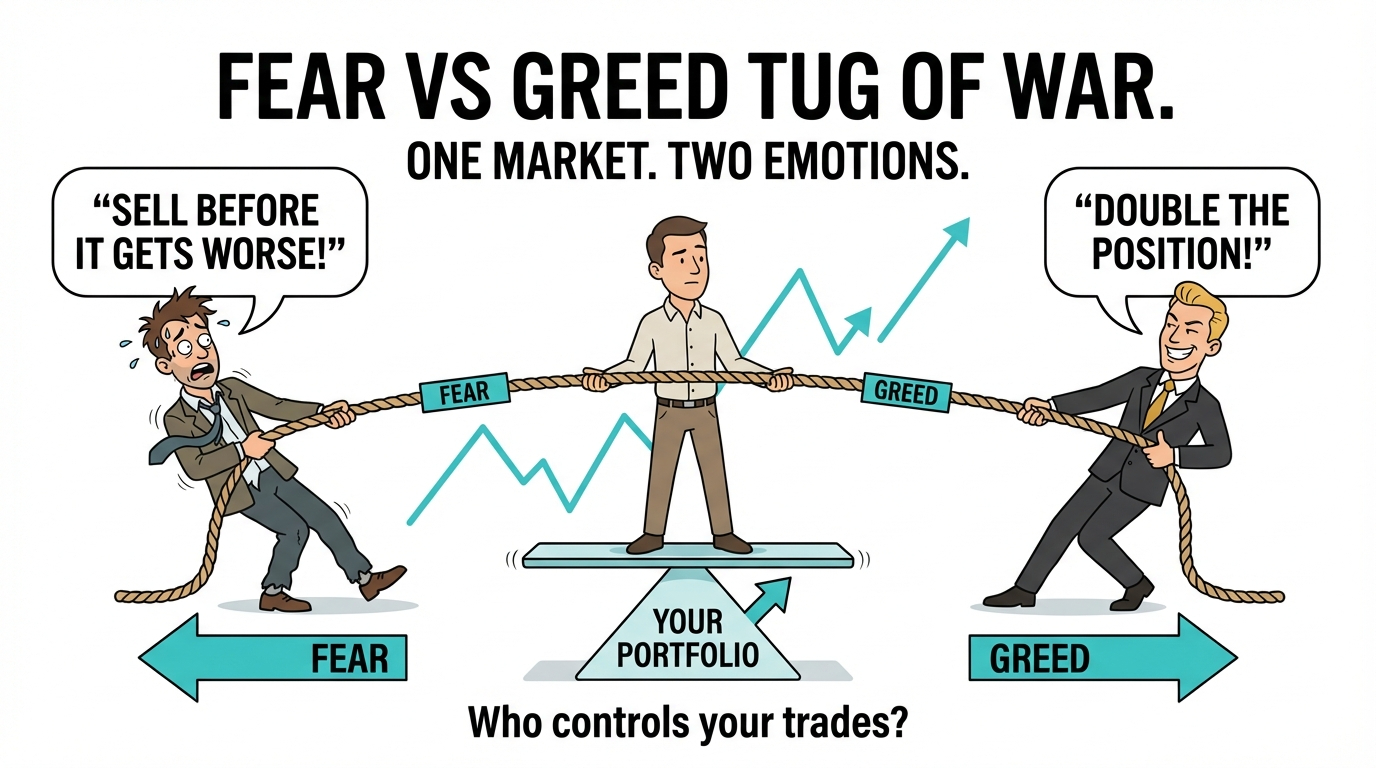
Fear and greed affect investments by influencing how individuals interpret market information, assess financial risks and make buying or selling decisions.
When prices fluctuate, investors may experience uncertainty about potential losses or excitement about possible gains. These emotional responses can sometimes encourage impulsive decisions that differ from an established investment plan.
Fear may lead to premature selling or excessive hesitation, while greed may contribute to overconfidence, increased financial exposure or unrealistic expectations about returns.
However, emotions are only one factor influencing investment outcomes. Market conditions, investment knowledge, costs and individual financial circumstances also play important roles.
Understanding how fear and greed influence behaviour can help beginners recognise psychological biases and approach financial decisions with greater awareness.
How Emotions Influence Investment Strategies
An investment strategy provides a framework for evaluating opportunities, managing financial exposure and making decisions.
However, emotions can influence how consistently an investor follows that strategy.
For example, fear may encourage someone to sell during a market decline without reassessing the investment's underlying rationale. Overconfidence may lead another investor to take greater risks after profitable outcomes.
Neither strategy nor emotional discipline guarantees favourable investment results.
The objective is to combine financial knowledge, realistic expectations and considered decision-making while remaining willing to review a plan when circumstances change.
That's why people say investing is more about structured participation than just guessing, especially in What Is Investing?, where sticking to a plan is key to staying consistent.
Understanding financial risk is essential when managing fear and greed in investing. The Financial Conduct Authority (FCA) provides educational guidance on investment risks and returns, helping beginners understand why potential rewards should be considered alongside the possibility of financial losses.
What Fear Means in Investing
Fear is a natural emotional response to uncertainty and the possibility of financial loss.
In investing, fear may become more noticeable during market declines, unexpected economic developments or periods of increased volatility.
How Fear Shows Up in Beginner Traders
Fear often shows up when traders pull out too soon, miss out on good chances, or wait too long to jump back in after a loss. Instead of following rules, the trader seeks emotional relief.
How Fear Can Distort Decision-Making
Fear may cause investors to focus excessively on short-term price movements or overestimate the likelihood of unfavourable outcomes.
Recognising these reactions can help investors distinguish between reasonable caution and decisions driven primarily by emotional pressure.
What Greed Means in Investing
Greed refers to an excessive desire for financial gains that may encourage investors to overlook potential risks.
It can become more noticeable after profitable outcomes or during periods when asset prices are rising rapidly.
How Greed Appears in Trading Behavior
Greed shows up as overtrading, increasing position size, or ignoring exit rules. Instead of protecting capital, the trader chases expansion.
Why Greed Increases Risk Exposure
The pursuit of higher returns may lead to excessive leverage, concentrated investments or decisions made without sufficient analysis.
Increasing financial exposure can magnify potential losses, and previous gains do not guarantee future profits.
Recognising these patterns can help beginners evaluate whether their decisions remain appropriate for their financial circumstances.
How Fear and Greed Influence Buy and Sell Decisions
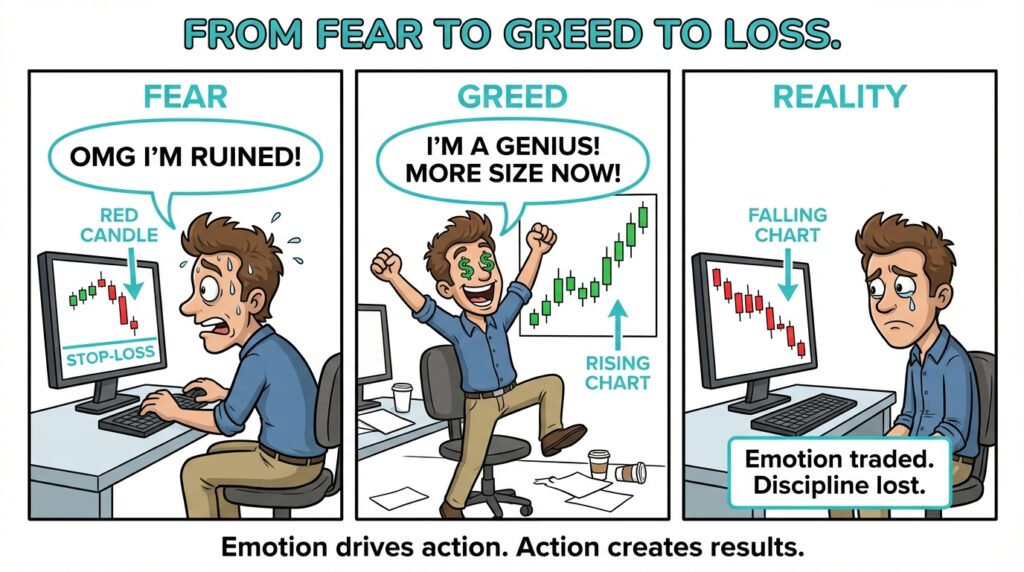
Investment profits and losses are influenced by changes in market prices, the size of an investment, transaction costs and other relevant factors.
Fear and greed do not directly determine market outcomes, but they can influence the decisions that affect financial exposure.
For example, fear may encourage an investor to sell during a temporary market decline, while greed may lead someone to increase a position without adequately considering potential losses.
Execution starts to react rather than being planned, often leading to impulsive decisions that can result in significant financial losses. The mechanics behind this are explained in Trade Mechanics & Execution Basics, where orders are shown as emotional expressions when discipline is missing.
How Fear and Greed Influence Profit and Loss
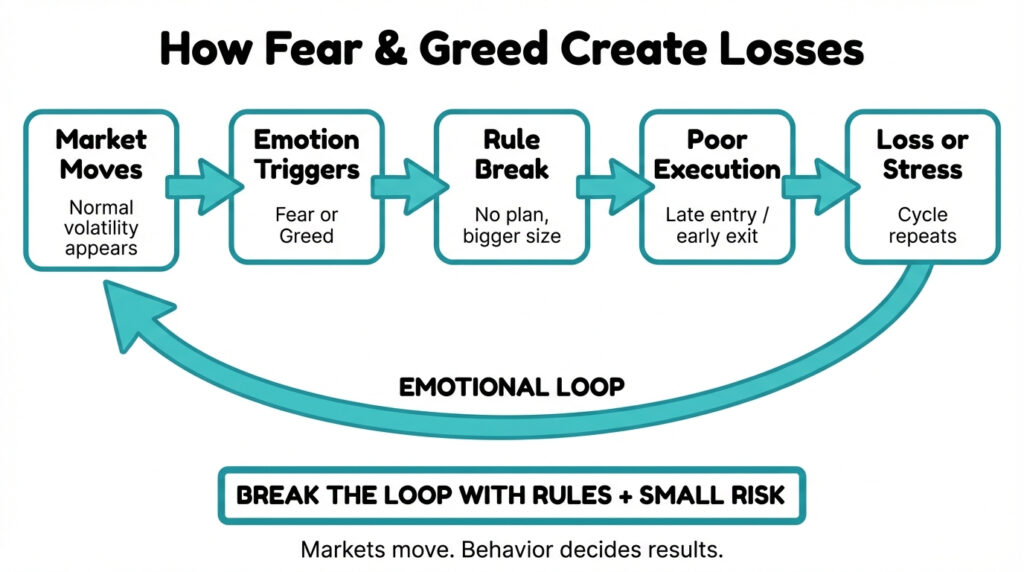
Fear and greed can influence how investors perceive potential gains and losses.
During periods of optimism, investors may underestimate financial risks or place excessive confidence in favourable outcomes.
During market declines, fear may encourage individuals to overestimate the likelihood of further losses or focus disproportionately on short-term volatility.
These reactions can affect risk assessment, particularly when decisions are made without reviewing relevant financial information.
The outcome's not looking bright, even with solid concepts, as fear and greed can cloud judgement and lead to poor decision-making in financial contexts. This outcome is explained in the section What Is Profit and Loss? where P&L is depicted as feedback rather than validation.
How Emotions Distort Risk Perception
When greed is in control, risk appears insignificant, but when fear is in control, it becomes significant.
This distortion prevents rational decision-making and is structurally explained in this link, where uncertainty is described as something we can't avoid but can handle
Psychological Biases Behind Fear and Greed
Several cognitive biases can influence how investors interpret information and respond to financial uncertainty.
Loss aversion describes the tendency to experience losses more strongly than equivalent gains.
Confirmation bias involves favouring information that supports existing beliefs while overlooking contradictory evidence.
Overconfidence bias may lead investors to overestimate their knowledge, forecasting ability or control over financial outcomes.
Recognising these biases can help investors question assumptions and evaluate financial decisions more carefully.
However, awareness of cognitive biases does not eliminate their influence or guarantee improved investment performance.
Why Beginners Feel Stronger Emotional Pressure
Beginners lack experience, probability understanding, and emotional tolerance. Every price shift seems significant, and every drop hits hard. This really stokes up fear and greed big time.
How Trading Platforms Amplify Emotional Reactions
Platforms show profit and loss as it happens. This ongoing feedback really shapes how we feel about things.
The interface doesn't stir up feelings, but it speeds up our response time, allowing us to make quicker decisions in the face of market fluctuations and manage our fear and greed more effectively. This dynamic is explained in the article, How Online Trading Platforms Work?
How to Manage Fear and Greed in Investing
Fear and greed are natural emotional responses. The objective is not to eliminate them but to recognise when they may influence financial decisions.
Evaluate Position Sizes
Consider how much financial exposure is appropriate for your objectives, circumstances and risk tolerance.
Smaller positions generally reduce the monetary impact of a given price movement, assuming the same instrument and conditions. However, they do not eliminate risk or guarantee emotional control.
Establish Rules Before Making Decisions
Consider your investment objectives, potential losses and the circumstances under which you may need to reassess a position.
For active trading, this may include planning entry and exit conditions while recognising that stop-loss orders do not guarantee execution at a specified price.
Practise Using Simulated Funds
Demo trading can help beginners become familiar with trading platforms, order placement and decision-making without risking real trading capital.
However, simulated trading cannot fully reproduce live-market execution conditions or the emotional pressure of risking real money.
Follow a Structured Learning Path
Learning about investment psychology, market behaviour and risk management can help beginners understand how emotions influence financial decisions.
Explore VARIANSE Academy for educational resources covering these topics.
Conclusion: How Fear and Greed Affect Investments and Decision Making
Fear and greed can influence how investors interpret market information, assess risks and respond to financial uncertainty.
Fear may encourage premature selling or excessive hesitation, while greed can contribute to overconfidence and unnecessary financial exposure.
Recognising these emotional patterns can help beginners develop greater awareness of their decisions and establish more structured approaches to investing.
However, emotional discipline cannot eliminate market uncertainty, prevent financial losses or guarantee favourable outcomes.
Understanding how fear and greed affect investments is one part of developing financial knowledge, realistic expectations and a considered approach to risk management.