


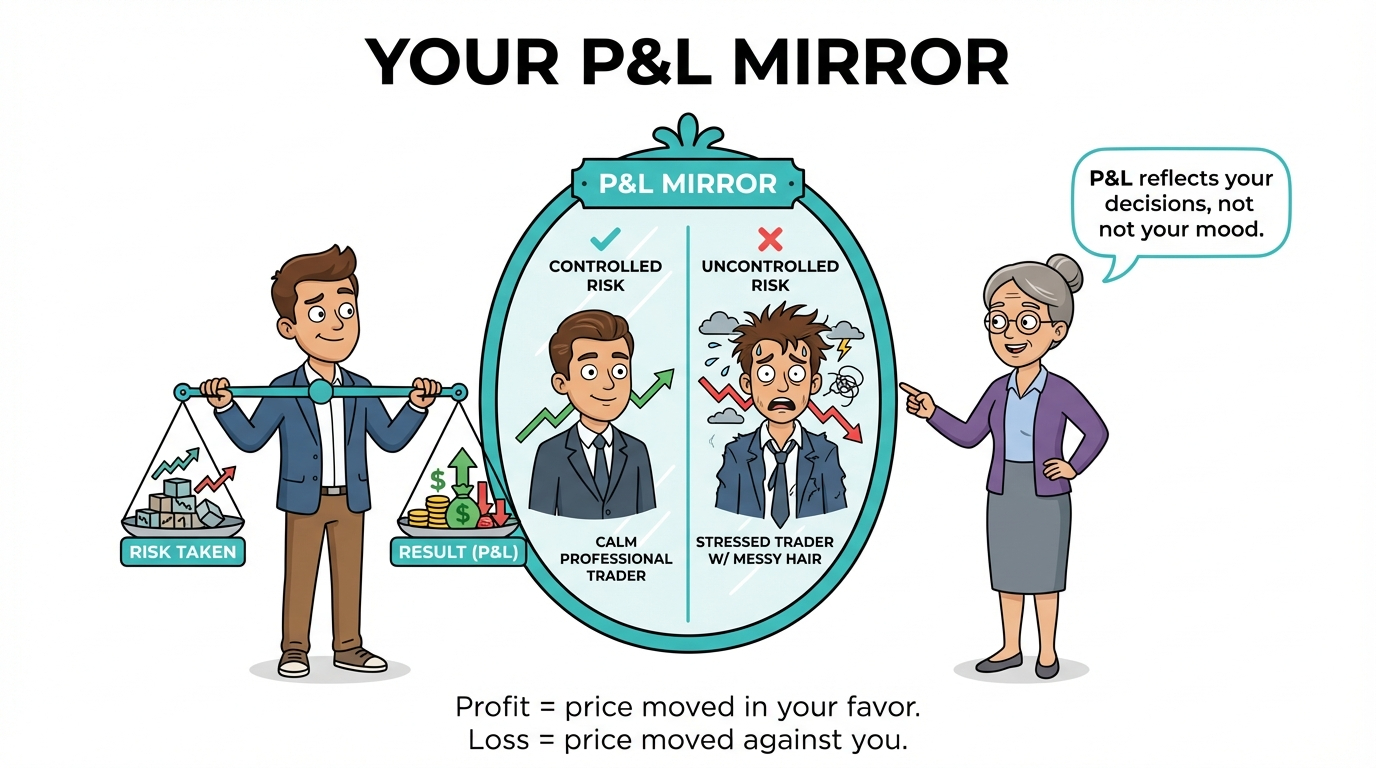
What is profit and loss? In trading and investing, profit and loss (P&L) measures the financial gain or loss associated with a position or transaction.
When market prices move, the value of an open position may increase or decrease. The final trading result depends on factors such as entry and exit prices, position size, and applicable trading costs.
Understanding how P&L works helps beginners interpret trading account figures, distinguish between realized and unrealized results, and evaluate trading performance more effectively.
What Does Profit and Loss Mean in Simple Terms?
Profit and loss (P&L) measures the financial gain or loss associated with a trading position.
For a simple long position, profit occurs when the selling price is higher than the buying price, after accounting for applicable trading costs. A loss occurs when the selling price is lower.
For example, if you buy one share at £100 and sell it at £110, your gross profit is £10. If you sell it at £90, your gross loss is £10.
The final result also depends on the number of units traded and any applicable spreads, commissions or other charges.
Short positions work differently because they generally benefit when prices fall and lose value when prices rise.
Does Profit and Loss Measure Trading Decision Quality
P&L isn't just about the cash. It's feedback. This data shows if you followed your trading plan, how much you invested, and how you reacted emotionally.
This idea aligns perfectly with how investing is explained in the link What Is Investing? It's about playing a structured game rather than just trying to predict what will happen.
How Is Profit and Loss Calculated?
Trading profit and loss is primarily influenced by the difference between entry and exit prices, the size of the position and applicable trading costs.
For a simple long position:
Gross P&L = (Exit Price − Entry Price) × Quantity
For a simple short position:
Gross P&L = (Entry Price − Exit Price) × Quantity
These formulas illustrate basic price-based calculations. The actual calculation may differ depending on the financial instrument, contract specifications and account currency.
However, looking at prices alone doesn't give a complete picture. Your account's change depends on your position size, execution prices and trading costs, and how long you play. The gist of this concept is in the Trade Mechanics & Execution Basics, where we see orders and exposure as math equations, not just guesses.
Gross Profit vs Net Profit
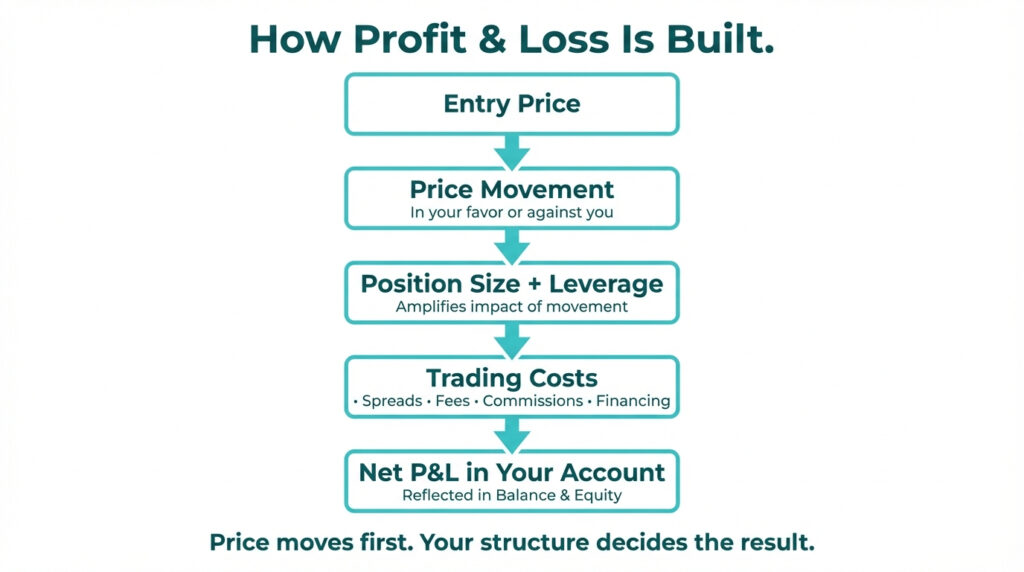
Gross profit and loss represents the trading result before deducting separately charged trading expenses.
Net profit and loss reflects the result after applicable costs, such as commissions, financing charges and other transaction-related fees.
For example, if a trade generates £100 in gross profit and incurs £8 in additional charges, its net profit is £92.
The bid-ask spread can also affect the trading result because buying and selling generally occur at different prices. When gross P&L is already calculated using actual execution prices, the spread's effect may already be reflected in that figure.
The Financial Conduct Authority (FCA) provides guidance on investment risks and returns, helping beginners understand why trading costs and potential losses should be considered when evaluating financial performance.
Many newbies just look at the potential gains without thinking about the expenses. That's why we dive into What Are Spreads, Fees, and Commissions?, where trading costs are clearly part of the real deal, rather than optional considerations.
Floating P&L vs Realized
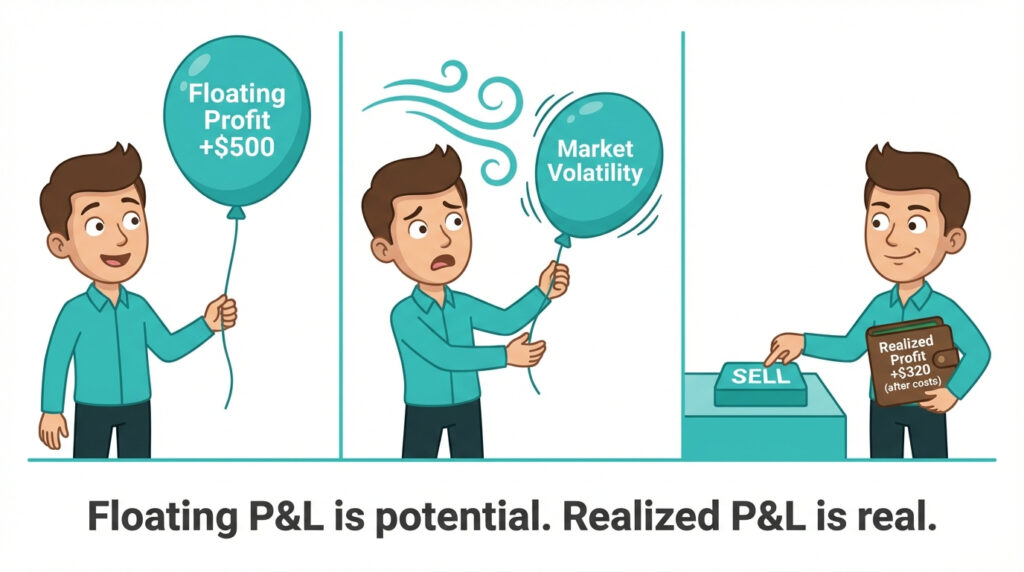
Floating P&L, also called unrealised P&L, represents the current profit or loss on an open trading position.
It changes as market prices move and may also be affected by applicable costs.
Realised P&L is the profit or loss recorded when a position, or part of a position, is closed.
For example, an open trade may show £50 in floating profit. If the market moves against the position, that profit may decrease or turn into a loss before the trade is closed.
How Does Your Trading Account Display P&L
Trading accounts commonly display several financial measures that help traders monitor their funds and open positions.
- Balance: The account amount after recorded transactions, including realised trading results, deposits, withdrawals and applicable charges.
- Equity: The account balance adjusted for unrealised profits and losses and any other relevant account adjustments.
- Used Margin: The amount of margin allocated to support open leveraged positions.
- Free Margin: The portion of equity remaining after deducting used margin, subject to the platform's calculation rules.
The trading account acts as your go-to for managing operations, and it's all about how your capital, exposure, and trades come together. Check out What is a Trading Account? for the full scoop.
How Does Leverage Affect Profit and Loss
Leverage allows traders to control larger market positions with a smaller amount of capital committed as margin.
Because profit and loss depends on the total position exposure, using leverage to increase position size can magnify potential gains and losses relative to the capital committed.
For example, a 1% price movement on a £10,000 position represents approximately £100 in gross P&L, before costs, regardless of the margin required to open that position.
Higher leverage does not automatically change the profit or loss of an identical position. The risk increases when traders use the available leverage to take larger market exposure.
That's why people call leverage a risk booster, not just a way to make more money. The explanation for this is in the article, Understanding Leverage in Simple Terms.
What Is the Difference Between Profit and Loss and Risk
Profit and loss measures the financial outcome of trading activity, while risk refers to the possibility and potential extent of an unfavourable outcome.
Traders can assess risk before entering a position by considering position size, market volatility, leverage, and potential losses.
Once a position is open, unrealised P&L changes with market conditions. Realized P&L is recorded when the position is closed.
The deeper meaning of uncertainty and results is laid out in the link What Does Investment Risk Really Mean?, where we swap out the idea of certainty for probability
Why Beginners Misread Profit and Loss
Newbie traders usually get excited about gains and react emotionally to losses without grasping the bigger picture.
Many losses happen because of how we feel, not just because the market says so. The article Why Emotions Affect Investment Decisions elucidates this behavior, demonstrating how fear and greed can skew our investment choices.
How Can Traders Lose Money Despite Having Profitable Trades
Having more winning trades than losing trades does not guarantee overall profitability.
For example, imagine a trader completes 10 trades:
- 7 profitable trades, each generating £20 = £140
- 3 losing trades, each losing £60 = £180
Despite winning 70% of their trades, the trader records a gross loss of £40 before additional trading costs.
This pattern is laid out in the article How People Lose Money in Investing, where a bad risk-reward balance can trump even solid strategies.
Profit and Loss Is a Long-Term Measure, Not a Single Trade Result
One trade doesn't mean much. P&L only gains significance across multiple trades or over a defined period. Professional thinking is all about staying consistent, not just winning or losing.
Learning P&L Without Financial Damage
It is safest to learn how profit and loss fluctuate in real time. You've got a safe spot to check out how prices move, spreads, and trades play out without putting any cash on the line, all through the VARIANSE trading account page.
Profit and Loss and Structured Education
P&L interpretation is a key aspect of financial literacy, not just a matter of trading skill
That's why we've got solid foundations in place on VARIANSE academy's website, where we teach profit, risk, psychology, and execution as part of one cohesive system.
Conclusion: What Is Profit and Loss?
What is profit and loss? Your trading results reflect changes in market prices, position sizes, and applicable costs. It ensures that your setup, self-control, and safety measures are up to par.
Profit doesn't necessarily mean you're skilled. Losing doesn't mean you've failed. Both are pieces of info. When you get it right, P&L is your most truthful market teacher.








