


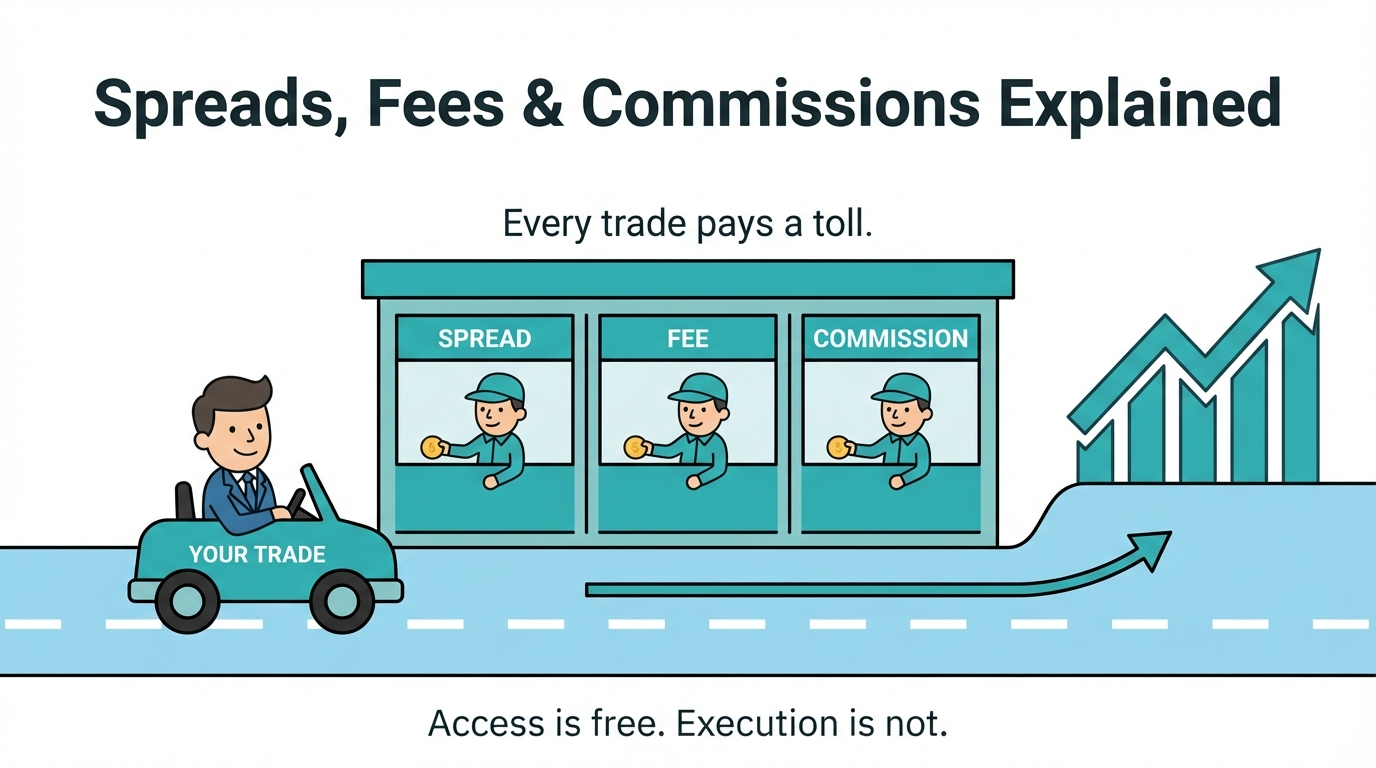
What are spreads, fees, and commissions? These are common trading costs that beginners should understand before entering financial markets.
Every trading transaction may involve expenses, whether through the difference between buying and selling prices, direct commissions, or additional account-related charges.
Understanding how these costs work helps traders evaluate trading conditions, compare pricing models, and make more informed financial decisions.
Why Does Trading Involve Costs
Trading isn't free; you need the right setup, easy access to cash, technology, and systems to make it happen. We must somehow account for these expenses.
Spreads, fees, and commissions are all different ways of arranging operational costs. People's engagement with the financial markets, where prices and trades form part of a well-oiled financial system, closely aligns with this idea. Costs aren't penalties. They're the cost of entering the global market.
What Is a Spread in Trading
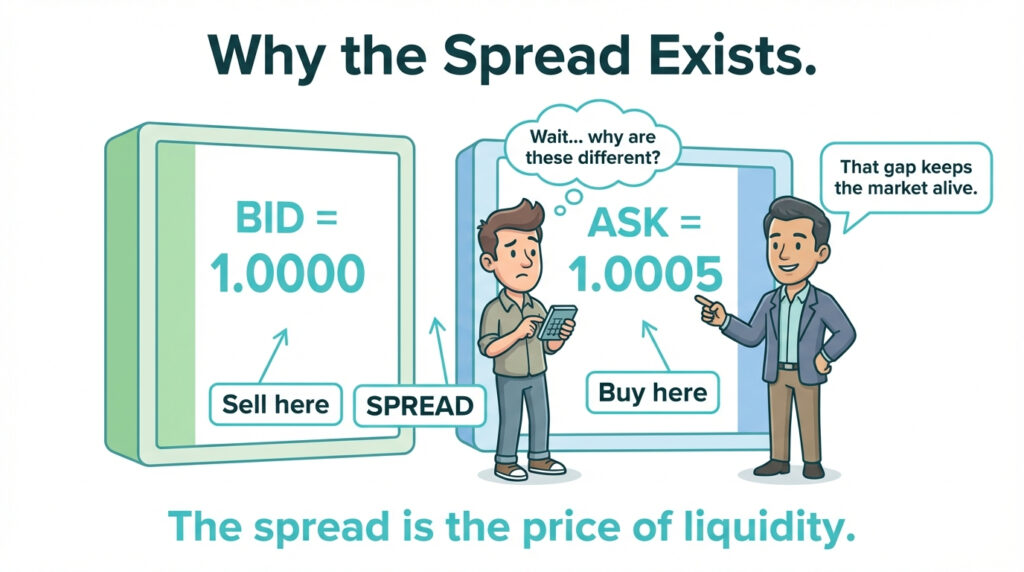
A spread is the difference between the bid price (the price at which you can sell) and the ask price (the price at which you can buy) at a particular moment.
For example, if a currency pair has a bid price of 1.1000 and an ask price of 1.1002, the spread is 0.0002, or 2 pips for a currency pair quoted to four decimal places.
Spreads are an important part of trading costs because traders generally buy at the ask price and sell at the bid price.
Spreads can vary depending on market liquidity, volatility, the financial instrument and the broker's pricing model. They may widen during periods of significant market activity or reduced liquidity.
Grasping how prices move and executing trades is key in Trade Mechanics & Execution Basics, where we see spreads as a feature of market structure, not just a platform feature.
For a broader understanding of how financial markets operate, the Bank for International Settlements (BIS) publishes research on market liquidity, trading activity and financial market structures, which can help explain why bid-ask spreads vary across different market conditions.
What Are Trading Fees
Fixed or variable fees are the charges we pay for certain things we do
They may apply to:
- Account maintenance
- Deposits or withdrawals
- Inactivity
- Currency conversion
Fees don't always match up with each trade. They mirror the behind-the-scenes work that keeps your account running smoothly.
Not all traders pay every fee, but knowing what's out there helps you avoid nasty shocks.
What Are Trading Commissions
A trading commission is a fee charged by a broker for executing or facilitating a transaction.
Commissions may be calculated as a fixed amount per trade, a percentage of the transaction value, or a charge based on trading volume.
Some brokers offer commission-based accounts with relatively tight spreads, while others include more of their trading charges within the spread.
Neither pricing model is automatically cheaper. Traders should compare the total cost of trading, including spreads, commissions and any additional charges.
Spreads vs Fees vs Commissions: What's the Difference
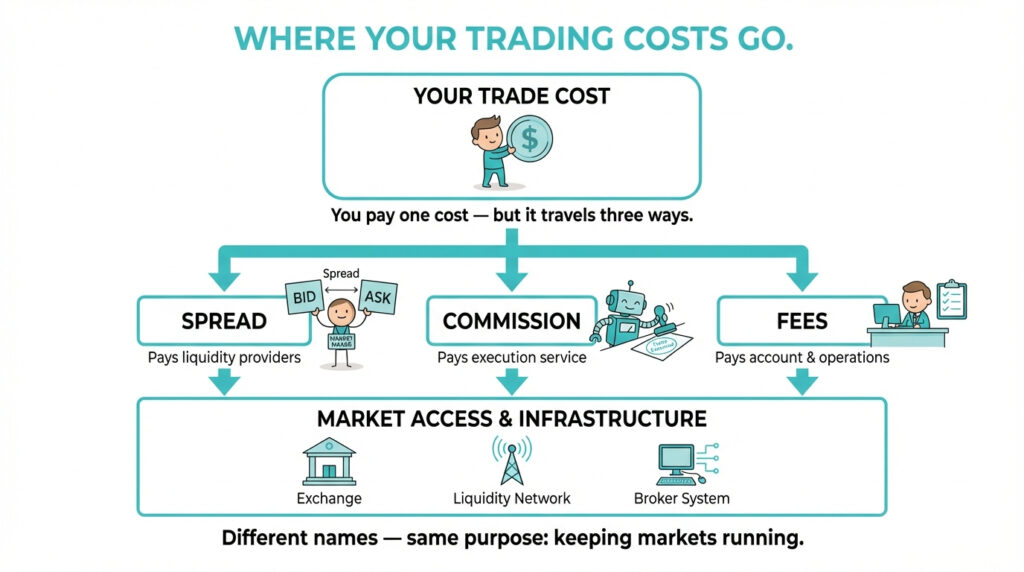
- Spreads: The difference between bid and ask prices, which can contribute to the cost of opening and closing positions.
- Commissions: Direct charges that may apply to trading transactions, depending on the broker and account type.
- Other Fees: Additional charges that may include overnight financing, currency conversion, withdrawals, or account inactivity.
The total cost of trading depends on the financial instrument, pricing model, position size, and trading activity.
These issues aren't standalone problems. These are various levels of trading expenses. Grasping this setup helps traders set realistic goals and avoid confusion when outcomes don't align with their expectations.
Why Do Trading Costs Matter for Beginners
Small costs become large over time. A few small spreads or commissions happening repeatedly across various trades can really add up to big profits over time.
Many traders lose their groove not because their game plan flops, but because they never got the math right.
In the article How People Lose Money in Investing?, it talks about how sneaky little things can quietly eat away at your investment gains.
How Do Trading Costs Affect Risk Management
Risk is not only about price movement. It is also about cost exposure. The link What Does Investment Risk Really Mean? discusses investment risk and covers all types of uncertainty, such as costs, that can impact results.
Lower-cost execution improves efficiency. Higher costs increase the pressure to be accurate. The Financial Conduct Authority (FCA) provides guidance on investment risk and returns, helping beginners understand why trading costs and potential losses should be considered before committing capital.
How Can Beginners Understand Trading Costs
Beginners should not chase the lowest number. They should seek transparency and understanding. The safest approach is:
- Know what you are paying.
- Understand when you are paying it.
- Calculate how it affects results.
Before putting actual money on the line, you can check out how things work in a safe space using the Variance account page for trading. There, you can see how spreads and the nitty-gritty of executing trades play out without losing any cash.
Why Is Understanding Trading Costs Important
Grasping the ins and outs of fees and commissions isn't just helpful; it's essential. It is foundational. This subject seamlessly integrates into the organized learning journey outlined on VARIANSE Academy's website, where cost, risk, and implementation are all part of a unified approach. Without cost awareness, strategies remain incomplete.
How Does Market Liquidity Affect Spreads
Market liquidity influences how easily financial instruments can be bought or sold without significantly affecting their prices.
In general, highly liquid markets tend to have narrower bid-ask spreads because more buyers and sellers are available.
However, spreads can widen during periods of increased volatility, reduced market participation or major economic announcements.
Understanding these conditions helps traders recognize why transaction costs can change throughout the trading day.
Why Are Trading Costs a Normal Part of Trading
Costs are not obstacles. They are structured. They prevent unrealistic expectations and encourage discipline. They remind traders that every choice carries weight and responsibility. Trading turns pro when you actually care about the costs, not just brush 'em off.
Conclusion: What Are Spreads, Fees, and Commissions
Understanding spreads, fees, and commissions is essential for recognizing the true cost of trading.
Spreads represent the difference between bid and ask prices, commissions are direct transaction charges, and other fees may apply to account services or trading activities.
Although these costs may appear small individually, they can accumulate over time and affect overall trading performance.
Before choosing a trading account or placing a trade, beginners should review the broker's pricing structure, compare total trading costs, and understand how charges may affect potential returns.
Trading costs cannot always be avoided, but understanding them is an important part of informed trading and effective financial planning.








