


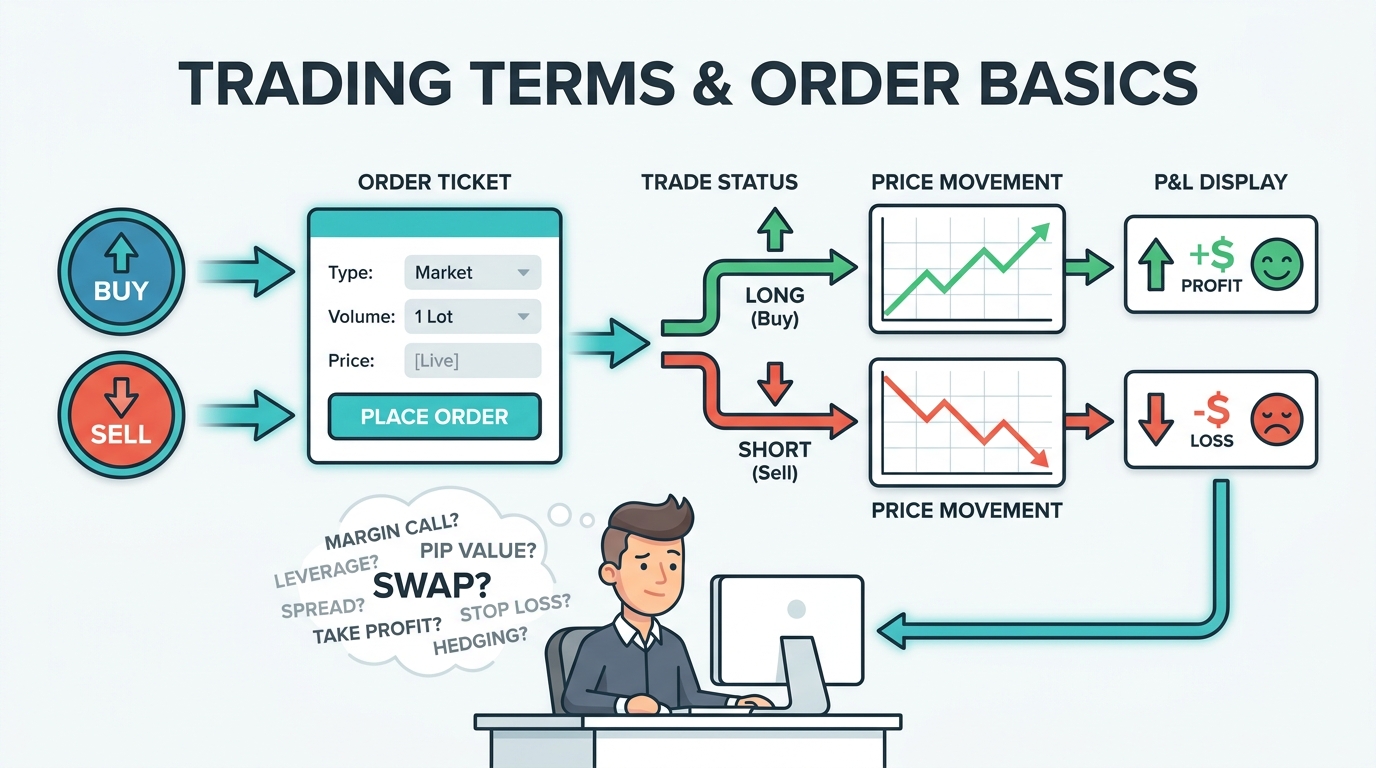
Despite the complexity of trading, its fundamentals are straightforward: you place an order to buy or sell, establish a position as long or short, prices fluctuate, and your account displays your profit or loss.
This parent guide ties together key trading terms and straightforward order basics and points you to more in-depth child articles so newbies can grasp each idea accurately without having to make wild guesses.
How Does the Trading Lifecycle Work
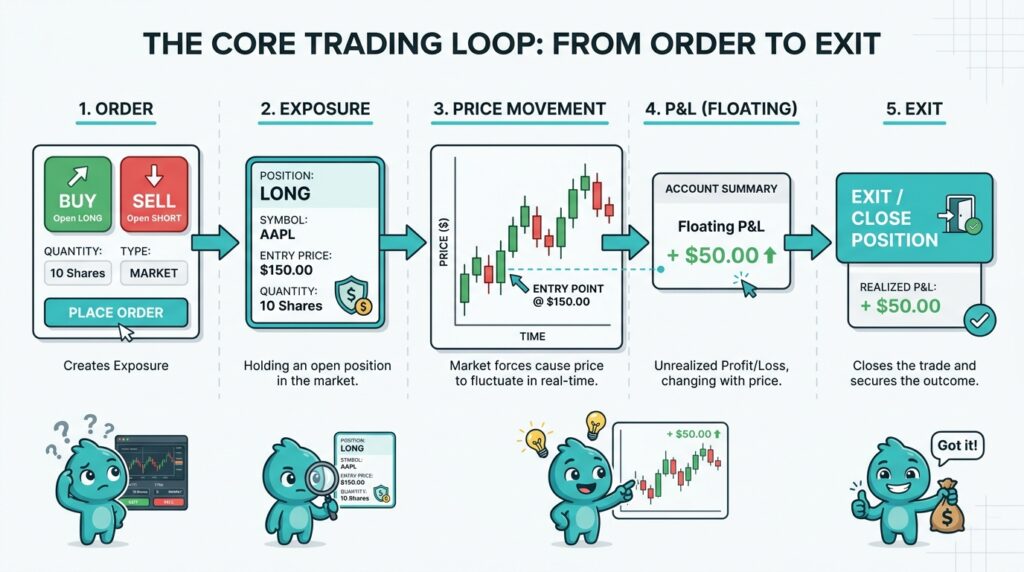
Every trade goes through a similar cycle: an executed order establishes or changes market exposure, price changes result in profit or loss, and closing the position completes the trading cycle.
Once you grasp the concept, terms such as "market order", "long", "spread", and "floating P&L" no longer seem ambiguous and begin to make sense.
What Do Buy and Sell Mean in Trading
Buy and sell orders are instructions used to enter or exit positions. They are instructions that open, adjust, or close exposure to a market price based on real costs, execution rules, and uncertainty. Orders, trades, positions, and profit or loss form the foundation of trading activity.
For a complete rundown on everything from bid/ask prices and "buy to open vs sell to close" to how leverage affects your exposure, check out this resource What Do ‘Buy’ and ‘Sell’ Mean in Investing? Explained Simply.
What Is Profit and Loss (P&L) in Trading
Profit and loss (P&L) is like the scoreboard, but it also gives us feedback. This illustrates how price changes affect your entry and exit points, costs, leverage, and position size.
A common beginner mistake is treating trading results as a measure of personal ability rather than evaluating the underlying decisions (ego) rather than what's happening (process)
To understand how P&L is calculated, including gross vs net profit, floating vs realized P&L, and how accounts display it, read: What Is Profit and Loss? A Starter's Guide to Trading Success
What Is a Trade and How Does It Work
A trade occurs when a buy or sell order is executed. In exchange-traded markets, transactions typically involve matching buying and selling interest. In other markets, including certain over-the-counter products, trades may be executed directly with a broker or another counterparty.
Execution prices depend on the financial instrument, market conditions, available liquidity, and the broker's execution arrangements.
If you're looking to get the fundamentals on what trading is all about, how it actually happens with the help of a broker or platform, and why every single trade comes with its own set of risks and fees, check out this article What Is a Trade?
What Is a Price Chart in Trading
A price chart visually represents historical price movements over a selected period.
Depending on the market and data source, charts may display transaction prices, bid prices, ask prices or other quoted market data. Traders use charts to identify trends, observe volatility, analyse price patterns and support trading decisions. However, charts cannot guarantee future price movements, and historical performance does not reliably predict future results.
Check out this article for insights on chart types like lines and bars, timeframes, and how they tie into risk and psychology What Is a Price Chart? A Starter's Guide to Stock Market Trends
Market Orders vs Pending Orders: What's the Difference
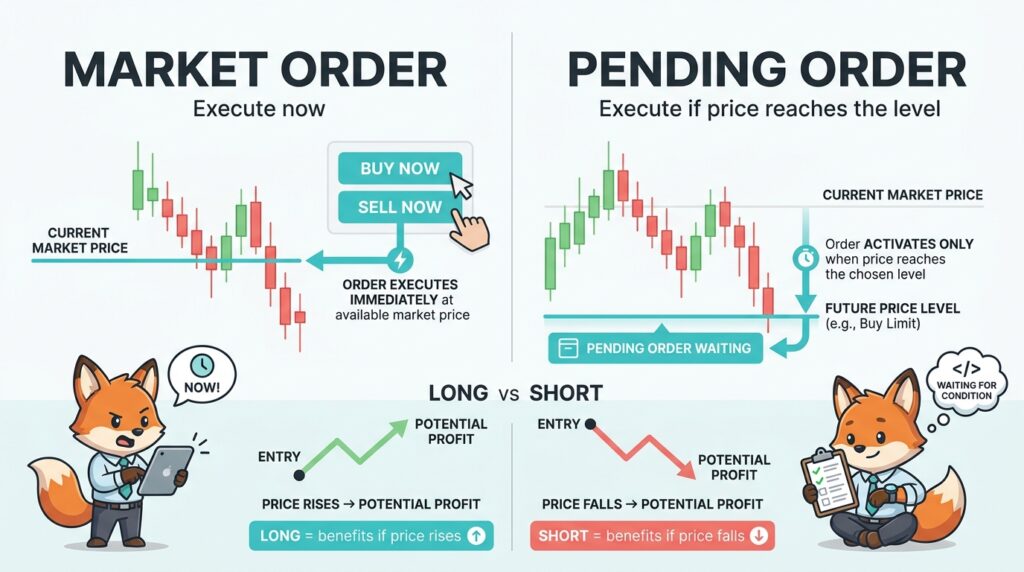
A market order instructs you to buy or sell at the best available price when the order reaches the execution system. It prioritizes execution but does not guarantee a specific price.
A pending order is an instruction that remains inactive or unexecuted until specified price conditions are met.
Common pending order types include:
- Buy Limit: An instruction to buy at a specified price or lower.
- Sell Limit: An instruction to sell at a specified price or higher.
- Buy Stop: An instruction that typically activates when the market reaches a specified higher price.
- Sell Stop: An instruction that typically activates when the market reaches a specified lower price.
Limit orders are not guaranteed to execute, even if the market reaches the specified price. Stop orders may execute at a different price from the trigger level, depending on market conditions and order configuration.
Understanding these differences helps traders choose order types that match their trading objectives and risk management approach.
The U.S. Securities and Exchange Commission (SEC) explains different types of trading orders, including market, limit and stop orders, helping beginners understand how execution conditions can affect their transactions.
Let's break down the difference between a Market Order and a Pending Order in a way that's easy to understand
What Do Long and Short Mean in Trading
A long position generally benefits when an asset's price rises, while a short position generally benefits when its price falls. These terms describe the direction of market exposure, not how long a trade remains open.
For example, a trader may hold a long position for a few minutes or maintain a short position for several weeks.
The financial mechanics of long and short positions depend on the product being traded. Short selling shares differs from opening a short position through a derivative such as a CFD.
To fully understand how you set up long and short positions, how the money moves for each, and how feelings come into play in both, check out What Do Long and Short Mean in Trading?
How Do Trading Terms and Orders Work Together
These aren’t separate lessons; they’re one structure:
Buy/Sell = the instruction
Order type = how the instruction executes (now vs. conditional).
Trade = the event created by execution
Long/Short = the direction of exposure
Chart = the record of behavior.
P&L = the result after expenses and activity
When newbies pick up these skills in this sequence, they develop a clearer understanding of trading mechanics.
How Can Beginners Practise Trading Without Risking Real Money
Terms really click when you see them in action, not under the stress of money. Observing a demo-style setup lets you see how orders are placed, how bids and asks work, how charts shift, and how the P&L responds
Start here: Varianse Academy education page
Conclusion: Understanding Trading Terms and Order Basics
Understanding trading terms and order basics helps beginners recognize how financial market transactions work. The process begins when a trader submits a buy or sell order. If the order is executed, it may open, adjust, or close a trading position.
Long and short positions describe the direction of market exposure, while price charts help traders observe historical price movements. Profit and loss (P&L) reflects how changes in market prices, position size, and trading costs affect financial results.
By understanding how orders, trades, positions and market prices connect, beginners can approach trading with greater clarity and make more informed decisions. However, understanding trading mechanics does not eliminate market risk or guarantee profitable outcomes.








