


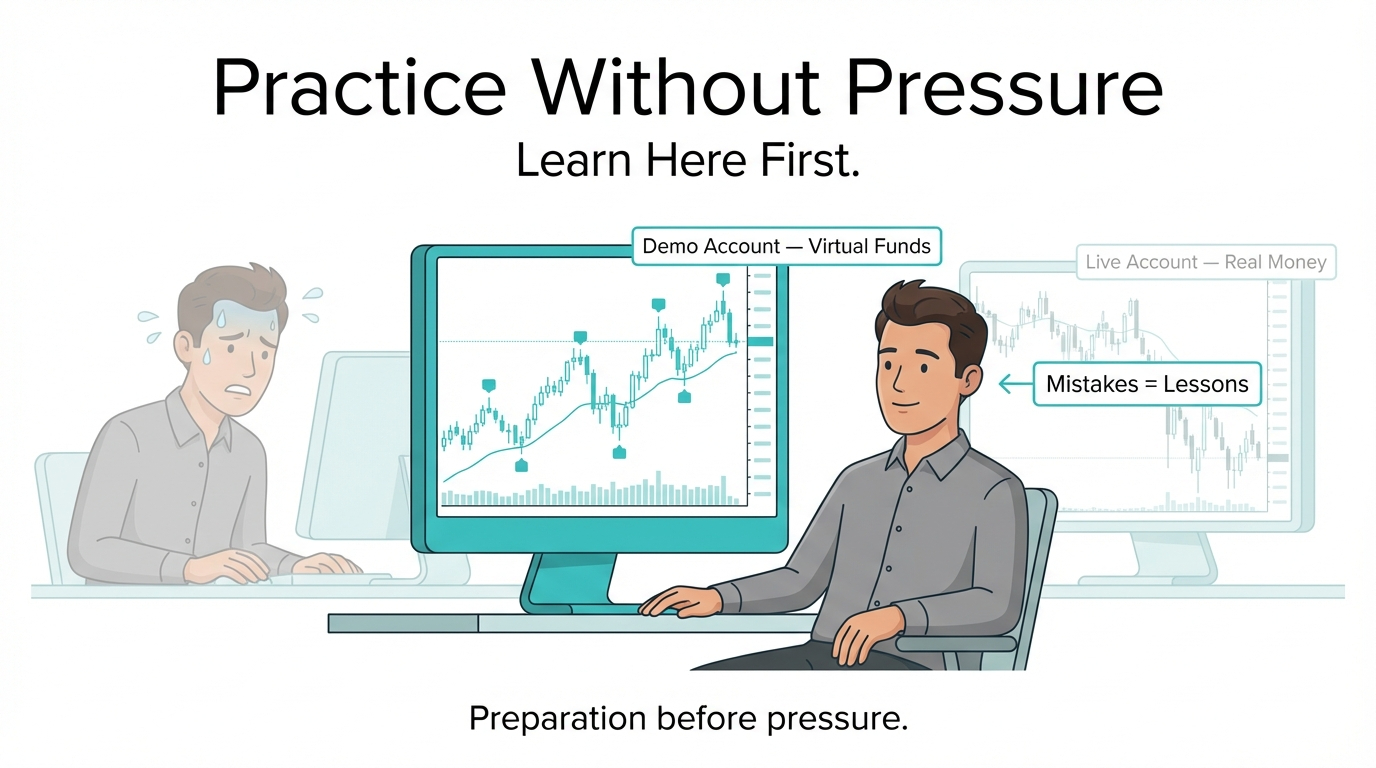
If you've ever wondered what a demo trading account is, you're basically asking how people can practice trading without putting their money on the line.
A demo trading account works similarly to a real trading environment, allowing you to practice with virtual funds. This lets newbies get a feel for the ups and downs of trading, placing orders, and demo profits are simulated, not real earnings on the line.
For most new traders, the fear of losing money stops them from learning. A demo account effectively takes away that fear and replaces it with watching, trying things out, and learning in an organized way. Mistakes turn into lessons rather than just losses.
What a Demo Trading Account Means in Simple Terms
A demo trading account is a trial account. Instead of real cash, you're handed virtual currency. You can start trading, wrap things up, try out strategies, and keep an eye on the market's real-time movements.
The difference is more about feelings than it is about the nitty-gritty details. The platform works the same way, and no real capital is exposed in demo trading, but simulated results do not guarantee future performance. This option lets you get the hang of how markets operate before you dive into the risk pool.
Why Demo Trading Exists in Financial Education
Markets are a bit unpredictable right now. Every trade comes with the chance of losing something. A demo account is set up to let you practice before spending real money.
Investing's all about structure, as detailed in What Is Investing?, where it's said to be about disciplined exposure, not just jumping in on a whim
How a Demo Trading Account Works
A demo account simulates a genuine trading setting. Check out live prices, stick with the same order types, and get a feel for spreads and how things get executed.
Money's got a new look. Your balance is simulated, so you can focus on grasping behaviours rather than safeguarding your money.
The mechanics of how trades are created and executed are explained in Trade Mechanics & Execution Basics, which shows that trading is a system of instructions rather than opinions.
What You Can Learn from a Demo Trading Account
A demo trading account can help beginners develop practical skills in several areas.
Understanding Trading Orders
Practise placing market and pending orders, opening positions and closing trades.
Understanding Trading Costs
Explore how spreads, commissions and other applicable charges may affect simulated trading results.
Monitoring Profit and Loss
Learn how market movements, position sizes and trading costs influence floating and realised profit and loss (P&L).
Practising Risk Management
Experiment with position sizing, leverage and risk management tools while using virtual funds.
Reviewing Trading Decisions
Keep a record of trading decisions, identify mistakes and evaluate whether a predefined trading plan was followed.
Demo Trading vs Real Trading: What's the Difference
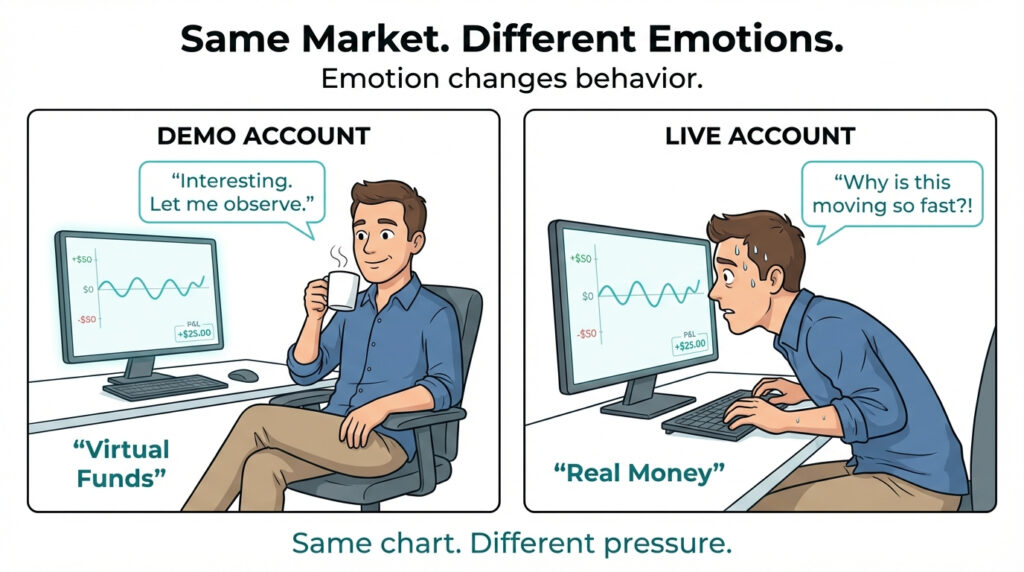
Demo and live trading accounts may offer similar interfaces and trading tools, but important differences remain.
Demo accounts use virtual funds, allowing traders to practise without exposing real capital to trading losses.
Live trading involves actual financial risk, which may create stronger emotional responses such as fear, hesitation or overconfidence.
Execution conditions may also differ. Live orders can be affected by liquidity, slippage, market gaps and trading costs that are not fully reproduced in demo environments.
Therefore, successful demo trading results do not guarantee similar outcomes when trading with real money.
The emotional strain of trading is unpacked in the link Why Emotions Affect Investment Decisions?, where it's clear that uncertainty has a greater impact on our actions than pure reason.
Why Is Demo Trading Useful for Beginners
Demo trading provides beginners with an opportunity to become familiar with financial markets before committing real capital.
It allows users to practise placing orders, observing price movements and understanding basic trading platform features.
Beginners can also explore different approaches to risk management and learn from mistakes without incurring real trading losses.
However, demo trading is only one part of financial education. Understanding market risks, trading costs and the characteristics of different financial instruments remains essential.
A demo account lets traders get a feel for the market, learn when to act, and wait out the ups and downs without spending cash yet. This matches up with the organized learning routes you can find on the VARIANSE academy education page.
What Are the Limitations of Demo Trading Accounts
Although demo accounts are useful educational tools, they cannot fully reproduce every aspect of live trading.
Emotional Pressure: Trading with virtual funds may not create the same fear, stress or hesitation associated with risking real money.
Execution Conditions: Demo accounts may not accurately reproduce slippage, liquidity constraints or order rejections.
Trading Costs: Some simulated environments may not reflect all commissions, financing charges or other live trading costs.
Market Behaviour: Demo pricing and execution may differ from live market conditions.
Performance Expectations: Profitable demo results do not guarantee success in live trading.
Understanding these limitations helps beginners develop realistic expectations about demo trading. Although demo accounts allow beginners to practise without risking real capital, live trading involves genuine financial exposure. The Financial Conduct Authority (FCA) explains the risks associated with leveraged products such as contracts for difference (CFDs), including the possibility of substantial financial losses.
When Should Beginners Consider Moving from Demo to Real Trading
There is no universal timeframe for transitioning from demo trading to real-money trading.
Before considering live trading, beginners should understand:
- How different order types work.
- How position sizing and leverage affect financial exposure.
- The potential for losses and the costs associated with trading.
- The importance of following a structured trading plan.
- The differences between simulated and live execution.
Moving to real-money trading is optional and should depend on personal financial circumstances, risk tolerance and understanding of the products involved.
Even extensive demo practice cannot eliminate the risks of live trading.
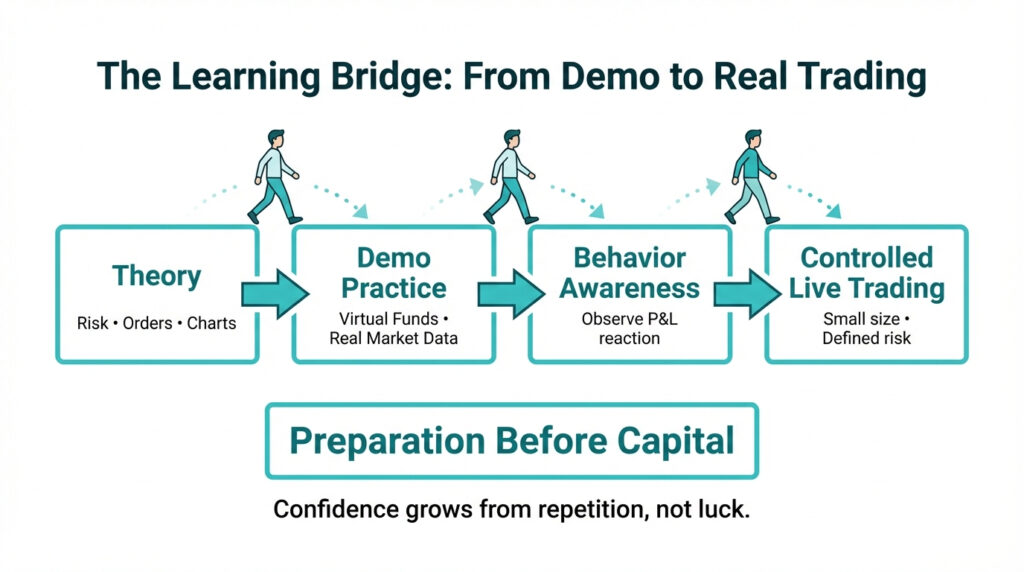
Exploring Trading Education with VARIANSE
Beginners can develop their understanding of financial markets through structured education and practical learning.
You can check out the VARIANSE trading account page for a safe space to watch how prices move, how orders are filled, and the different types of orders, all without the worry of losing money
This approach ties right into the organized learning paths on the Variance Academy website, allowing education and action to develop hand in hand.
Conclusion: What Is a Demo Trading Account?
A demo trading account allows beginners to practise trading using virtual funds without exposing real capital to trading losses.
It provides an opportunity to understand order placement, market movements, trading costs and simulated profits and losses.
However, demo trading cannot fully reproduce the execution conditions or emotional pressures associated with real-money trading.
By combining practical experience with structured financial education, beginners can develop stronger trading knowledge and more realistic expectations.








