


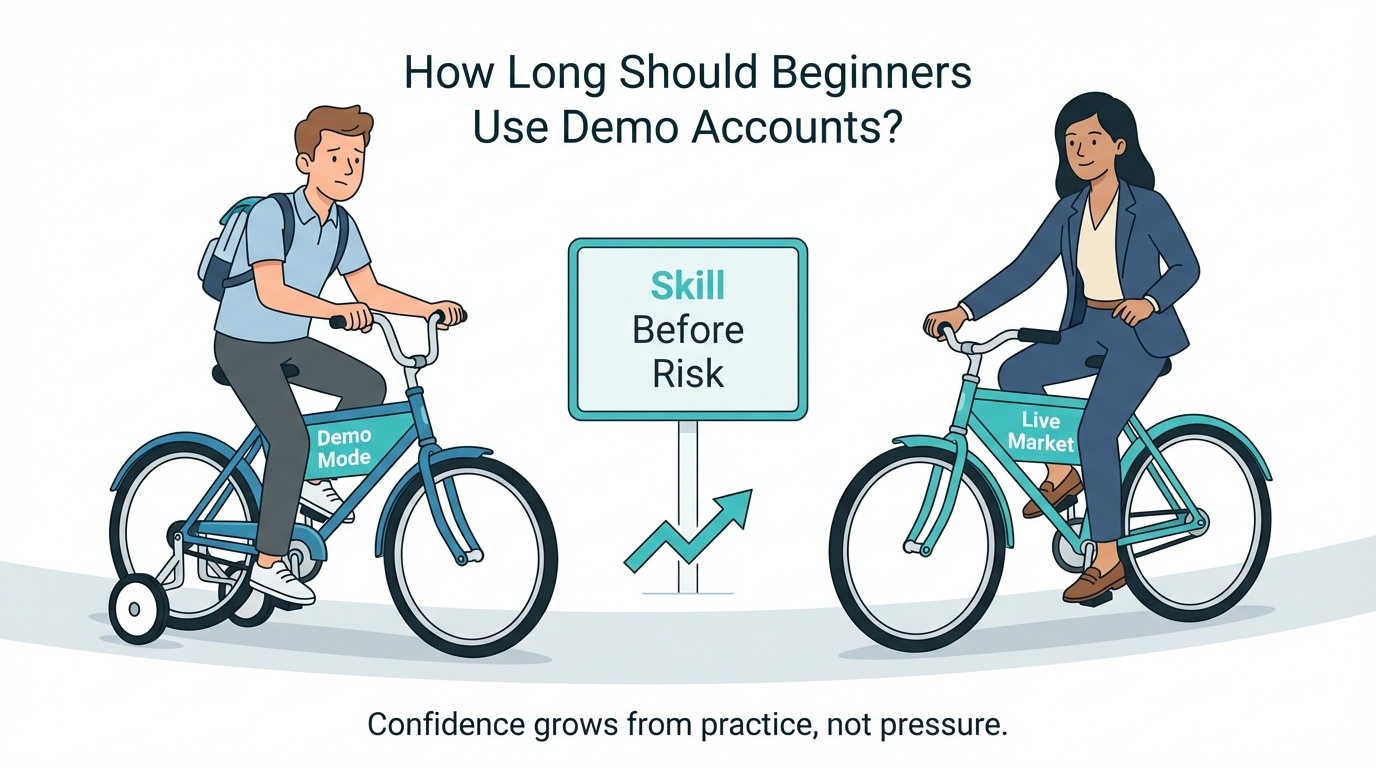
How long should beginners use demo trading accounts? There is no fixed timeframe. Some beginners may practice for several weeks, while others may need months to become familiar with trading platforms, order execution, and risk management.
If you're wondering how long beginners should stick with demo accounts, you're being smart about your learning journey.
A demo account helps you refine your skills before investing real money. Time matters less than competence.
Most newbies jump into live trading thinking they're emotionally prepared. In real life, being ready means sticking to your plan, staying disciplined, and getting the hang of how the market works. A demo account helps you build those skills without risking real trading capital.
How Long Should Beginners Use Demo Trading Accounts Before Live Trading
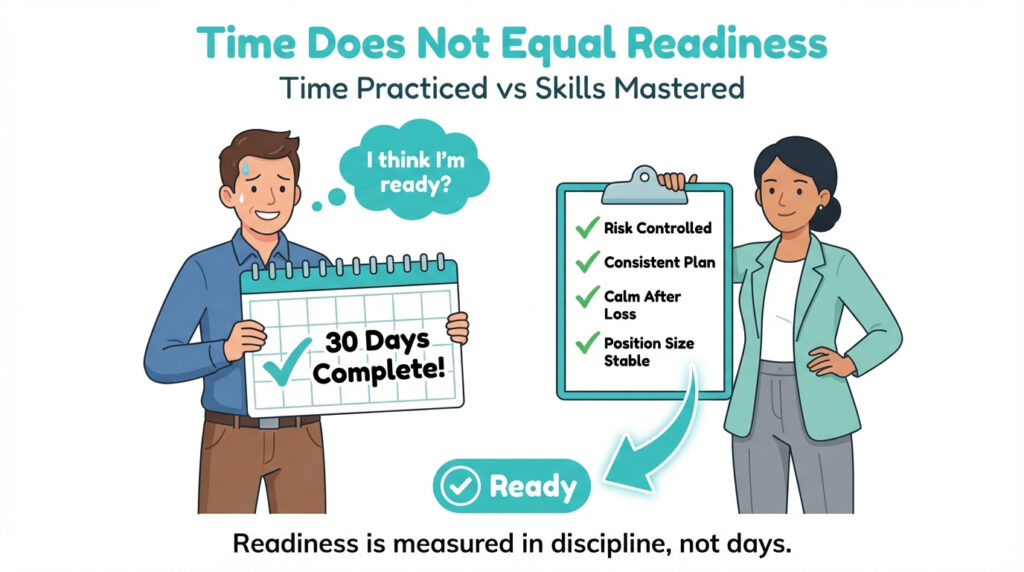
The amount of time beginners spend using demo accounts depends on their learning objectives, existing knowledge and familiarity with trading platforms.
Some traders need weeks; others, months. The gap varies based on how quickly you grasp execution, risk, and emotional control.
A demo account isn't a countdown. It's a place for learning and practice. You should consider stepping back when things start to settle down, not just because the calendar rolls over. You can try out real market simulations using the VARIANSE trading account page.
The Goal of a Demo Trading Account Is Skill, Not Profit
Generating simulated profits should not be the only measure of progress when using a demo trading account.
Many beginners think demo success means high profits. That is not the goal. Beginners should focus on developing practical skills, including:
The real purpose is to show that you can:
- Understanding how market and pending orders work.
- Following a predefined trading plan.
- Managing position sizes and potential exposure.
- Monitoring simulated profits and losses.
- Reviewing trading decisions and identifying mistakes.
- Understanding how spreads, commissions and other costs affect results.
These skills can support financial education, but successful demo trading does not guarantee profitable live trading.
How Can Beginners Evaluate Their Demo Trading Progress
Rather than measuring progress only through simulated profits, beginners can review whether they consistently follow a structured trading process.
Useful questions include:
- Do I understand the trading instruments and order types I use?
- Can I calculate position sizes and potential losses?
- Do I follow a predefined trading plan?
- Can I explain how leverage and trading costs affect my exposure?
- Do I review mistakes and adjust my approach when necessary?
These questions can help beginners assess their learning progress.
However, demonstrating discipline in a simulated environment does not guarantee the same behaviour or results when real money is involved.
This execution discipline is a key component of the operational system detailed in Trade Mechanics & Execution Basics.
Can Demo Trading Help Develop Emotional Discipline
Demo trading can help beginners practise following a trading plan, reviewing decisions and avoiding impulsive behaviour.
However, trading with virtual funds does not fully reproduce the emotional pressure associated with risking real money.
Fear, frustration, overconfidence and hesitation may become more pronounced when actual financial losses are possible.
For this reason, demo trading should be viewed as an opportunity to develop disciplined habits rather than proof of emotional readiness for live trading.
The emotional factors influencing these decisions are detailed in Why Emotions Affect Investment Decisions?
Demo Trading Practice Helps Beginners Understand Trading Costs
Trading costs can influence the overall outcome of a trade. These may include spreads, commissions, overnight financing charges and other applicable fees.
Demo accounts can help beginners observe how certain costs affect simulated profit and loss.
However, demo trading may not accurately reproduce every cost, spread variation or execution condition experienced in live markets.
That's why trading costs are laid out in What Are Spreads, Fees, and Commissions?, where they're presented as necessary parts of the market setup.
Demo Trading Time Depends on How Well You Understand Risk
Understanding financial risk is an important part of trading education. Trading risk involves uncertainty and the possibility of financial loss.
A demo account allows beginners to explore how market movements, position sizes and leverage can influence potential trading outcomes. Beginners can also practise using risk management tools and evaluating simulated losses.
However, understanding risk in a demo environment does not eliminate the possibility of losing money in live trading.
The meaning of this uncertainty is laid out in the link What Does Investment Risk Really Mean? where we swap certainty for probability.
How Can Structured Education Support Demo Trading
Combining practical experience with structured education can help beginners develop a clearer understanding of financial markets.
Rather than experimenting without a plan, learners can focus on specific topics such as order execution, trading costs, leverage and risk management.
Random practice takes longer. Structured learning accelerates growth. That's why at VARIANSE Academy, educational resources are available that beginners can explore alongside their demo trading practice.
This approach encourages learning through both theoretical knowledge and practical observation.
Why Do Experienced Traders Use Demo Accounts
Demo trading is not limited to beginners. Experienced traders may use demo accounts, simulations, and backtesting to explore new strategies, become familiar with different platforms, or evaluate trading approaches.
These methods can help identify potential weaknesses before committing real capital.
However, simulated results and historical performance cannot reliably predict future trading outcomes.
This aligns with how the Bank for International Settlements describes maintaining market stability and testing risks, where careful exposure helps keep the financial system safe.
Conclusion: How Long Should Beginners Use Demo Accounts?
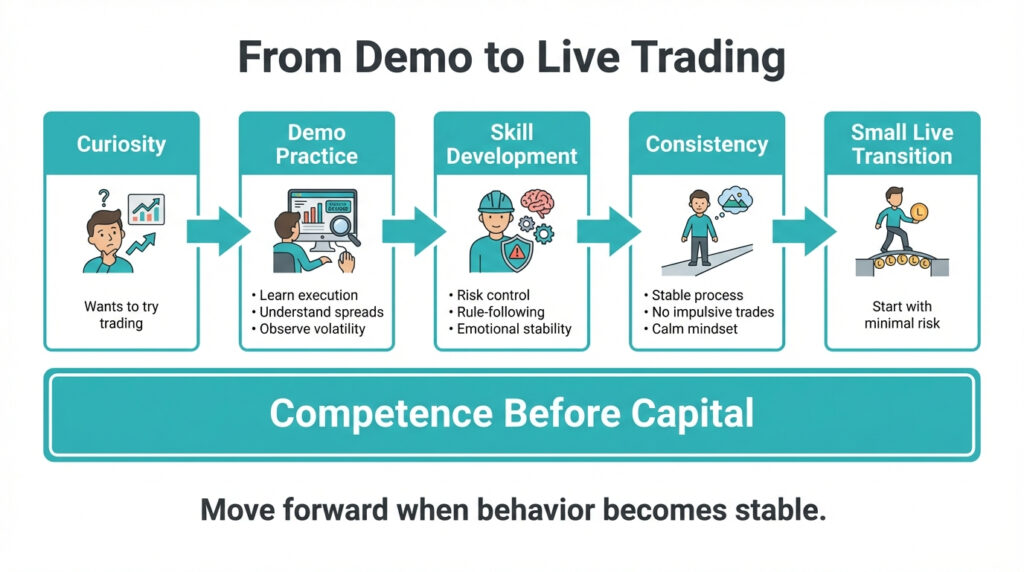
There is no universal time limit. Newbies should keep using trial accounts until they are ready to fully commit. Beginners should focus on building practical trading skills, understanding financial risks, and learning to follow a structured trading plan rather than reaching a specific number of practice days.
Demo trading allows users to explore financial markets and learn from simulated mistakes without risking real trading capital.
However, even extensive practice cannot fully reproduce live execution conditions or the psychological pressure of real-money trading.
Ultimately, the decision to move from demo to live trading is optional and should depend on individual financial circumstances, risk tolerance and understanding of the risks involved.








