


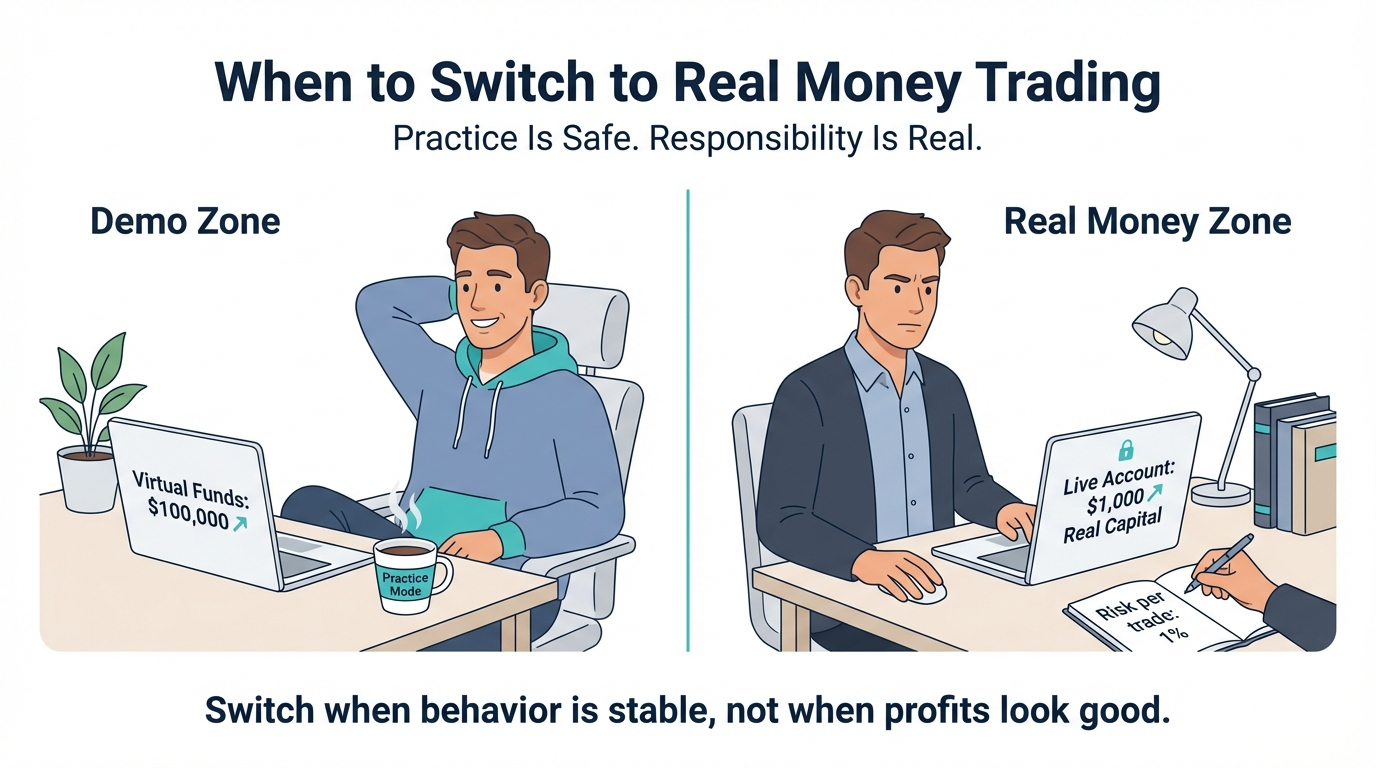
If you're asking when to switch to real money trading, it probably means you're not feeling totally lost in the markets anymore, right? You kind of get how orders work, how prices move, and how your demo account behaves. Now, the challenge lies in deciding when to shift from practice trading to real-money trading.
The switch is kind of a big moment. Jumping in too early is going to hurt you emotionally and financially, obviously. But Implies beginners should eventually trade with real money from becoming more confident and growing as a trader. The right time? It's about your behaviour, discipline, and emotional control, not profit.
Instead, beginners should consider their understanding of trading mechanics, risk management, financial circumstances and ability to follow a structured trading plan.
Importantly, moving from demo to live trading is optional, and successful demo performance does not guarantee future trading results.
When to Switch to Real-Money Trading: What Beginners Should Know
Should you transition to real money trading? It's not really a technical thing. Live trading also involves actual financial risk, costs and different execution conditions. If you make a mistake in a demo account, it won't have a significant impact. In a real account, mistakes cause stress, fear, and hesitation.
This phase is where you find out if your trading skills are solid or kind of shaky. This is why structured stuff in markets is talked about a lot, like in What Is Investing?, where planning and being disciplined matter way more than getting all hyped up.
Why Demo Profits Do Not Guarantee Trading Readiness
Profitable demo trading results do not necessarily indicate that a beginner is prepared for live trading. Simulated profits may result from favourable market movements, excessive leverage or unusually large position sizes.
Beginners should also evaluate whether they understand trading costs, follow a predefined plan and manage simulated risk consistently. However, even disciplined demo trading cannot guarantee similar results or behaviour when real money is involved.
How to Evaluate Your Trading Process Before Going Live
Before considering real-money trading, beginners should understand the reasoning behind their trading decisions.
Useful questions include:
- Why am I entering this trade?
- What conditions would lead me to close the position?
- How much capital could I potentially lose?
- How do position size and leverage affect my exposure?
- When should I avoid placing a trade?
A structured trading process can help beginners evaluate decisions more consistently.
However, following a plan in a simulated environment does not eliminate the risks associated with live trading.
This whole process thing is broken down in Trade Mechanics & Execution Basics, where they present trading as a more machine-like approach rather than just a reactive response to your feelings.
Why Emotional Control Matters Before Live Trading
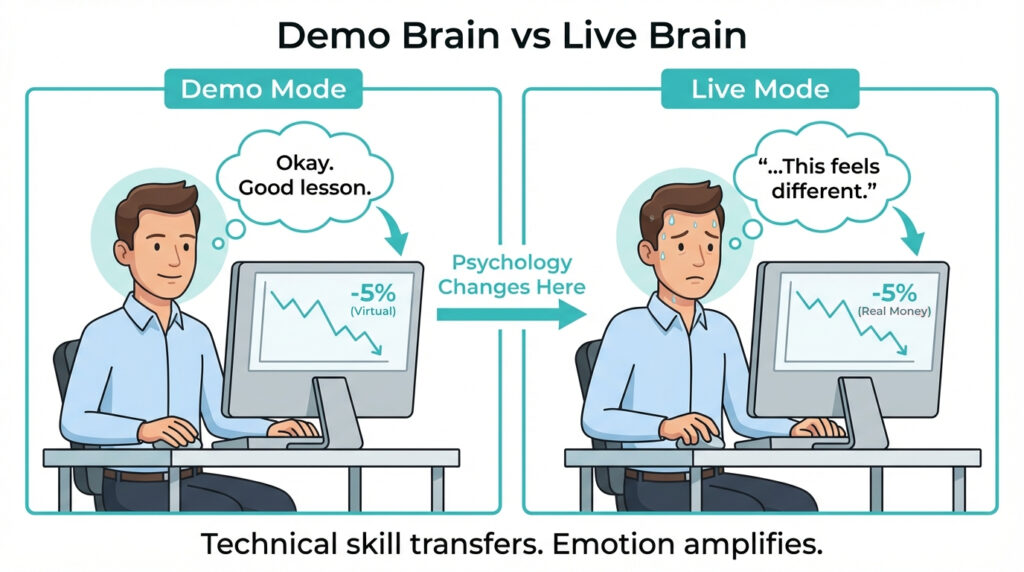
Trading decisions can be influenced by fear, frustration, excitement and overconfidence. Demo trading provides an opportunity to practise following rules, reviewing decisions and avoiding impulsive actions.
However, the psychological pressure of losing real money may be significantly different from experiencing simulated losses.
Beginners should recognise that emotional responses may change when actual capital is at risk. The feelings behind all this are explained in Why Emotions Affect Investment Decisions?
Understanding Trading Risk Before Seeking Returns
Trading involves uncertainty and the possibility of financial loss.
Before considering live trading, beginners should understand how market volatility, leverage, position sizing and trading costs affect potential outcomes.
Risk management tools may help control exposure, but they cannot eliminate financial risk.Risk is like the foundation of every trade. It's all in What Does Investment Risk Really Mean? where they say uncertainty is always there, but you can deal with it.
Before considering live trading, beginners should understand the financial risks involved. The Financial Conduct Authority (FCA) explains the risks associated with contracts for difference (CFDs), including leverage and potential financial losses.
Using Realistic Position Sizes
Beginners sometimes use larger positions in demo accounts than they could reasonably afford when trading with real money.
This can create unrealistic expectations about potential profits and losses.
Practising with position sizes that reflect personal financial circumstances can help users develop a clearer understanding of market exposure.
However, even small positions can result in financial losses, particularly when leverage is involved.
Check out Understanding Leverage in Simple Terms, which tells you that leverage is about amping up the risk, not giving you some crazy advantage.
Following Trading Rules After Losses
Losses are a possible outcome of trading, even when decisions are carefully planned. A simulated trading environment allows beginners to practise reviewing losing trades without immediately changing their strategy or taking unnecessary risks.
However, emotional reactions to real financial losses may differ from those experienced in demo trading.
Do you exhibit this type of behaviour pattern? Yes, it is discussed in How People Lose Money in Investing?, and essentially, emotions can significantly disrupt decision-making.
Avoiding Overtrading and Impulsive Decisions
Overtrading occurs when traders place unnecessary or excessive trades, often without following a predefined strategy.
Beginners can use demo accounts to practise identifying trading opportunities and recognising when market conditions do not meet their criteria.
Developing patience and following a structured plan may help reduce impulsive decision-making.
However, avoiding overtrading does not guarantee profitable results or establish readiness for live trading.
Why Emotional Control Matters Before Live Trading
Some beginners consider using smaller amounts of capital when transitioning from demo to live trading.
Although a smaller position may reduce the amount of money exposed to a particular trade, it does not eliminate financial risk.
Leverage, market volatility, trading costs and execution conditions can still affect outcomes. Before opening a live account, individuals should consider their financial circumstances, risk tolerance and understanding of the trading products involved.
Moving to live trading is optional, and beginners can continue learning through demo accounts and educational resources.
Why Trading With Small Capital Still Involves Risk
Some beginners consider using smaller amounts of capital when transitioning from demo to live trading.
Although a smaller position may reduce the amount of money exposed to a particular trade, it does not eliminate financial risk. Leverage, market volatility, trading costs and execution conditions can still affect outcomes.
Before opening a live account, individuals should consider their financial circumstances, risk tolerance and understanding of the trading products involved.
A safe start is at the VARIANSE trading account page, where you can see how you trade but without losing, like, too much.
How Structured Education Supports Trading Decisions
Understanding financial markets involves more than learning how to place trades.
Beginners should also develop knowledge of trading costs, leverage, risk management, market behaviour and the psychological factors that influence financial decisions.
This thing includes things like feelings, risks, how you trade, and discipline. It's all in VARIANSE Academy.
Conclusion: When Should You Move From Demo to Live Trading?
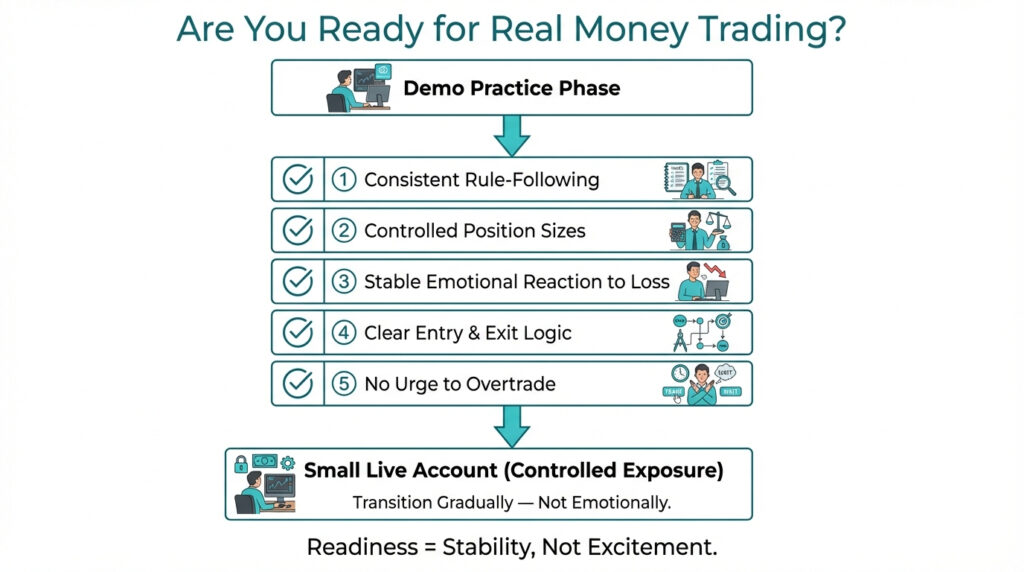
There is no universal point at which beginners must move from demo trading to live trading.
The decision should not be based solely on simulated profits, the number of trades completed or the amount of time spent practising.
Instead, beginners should evaluate their understanding of trading mechanics, financial risks, position sizing, leverage and trading costs.
Demo trading can help develop practical skills and disciplined habits, but it cannot fully reproduce the emotional pressure or execution conditions of real-money trading.
Ultimately, transitioning to live trading is a personal and optional decision that should reflect individual financial circumstances, risk tolerance and understanding of the risks involved.








