


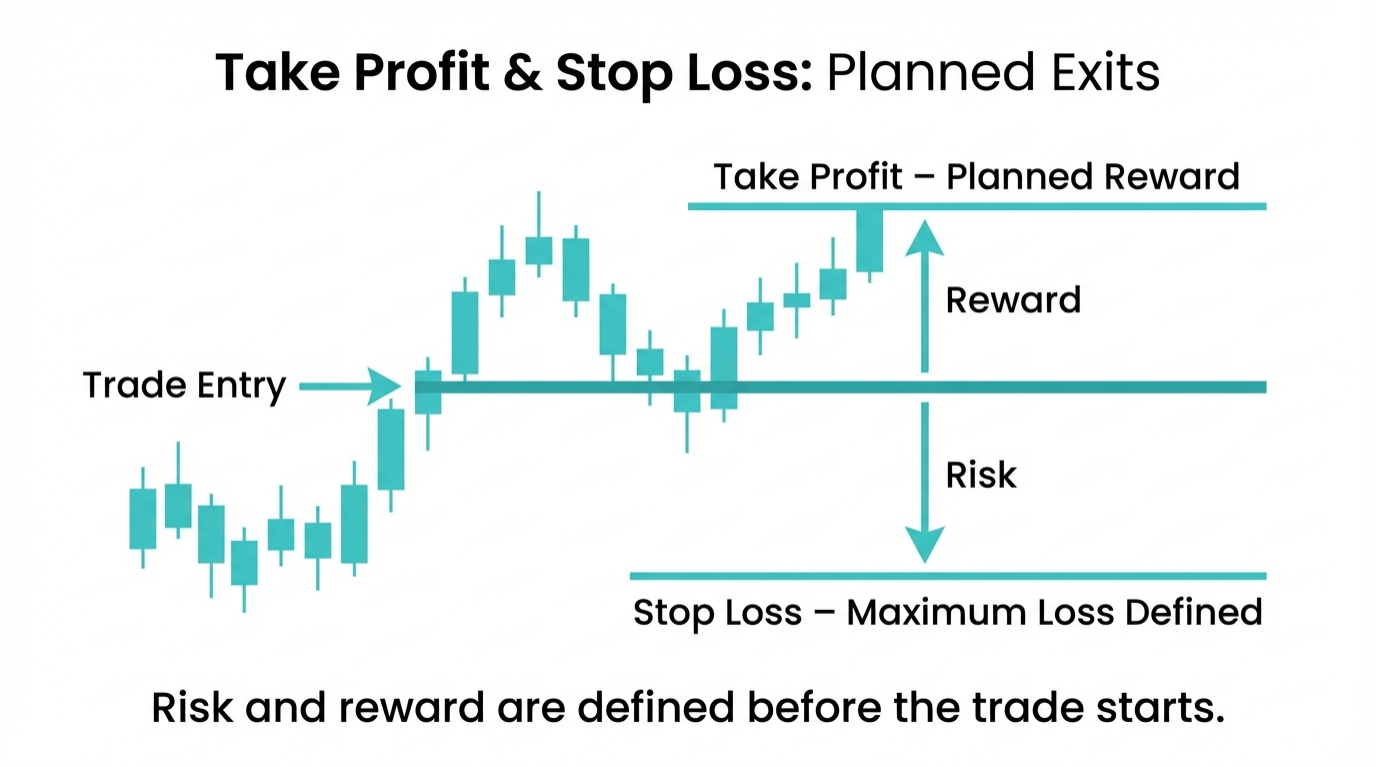
Take Profit & Stop Loss orders are important tools for planning how and when to exit a trading position.
Apart from looking for possible entry points for trade, knowing how to execute an exit strategy should be equally considered. Market prices tend to fluctuate frequently, and thus there could be a difference between the expected exit price and actual price obtained.
A stop-loss order assists in outlining a possible exit point in case the market goes against the desired direction of trade, while the take-profit order indicates the point at which a trader wants to make some profit.
The two can assist in making an organized approach to risk management in trading activities, though not ensuring that prices will be executed as per their specification.
These tools turn trading from mere guessing into a more organized way to manage risk. They're key elements in Trade Mechanics & Execution Basics, where proper execution, risk planning, and sticking to your exit strategy are the bedrock of serious trading.
To trade safely and consistently, getting the hang of take profit and stop loss is a must, not just a nice-to-have
What Are Take Profit and Stop Loss Orders?
Take-profit and stop-loss orders are instructions used to manage the exit of an open trading position.
A stop-loss order is intended to close a position when the market reaches a specified adverse price level.
A take-profit order is intended to close a position when the market reaches a specified favourable price level.
Both can help traders establish exit conditions in advance rather than relying entirely on decisions made during market movements.
However, their execution depends on the order type, market conditions and trading platform. A specified price does not always guarantee that a position will close at that exact level.
What Is a Stop Loss?
A stop-loss order is designed to close an open trading position when the market reaches a predefined adverse price level.
For example, a trader who buys an instrument at £100 might place a stop-loss at £95 to plan an exit if the price falls.
However, a standard stop-loss order does not guarantee execution at £95. During rapid market movements or price gaps, the position may close at a less favourable price.
Stop-loss orders can help traders define risk parameters and reduce reliance on emotional decision-making, but they cannot eliminate trading risk or guarantee that losses will remain within a specified amount.
What Is a Take Profit?
A take-profit order is an instruction intended to close a trading position when a predefined favourable price level becomes available.
For example, a trader who buys an instrument at £100 might set a take-profit level at £110.
If the relevant execution conditions are met, the position may close and realise a gain.
However, reaching the displayed target price does not guarantee that the order will execute in every circumstance. Execution depends on the instrument, platform and applicable order rules.
Take-profit orders help traders plan potential exits, but they do not guarantee profitable trading outcomes.
Why Are Take-Profit and Stop-Loss Orders Used?
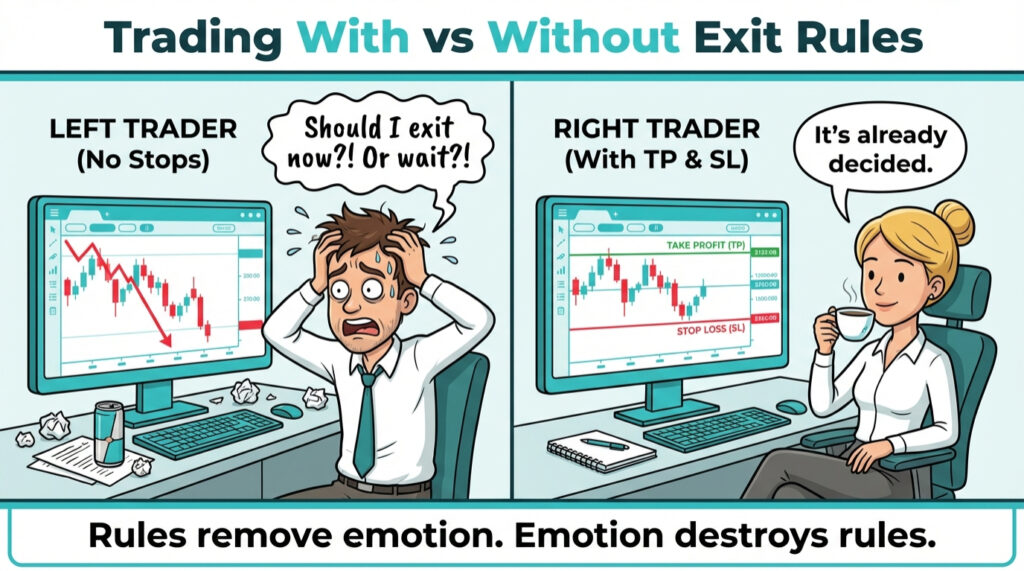
Markets are extremely volatile and subject to rapid fluctuations. Without predefined exits, traders often react emotionally instead of following a structured plan.
Set profit-and-loss orders to ensure each trade has a clear risk and reward. This structured approach is part of professional trading discipline and connects directly to Risk Management Fundamentals, where protecting capital is always the first priority.
Professional traders don't simply rely on luck when making trades. They enter the market with a clear idea of their maximum potential loss and the reward they're aiming for before they make the trade.
How Take Profit and Stop Loss Work Together
Profit-taking and stop-loss orders complement each other well by clearly defining the boundaries of risk and reward.
What Is the Risk-Reward Ratio in Trading?
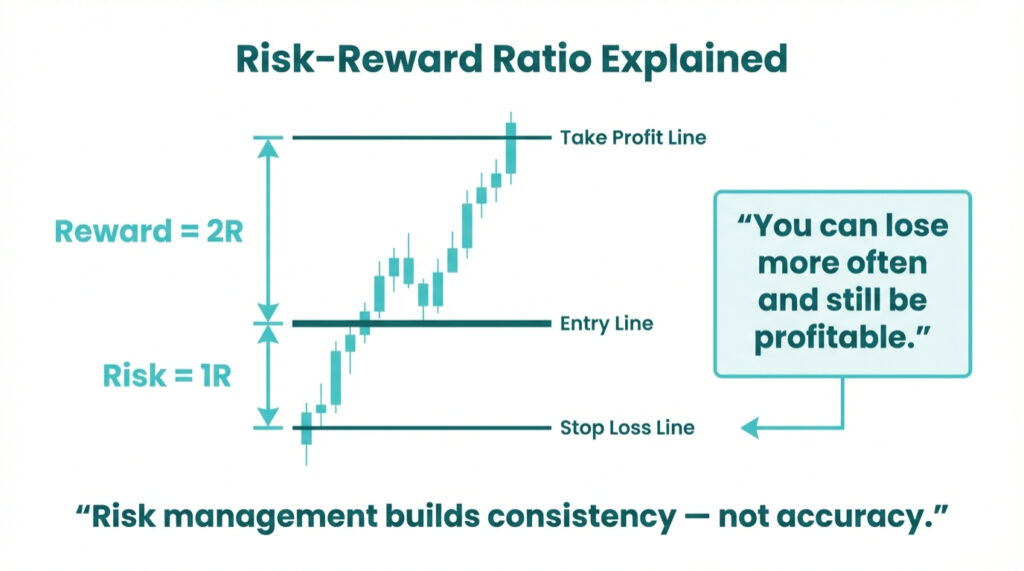
The risk-reward ratio compares the potential loss on a trade with its potential gain.
For example, suppose a trader enters a position at £100, places a stop-loss at £95 and sets a take-profit at £110.
The planned risk is £5 per unit, while the planned reward is £10 per unit.
This produces a risk-reward ratio of 1:2.
However, the ratio describes planned price distances rather than guaranteed financial outcomes.
Actual results may differ because of slippage, spreads, commissions, financing charges and other execution factors.
A favourable risk-reward ratio does not automatically make a trading strategy profitable. Trading outcomes also depend on how frequently trades succeed, the size of actual gains and losses, and transaction costs.
This idea gets a thorough breakdown in Reward-to-Risk Ratio & Trade Expectancy Explained Simply, where traders figure out that making money isn't about guessing right every time but about setting up the risk just right.
A positive risk-to-reward ratio helps traders stay in the black even when they're losing more trades than they're winning.
How to Calculate and Set Take-Profit and Stop-Loss Orders
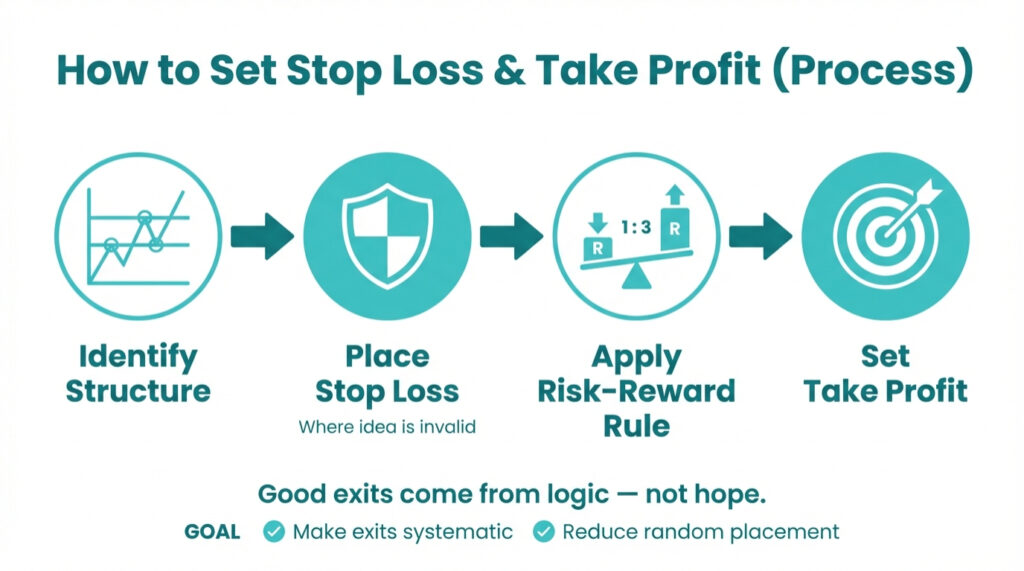
Take-profit and stop-loss placement ought to be based on reason, not just a hunch. Every floor should link up with the market structure and risk tolerance.
How to Set a Stop Loss
Stop loss determination needs to take into account the approach of the trader, size of position and the level of risk.
Some traders rely on technical indicators such as support and resistance, highs and lows of price in order to determine the likely exit points.
For instance, a long trader could choose to set his stop loss below support, while a short trader could set a stop above resistance.
Nevertheless, the above mentioned levels do not guarantee that the price would reverse or the orders will be executed at a certain price.
Traders should also take into account the effect of the intended distance between stops in terms of finances and suitability of position size relative to risks.
Grasping the market structure aids traders in setting stops more realistically, as detailed in Support & Resistance Explained
How to Set a Take Profit
The take-profit level is essentially the target price where a trader plans to book a profit from the trade.
It can involve some technical references like prior highs and lows, support and resistance levels, and the gap between the entry point and the stop-loss level.
For instance, a trader may determine the level based on the 1:2 risk reward ratio.
Nonetheless, the prevailing market situation may inhibit the achievement of the level or even the execution of the trade.
In any case, the setting of the take-profit level needs to be viewed in the light of position sizing and other factors.
Example Calculation
Suppose a trader opens a long EUR/USD position at 1.2000.
The trader sets a stop-loss at 1.1950 and a take-profit at 1.2100.
- Entry price: 1.2000
- Stop-loss price: 1.1950
- Take-profit price: 1.2100
- Planned risk: 50 pips
- Planned reward: 100 pips
The planned risk-reward ratio is:
50 ÷ 100 = 1:2
This means the potential price gain is twice the planned adverse price movement. However, actual financial results depend on position size, execution prices and trading costs. A standard stop-loss does not guarantee that the maximum loss will be limited to 50 pips.
Traders should calculate position size and understand their financial exposure before placing orders.
Why Stop Loss Is Critical for Survival
The use of stop-loss orders is typical to set up the pre-defined exit level in case the market price works in an opposite direction to the trading position.
In absence of the exit strategy, traders can stay longer in unfavorable price moves than needed.
With the products which are traded on leverage like forex contracts for difference, unfavorable market movements might lead to the reduction of equity and margin calls or even position closure.
However, a stop-loss order cannot guarantee safety in case of extreme losses, especially during market gaps and illiquid periods.
The practice of placing orders on a demo account will be useful for newbies to get familiar with the way stop-loss orders work.
Traders might keep on holding losing trades forever, hoping they'll bounce back. This kind of action usually results in margin calls, as detailed in Margin Calls Explained
Stop losses stop small losses from turning into big ones that could wreck your account. Trying out stop placements in a demo mode on the VARIANSE trading platform lets traders get a feel for how trades might play out without risking real money.
Common Beginner Mistakes With Take Profit and Stop Loss
Many newbies don't use these gadgets correctly, which makes them less helpful.
Moving stop losses further out after you've entered can actually hike up your risk more than you initially thought. Ditching stop losses could leave traders with unchecked losses. Snatching profits too soon can mess up your long-term gains, and just picking random price levels doesn't really respect how the market's built.
These slip-ups usually come from trading on emotion, which is covered in Trading Psychology Explained: Why Emotions Control Most Traders
Consistency is all about sticking to set guidelines, not just changing your mind on the fly.
How Take Profit and Stop Loss Support Trading Discipline
Pre-set exit levels can assist traders in following a structured decision-making process.
Through defining exit criteria prior to entering into the market, traders will be able to avoid making decisions on the run.
Nevertheless, pre-set take-profit and stop-loss levels do not relieve traders from the pressure of emotions and do not ensure disciplined behavior.
Traders will still need to re-examine their decisions and evaluate their appropriateness in current market conditions.
This process in Process-Focused Thinking for Consistent Trading, traders get the lowdown on how to assess their trading methods instead of just looking at each trade's results. Defined exits support rational decision-making.
How Exit Orders Fit Into the Full Trade Lifecycle
Profit-taking and setting stop-losses are key steps in a bigger plan that covers planning, doing, keeping an eye on things, and checking how it all went.
In Trade Lifecycle Explained: From Idea to Exit, traders learn that every trade begins with risk planning and ends with a clear-headed assessment.
Exits aren't just an afterthought; they're thought out before we even think about entry.
Conclusion: Take Profit and Stop Loss in Trading
Stop-loss and take-profit orders are effective techniques to help with the development of an exiting strategy from trades and managing both risk and profits.
The use of stop-loss allows traders to plan their exits when prices are against their interests, whereas take-profit allows them to define the prices at which they will make profits.
While both can contribute towards a structured trading approach, there is no guarantee that they will get executed at a particular price point, nor do they protect them from financial loss.
Market fluctuations, liquidity, slippage, and transaction costs can all impact trading results.
It is as essential for newbies to understand this as it is to learn how to place these orders.
Risk management includes using proper orders and position size along with leveraging knowledge.








