
If you’ve ever been blindsided by a sudden trend flip or found yourself going against the market flow, it’s usually because the market structure broke down, not because your game plan failed.
A Break of Structure (BOS) is one of the earliest objective signals that price behavior has changed and that the market regime may be shifting. For Forex and CFD traders, Break of Structure provides a more reliable picture than lagging indicators, because it comes directly from price movements.
Grasping Break of Structure is a natural next step after understanding the Market Structure concepts in the link, where trends are first defined.
What is the Break of Structure in Trading?
Break of Structure occurs when prices break above or below a notable prior swing high or low.
The reason traders analyze breakouts is to determine whether the ongoing price structure is continuing or if changes in the market environment are occurring.
Not all breakouts above or below price levels should be considered significant structural breakouts. There are a number of considerations regarding breakouts that help determine their significance.
How to Identify a Break of Structure
A Break of Structure arises where the price goes past a relevant swing high or swing low that has preceded it.
If we have an uptrend, then the breakout above a significant swing high could be considered a bull BOS implying continuation of the trend.
A downtrend may see a bear BOS when the price breaks below an important swing low implying continuation of the trend.
If the price breaks out of a relevant structural level in the opposite direction of the existing trend, some trading methods categorize the breakout as a Change of Character (ChoCH) but not a BOS.
Due to the different terminologies used, the trader needs to establish the relevant structural approach being used.
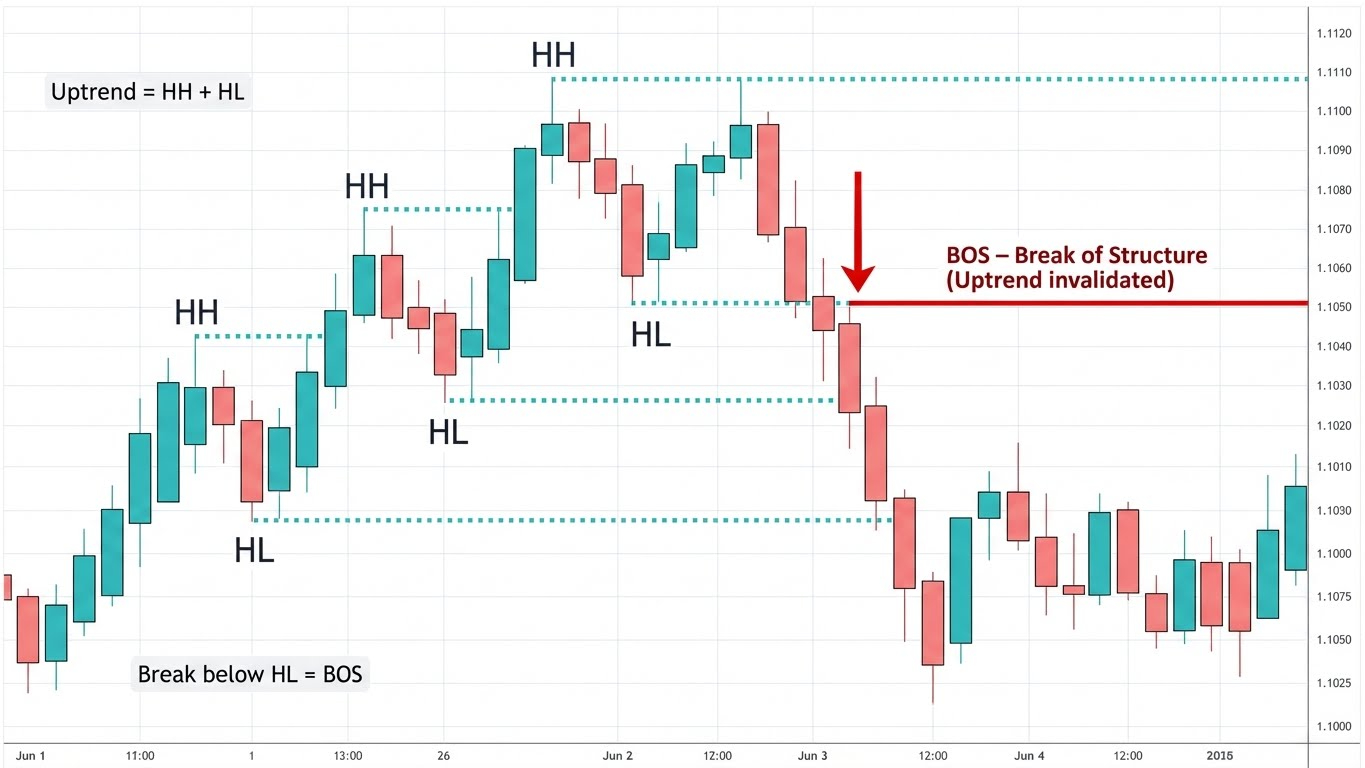
Chart Example 1 — Uptrend with Break of Structure
Here’s how an uptrend evolves into a structural break:
HH
/\ New structure
HL \ HH Break of structure
/ \ / ↓
---/--------\/---------------------------
^ HL ^ HL ⛔ BOS (break below HL)
HHs and HLs confirm the uptrend.
The price hits a high-low (HL) but then dips below it. This is a Break of Structure.
After this break, bullish bias weakens, traders become more cautious, and the probability of transition increases.
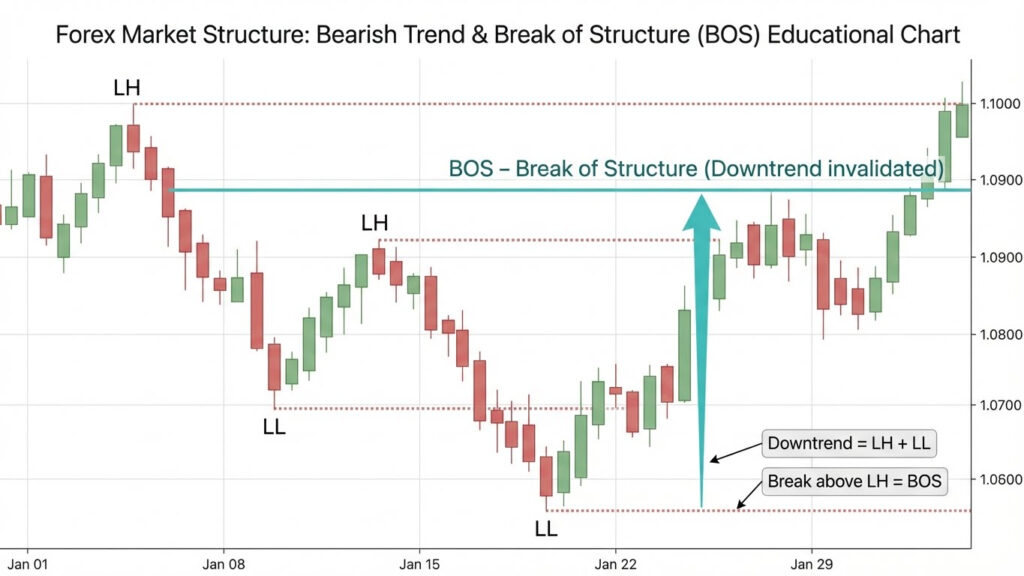
Chart Example 2 — Downtrend with Break of Structure
LH
/\
/ \ LL
LH / \
----\----------------/--------\----------------
^ LH ^ LL ⛔ BOS (break above LH)
Lower Highs and Lower Lows mark a downtrend.
When price stops falling and breaks above the most recent Lower High, a Break of Structure occurs.
This suggests that bearish momentum is weakening and that a potential regime shift may follow.
How Break of Structure Complements Technical Indicators
Technical indicators like RSI, MACD, and moving averages utilize prices to give information on momentum, trends and market environment.
The Break of Structure technique evaluates whether prices have moved out of a significant structural level. It provides an alternative viewpoint on evolving market behavior.
Nevertheless, it should be noted that structural break is not always an earlier or more reliable signal compared to indicators’ signals. Both techniques have their weaknesses and can provide misleading signals during volatile or ranging markets.
Market structure can be used along with other techniques, instead of the belief that one of them will always give more accurate information.
This idea ties into Why Indicators Don’t Predict Price: What Traders Must Understand prices, highlighting the downsides of relying on tools that look only backward.
Market Regime Shifts: What Happens After a Structural Break?
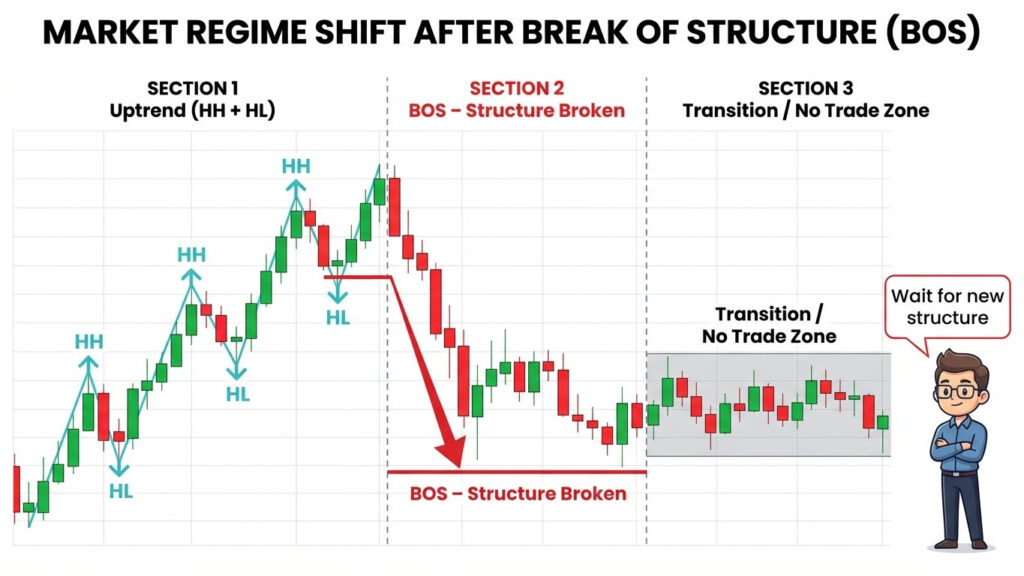
A market regime refers to a larger framework of market conditions, which could be direction of price movement, volatility and liquidity among others.
The structural break implies the beginning of a trend weakness or reversal. Nonetheless, one single break does not mean that a new market regime has formed.
After a structural break, prices may either maintain the previous direction, consolidate within a certain range or form a fresh trend.
Hence, it would be important to analyze other price action and the overall market context to determine the presence of a regime change.
What Is a Market Regime?
A market regime outlines the main price action pattern, like moving up, staying within a range, or shifting from one state to another
Structure defines these regimes clearly:
Uptrend → HH + HL in sequence
Downtrend → LH + LL in sequence
Range → Overlapping highs and lows
After a Break of Structure, price may consolidate, produce a false break, or require a new structural sequence before direction becomes clear.
Chart Example 3 — Break of Structure Leading to Regime Shift
An uptrend forms Higher Highs and Higher Lows.
Price breaks a key Higher Low, producing a Break of Structure.
Price then moves sideways, indicating a transition phase.
The emergence of a new trend depends on the formation of a new structural sequence
Break of Structure vs Change of Character (ChoCH)
BOS stands for Break of Structure, and ChoCH stands for Change of Character; they are two terms used in price action analysis when defining any change in market structure.
While in some trading approaches, BOS is defined as a structural break in the direction of the current trend, ChoCH is defined as a break against the current trend that can signal a possible change in the market direction.
For instance, a break above a key swing high in an up trend could be called a BOS. A break below a key higher low could be called a ChoCH.
Nevertheless, the definitions are not the same in all the trading approaches.
Neither BOS nor ChoCH signals a continuation or reversal. Both need to be analyzed within the overall market context.
What Is Change of Character?
Change of Character (ChoCH) is a more subtle signal than Break of Structure.
It appears when momentum weakens, extensions fail, or early structural shifts occur before a full Break of Structure develops.
Professionals use ChoCH to reduce risk and ensure everything’s solid, while Break of Structure gives the official thumbs-up on the structure.
How Traders Misinterpret Break of Structure
Mistake 1 — Treating Minor Breaks as BOS
Only well-defined swing levels qualify as structure. Minor fluctuations are noise.
Mistake 2 — Entering Immediately After Break of Structure.
Break of Structure is a cue to reassess bias, not a guarantee of reversal.
Mistake 3 — Ignoring Higher-Timeframe Structure
A lower-timeframe Break of Structure may be insignificant if higher-timeframe structure remains intact.
Mistake 4 — Overtrading During Transitions
Transition phases are often volatile. Patience protects capital.
These actions usually come from emotional stress, which is talked about in teh article Revenge Trading Explained: Why Traders Lose Control & How to Stop It.
Recognising a Break of Structure does not eliminate trading risk, particularly in leveraged Forex markets. The Commodity Futures Trading Commission (CFTC) provides independent guidance on trading risks, fraud prevention and investor protection. Understanding these risks is important when interpreting structural breaks and making trading decisions.
How Traders Can Use Break of Structure in Forex and CFD Markets
Break of Structure analysis is useful for traders to reevaluate their directional assumptions, find important price levels and check if a current trading idea is still valid.
Based on the trading approach and risk management policies of traders, they can decide to either reduce their positions, change their plans or just wait for additional confirmation of price action.
Nevertheless, the break of structure does not mean that traders should close their positions, move stop-losses or open trades in the opposite direction.
Working with charts in demo mode is useful for novice traders to learn how to spot structural patterns without any risks of losing money.
Professionals typically tighten stops, reduce position size, and wait for a new confirmed setup before committing capital. Practicing Break of Structure recognition in a simulated setting through a VARIANSE trading account page lets you build this skill without the stress of real money on the line
Conclusion — BOS Is a Signal, Not a Shortcut
Break of Structure serves as an analytical tool through which one may study the shift in price behavior.
In case traders identify an important structural break, they will be able to rethink their market outlook and determine whether a certain trend still persists.
Nevertheless, Break of Structure does not ensure any reversal, confirmation of the new regime or trading without risks.
The most critical thing for novices is to analyze structural break against the background of the market situation as a whole.