


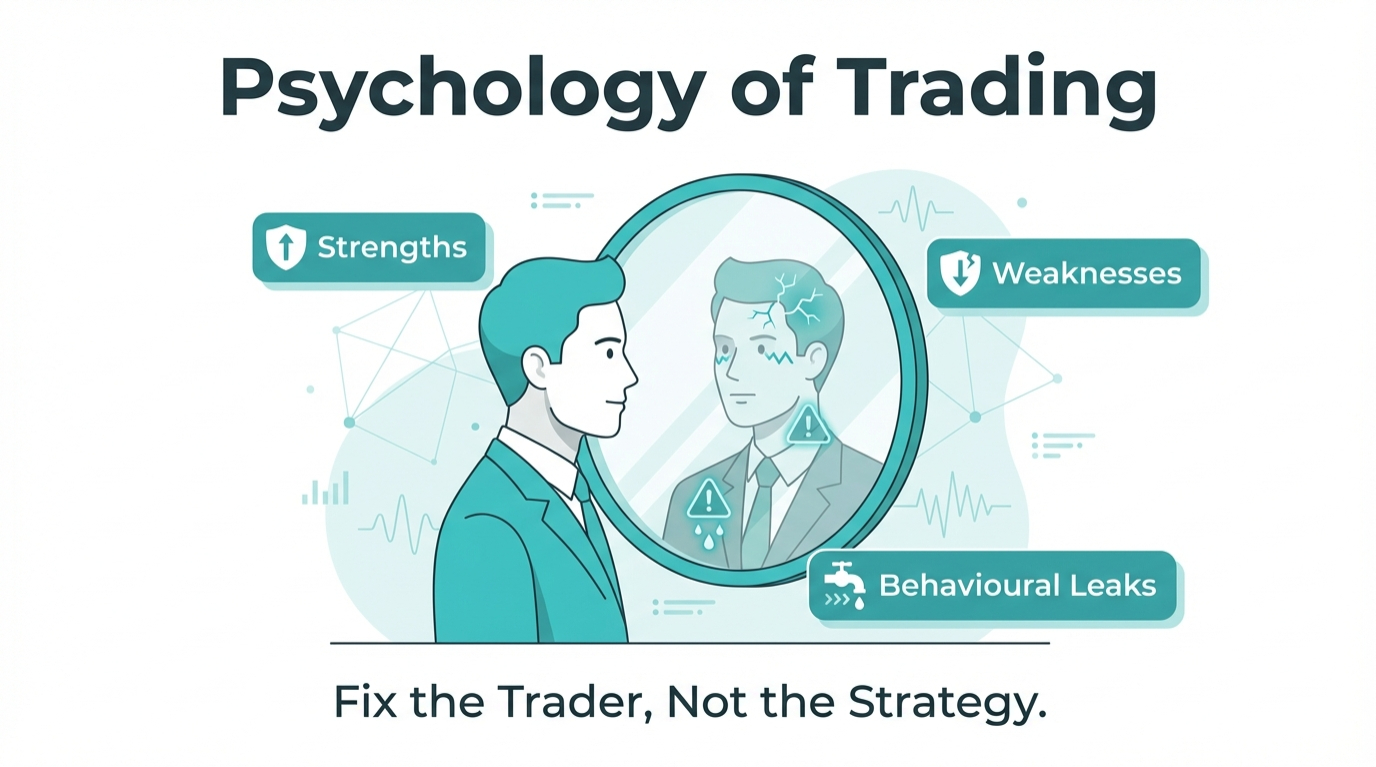
A trading strategy may provide clear entry and exit rules, but following those rules consistently can become more difficult under pressure.
Bad strategies rarely destroy trading success. Unrecognized behavioral patterns usually do.
Fears, frustrations, over-confidence and other such emotions may affect how traders deal with risk management, position execution, and the changes happening in the market.
Such behavioral characteristics of traders are essential components of psychology of trading.
Understanding one’s weaknesses, strengths and behavioral leaks is necessary for understanding how decisions are made by traders in different circumstances.
In this lesson, traders will learn how to identify their behaviors and assess their impact.
The aim of this lesson is not about avoiding emotions but about how they affect execution and risk management.
Why Trading Problems Can Be Difficult to Identify
If the results are not what was expected while trading, one may be tempted to criticize the trading strategy, indicators or the market situation.
There are various factors that might lead to poor performance in trading, including:
- Limitations in the trading strategy.
- Inconsistent execution.
- Poor position sizing or risk management.
- Changing market conditions.
- Emotion-influenced decisions.
For instance, a trader will execute his/her trading plan in the quiet market conditions but impulsively change his/her approach when market conditions are volatile.
Similarly, a trader may be overconfident following some successful trading deals and decide to take more risks.
Although such behaviors can suggest that there are certain patterns that need to be analyzed, it does not mean that they directly point to psychological factors as a key reason for the lack of success.
Being able to tell the difference between the two is very important in evaluating performance.
This misdiagnosis often co-occurs with the emotional loops described in Trading Psychology Explained: How Emotions Shape Forex & CFD Trading.
What Are Trading Psychology Strengths?
Strengths of trading psychology can be defined as behavioral patterns and approaches that make the trader stick to his or her strategy and minimize risks.
The strengths of trading psychology can be patience, emotional intelligence, adaptability and compliance with predefined rules.
Examples of Genuine Trading Strengths
- Following position-sizing and risk-management rules after losing trades.
- Waiting for setups that meet predefined entry criteria.
- Executing the same trading approach consistently.
- Recognising emotional reactions without automatically acting on them.
- Accepting that individual losses can occur even when a strategy is followed correctly.
- Reviewing decisions objectively rather than focusing only on profit or loss.
A behaviour becomes more meaningful as a potential strength when it appears consistently across different situations.
However, no single behaviour guarantees profitable trading results.
Trading Weaknesses vs Behavioural Leaks
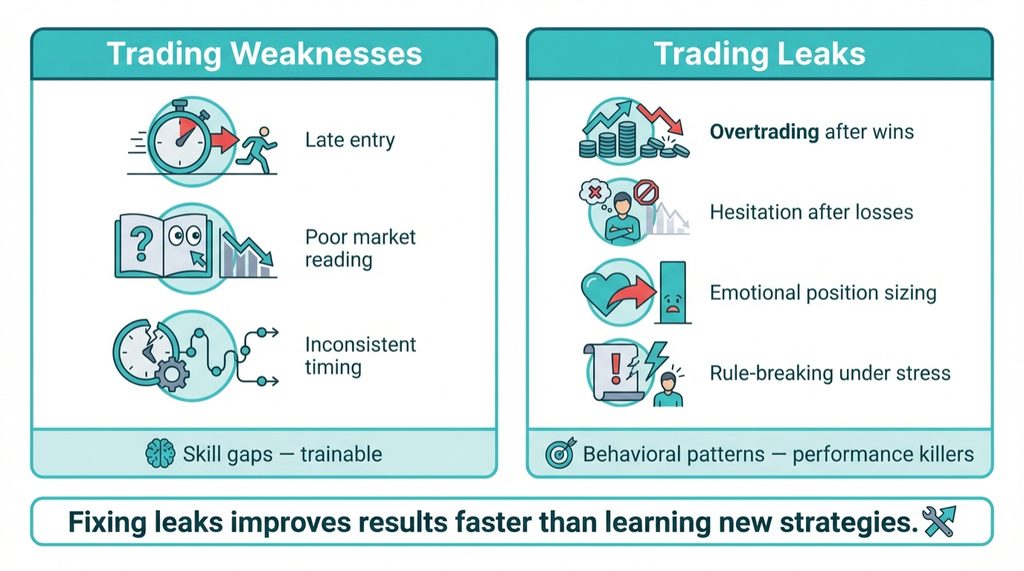
Trading weaknesses and behavioural leaks are related concepts, but they can be useful to examine separately.
Trading Weaknesses
Trading weaknesses may involve gaps in knowledge, technical skills or decision-making.
Examples include:
- Difficulty interpreting market structure.
- Inconsistent entry timing.
- Limited understanding of position sizing.
- Poor recognition of changing volatility conditions.
- Difficulty evaluating strategy performance.
These areas may benefit from education, practice and structured feedback.
You can improve these weaknesses through training and experience.
Behavioural Leaks
A behavioural leak is a recurring decision-making pattern that may undermine a trader's predefined rules or increase unnecessary risk.
- Increasing position size impulsively after profitable trades.
- Hesitating to execute valid setups after losses.
- Overtrading during periods of boredom or frustration.
- Moving stop-loss levels without a predefined reason.
- Taking trades outside the established strategy.
A behavioural leak can also point to a lack of skills underneath, so the two do not have to be entirely mutually exclusive.
What really matters is whether the repeated behaviour impacts execution performance, risk exposure, or decision-making.
Leaks are more dangerous than flaws since they sneak up on you. This pattern frequently overlaps with behaviors explored in Revenge Trading Explained.
How Emotional Trading Can Affect Performance
The way emotions affect trading decisions is often not easily identifiable.
For example, a trader thinks he is making a logical decision, but his decision is driven in part by feelings of fear, frustration, or arrogance.
Examples include:
- Justifying entries that do not fully meet the trading plan.
- Increasing trading frequency to recover recent losses.
- Closing positions prematurely because of fear.
- Taking unnecessary risks after a winning streak.
- Adjusting stop-loss levels without a predefined reason.
These can relate to the following psychological phenomena: loss aversion, overconfidence and confirmation bias.
Nevertheless, emotions are not necessarily negative things, and feeling emotions does not mean that one cannot trade disciplined.
The goal is to understand that emotions affect decision-making and determine whether those decisions still fit the trading plan.
Behavioural finance research provides examples of how psychological tendencies can influence financial decisions. For instance, Shefrin and Statman's research on the disposition effect examines investors' tendency to realise gains while remaining reluctant to realise losses. Although this research does not establish that every trader behaves this way, it illustrates why examining recurring decision-making patterns can be valuable.
How Behavioural Patterns Can Repeat in Trading
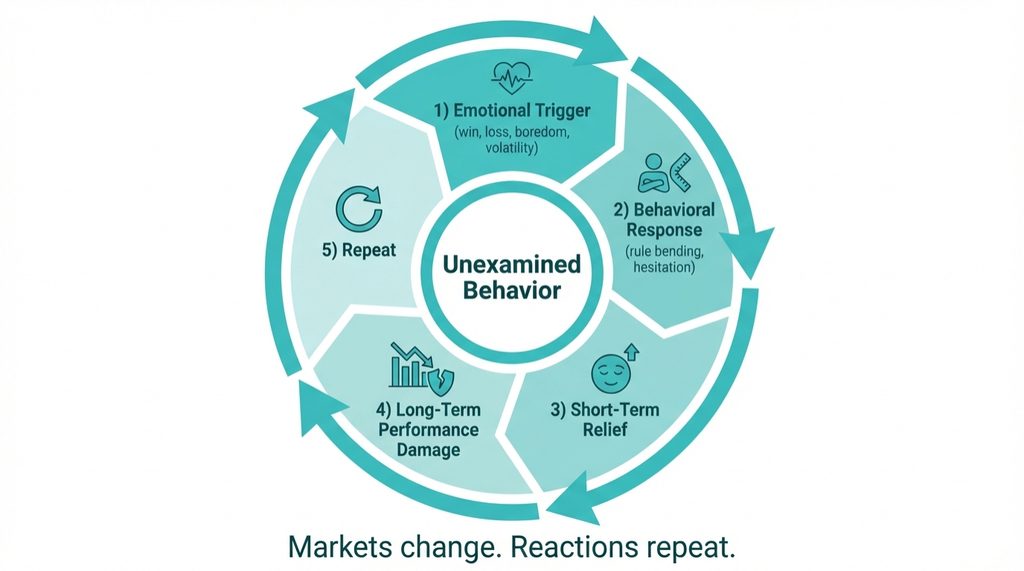
Emotions may be rekindled when the same trading conditions arise for traders in the future or when there are repeated results in the trading process.
A trader may be reluctant to take an upcoming valid trade opportunity after suffering multiple losses.
An experienced trader who is on a winning run can be too confident to violate his predefined risk management rules.
Understanding a Behavioural Trading Cycle
A recurring pattern may involve:
- Trigger: A losing trade, winning streak, increased volatility or period of boredom.
- Emotional response: Fear, frustration, excitement or overconfidence.
- Trading decision: Hesitating, overtrading or deviating from predefined rules.
- Outcome: A change in risk exposure, execution quality or trading results.
- Repetition: Similar responses occurring under comparable circumstances.
However, this is not the case for all traders, and the same factor can lead to different results.
This can serve as an introduction to the assessment of behavior and establishing decision-making guidelines.
Traders often adjust their strategy rather than address behavior until they recognize this cycle. Breaking this loop requires process awareness, a principle discussed in Process-Focused Thinking for Consistent Trading in Forex & CFDs.
How to Identify Your Personal Trading Leaks
Finding behavioural leaks starts with analysing how trading decisions alter in varying scenarios.
The goal here is to identify consistent patterns rather than evaluating each error individually.
Behavioural Self-Assessment Questions
Consider the following:
- Do I increase position sizes after winning trades?
- Do I hesitate to enter valid setups after losses?
- Am I more likely to trade when bored or frustrated?
- Do I justify entries that do not meet my predefined criteria?
- Do I adjust stop-loss levels without a planned reason?
- Does increased volatility influence my willingness to follow the strategy?
How to Interpret Your Answers
A single occurrence does not necessarily indicate a recurring behavioural problem.
Instead, consider:
- How frequently the behaviour occurs.
- Which situations trigger it.
- Whether it violates predefined trading rules.
- How it affects risk exposure or execution quality.
- Whether the pattern appears across multiple trades.
These questions are intended for personal reflection, not as a validated psychological diagnostic test.
Strengthening Trading Psychology Without Reinforcing Behavioural Leaks
Identifying patterns of behavior is just the first step. There are ways that a trader may modify their decision-making process.
Reinforcing Helpful Behaviours
- Identify situations in which trading rules are followed consistently.
- Use predefined entry and exit criteria to reduce unnecessary discretionary decisions.
- Establish position-sizing and risk limits before entering trades.
- Review whether decisions remain consistent across different market conditions.
- Consider reducing exposure or pausing trading when predefined risk limits are reached.
Professional traders do not eliminate emotion; they manage it through structure and discipline. This principle aligns closely with the discipline frameworks discussed in Motivation vs Discipline in Trading.
Addressing Recurring Behavioural Leaks
In case a trader continuously increases the amount of money to be traded upon winning several trades, there should be a rule that limits their maximum risk per trade and ensures that the rule is adhered to.
Whereby a trader continuously trades due to boredom, then there should be a set of requirements that the market must meet before he/she can trade.
This doesn’t eliminate the possibility of making mistakes because of emotions, but it creates a way of assessing the trader’s behavior.
When to Address Behavioural Leaks Before Changing Strategies
When trading results fall short of expectations, changing strategies may seem like the most obvious solution. however, it may be worthwhile to examine the execution prior to concluding whether it is necessary to change the strategy.
For instance, a trader may come to realize that their trading rules are often breached by entering trades on impulse, using an inappropriate position size or exiting the position prematurely.
In this case, examining one's behaviour may provide insights into whether the problem is execution-related, strategy-related or both.
However, increased discipline alone will not turn a loss-making strategy into a winning one.
Trading Psychology: Self-Awareness and Decision-Making
Self-awareness is an important component of trading psychology because it helps traders recognise how their reactions may influence decisions.
This includes understanding:
- Emotional triggers associated with winning and losing trades.
- Recurring behavioural patterns.
- Situations that increase pressure or uncertainty.
- Circumstances in which trading rules are more difficult to follow
Nevertheless, the recognition of these patterns will not necessarily alter the situation.
Traders may also find it useful to have preset risk thresholds, decision-making criteria, and periodic performance evaluation.
The combination of awareness and trading processes may lead to more consistent trading but is unlikely to reduce the risks associated with it.
Conclusion: Psychology of Trading
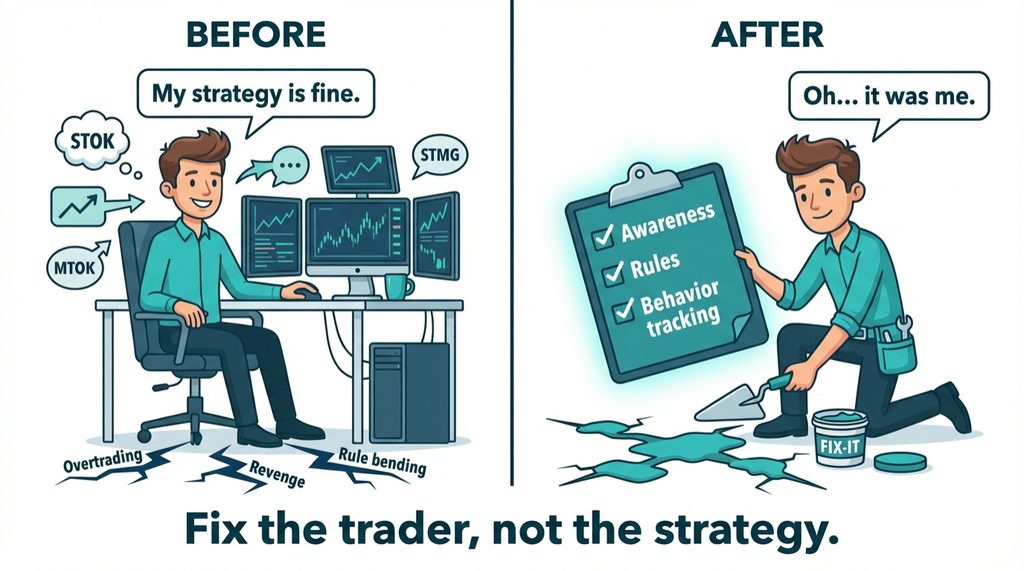
In addition to self-confidence, motivation and being calm in stressful situations, trading psychology includes other aspects, such as the impact of emotions and repeating behaviour patterns on the trader’s decisions.
Identifying the trader’s strengths, weaknesses and possible behavioral leaks will help understand the person better and find out how he or she behaves in case of successes, failures and changes in market conditions.
This information may assist in making more objective evaluations of performance and finding those behavioral patterns which need to be changed.
Nevertheless, behavioral development is just a part of trader development, because other factors, such as strategy, risk and market conditions, should also be taken into account.
What matters most is not the absence of emotions or mistakes but recognition of the repeating pattern and the decision-making process.








