


When beginners ask why all investments carry some risk, they're usually looking for a "safe" investment that guarantees returns. In real life, risk isn't a bad thing when you're investing. Investing involves uncertainty, which creates both potential opportunities and financial risks.
Changing economic conditions, investor behavior, and market dynamics can affect investment performance. Prices shift as expectations change, supply and demand adjust, and new information emerges. This uncertainty creates both potential opportunities and financial risks. This insight helps investors stop fearing risk and start managing it.
Risk Exists Because the Future Is Uncertain
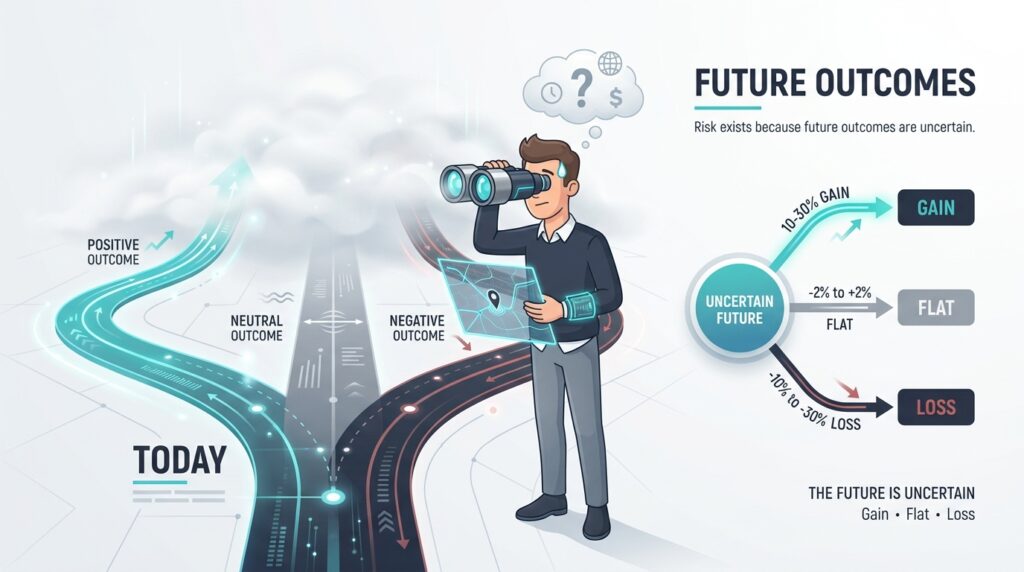
All investments carry some risk because we can't predict the future with certainty. Businesses may grow, struggle, or fail. Governments may change policies. Economies might get stronger or weaker. Global events can abruptly alter market conditions.
Financial markets are built on uncertainty. Financial Market Foundations explains how markets work and respond to news, with prices moving as expectations change. Investment risk reflects the uncertainty surrounding future market outcomes.
Risk Is the Price Paid for Growth
Investments offering higher potential returns generally involve greater risk. Investment growth is uncertain, and positive returns are never guaranteed. That's why when you're looking for bigger gains, you're also accepting greater investment risk.
The CFA Institute recommends this bond, implying that if you're prepared to adapt and accept some risk, you could achieve higher returns. Investing without taking any risks would be like saving, with minimal growth.
Even “Safe” Investments Carry Risk
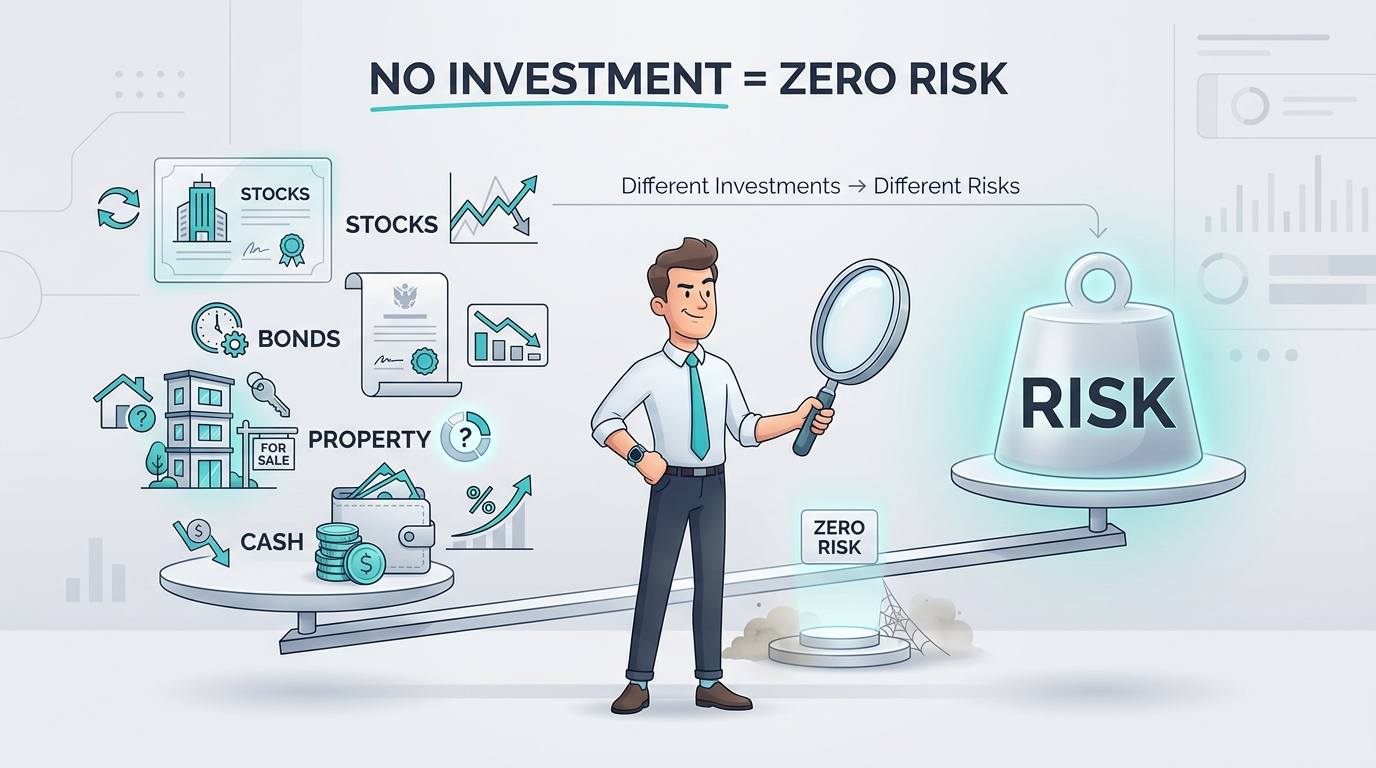
Many beginners assume that certain investments are completely risk-free. In real life, even safe choices carry some risk. Cash can lose value due to inflation. Bonds are subject to interest rate and credit risk. Property faces risks from cash-flow issues and market fluctuations.
The idea that safety means no risk is one myth debunked in Common Investing Myths Beginners Should Know, where risk is described as inevitable but controllable.
No investment is risk-free. Different investments carry different types and levels of risk.
Inflation Is a Risk Most People Ignore
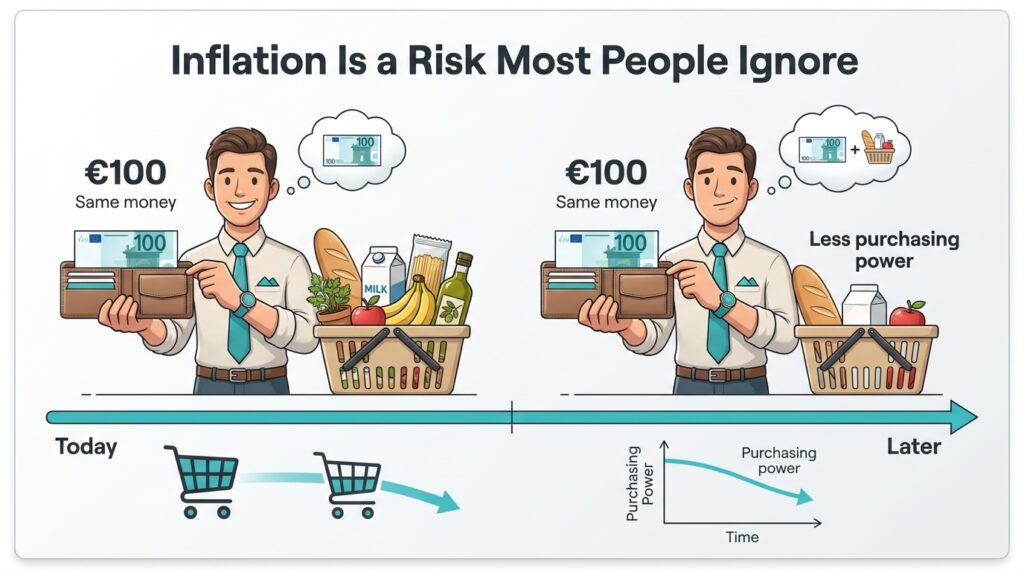
Carrying cash without putting it to work is risky, too. Inflation gradually reduces money's purchasing power. Even if your savings balance doesn't change, its real value goes down over time.
The International Monetary Fund (IMF) explains that inflation can significantly reduce the value of idle money, i.e., cash not invested or used to generate returns. Choosing to hold cash rather than invest also involves financial considerations and comes with its own risks. So the real question isn't just about taking risks; it's about what kind of risks we're willing to take.
Risk Comes from Market Participation
Investing exposes capital to constantly changing market conditions. Prices react to supply and demand, market sentiment, economic indicators, and major market participants' actions. These actions create opportunities and add unpredictability.
Trade Mechanics & Execution Basics covers how prices form and orders execute, showing market behavior as a mix of structure and psychology.
Risk is created by participation itself.
Risk Is About Probability, Not Certainty
Risk doesn't guarantee a bad outcome. Unexpected events can influence investment outcomes. Investment outcomes can vary significantly. Gains, losses, or flat results are all possibilities.
Experienced investors focus on understanding probabilities and managing risk rather than predicting every market move or guessing the future. The aim isn't always to be right, but to stay steady across many choices.
Why Risk Cannot Be Eliminated, Only Managed
Investing always comes with some risk. We can't control it entirely. Risk management involves diversification, appropriate position sizing, realistic time horizons, emotional discipline, deciding how much to put in each, planning for the long haul, and staying calm.
This approach turns potential danger into a useful tool. Rather than fearing uncertainty, investors can learn to manage their exposure more effectively.
Investing involves balancing risk, not blindly investing. The article What Is Investing? explains that investing is more about smart planning than gambling.
Why Time Reduces the Impact of Risk
Short-term market movements can be unpredictable. Long-term market stability has improved. Time helps smooth out the ups and downs and lets bigger-picture trends outweigh small, temporary fluctuations.
This is why long-term investing is important. Generally, long-term investing is less risky than making rash short-term bets. The article How Investing Helps Grow Wealth Over Time? explains how time supports growth, showing that compounding acts like a steady hand.
Emotional Risk Is as Real as Financial Risk.
Many losses aren't actually due to the markets themselves but to how people react to them. Fear, greed, and impatience can negatively influence investment decisions. We often overlook the role of emotional control when discussing risk.
Before risking real money, you can build your emotional game with a demo account from VARIANSE trading. This lets you get a feel for the market without the stress of spending money.
Education Is the First Layer of Risk Protection
The more you understand the market, the safer it can feel. Learning doesn't eliminate risk, but it helps you see, measure, and manage it better.
At VARIANSE Academy, you can find organized learning paths on their website to help newbies prepare for the market instead of rushing in. Knowledge is the strongest form of risk reduction.
Conclusion: Why All Investments Carry Some Risk
Therefore, every investment carries some risk because the future is unpredictable. Markets are dynamic and constantly changing, influenced by individuals' actions.
Risk isn't the enemy in investing. When you take control of risk, you can turn it into an opportunity rather than a source of fear. Investing isn't about dodging uncertainty. Learning how to navigate it smartly.








