
How successful investors think involves more than identifying investment opportunities or predicting future market movements.
Successful investing doesn't usually come from a hidden strategy. Usually, it's a mindset that helps maintain composure in volatile markets. If you're digging into how the pros invest, you're probably trying to figure out what sets the steady ones apart from those who let their feelings get the best of them and lose their cool
The most significant difference isn't about being smart, having signs, or having money. It’s how investors interpret risk, uncertainty, and time. This article explains the thought process of savvy investors, helping you develop discipline before you actually put your hard-earned cash on the line.
How Successful Investors Think About Risk and Uncertainty
Financial markets involve uncertainty, and future investment outcomes cannot be predicted with complete accuracy.
Rather than assuming that an investment will produce a particular result, experienced investors may consider several possible scenarios and their potential financial consequences.
This includes evaluating downside risks, market conditions and the possibility that an investment thesis may prove incorrect.
Understanding uncertainty is an important part of investment risk assessment.
This method aligns with the idea from What Does Investment Risk Really Mean? That risk is about uncertainty, not just the possibility of losing money. Once you get used to uncertainty, you stop obsessing over sure things and start handling risks smartly.
What This Looks Like in Practice
Instead of making decisions based on a single headline or market indicator, investors may examine several sources of information, assess relevant risks and consider whether an investment aligns with their financial objectives.
They Separate the Decision-Making Process From the Outcome
A profitable investment does not necessarily indicate that the original decision was well informed. Similarly, a financial loss does not automatically mean that the decision-making process was poor.
Market uncertainty means that even carefully researched investments can produce unfavourable outcomes.
Experienced investors may evaluate both the financial result and the reasoning behind their decisions.
This includes considering whether relevant information was assessed, financial exposure was appropriate and the investment remained consistent with their objectives.
Understanding Profit and Loss can help beginners distinguish between investment outcomes and the decisions that contributed to them.
Questions Investors Can Ask
- Was the investment decision supported by relevant information?
- Were the potential risks adequately considered?
- Was the financial exposure appropriate?
- Did changing circumstances justify reassessing the original decision?
They Think in Systems, Not Individual Outcomes
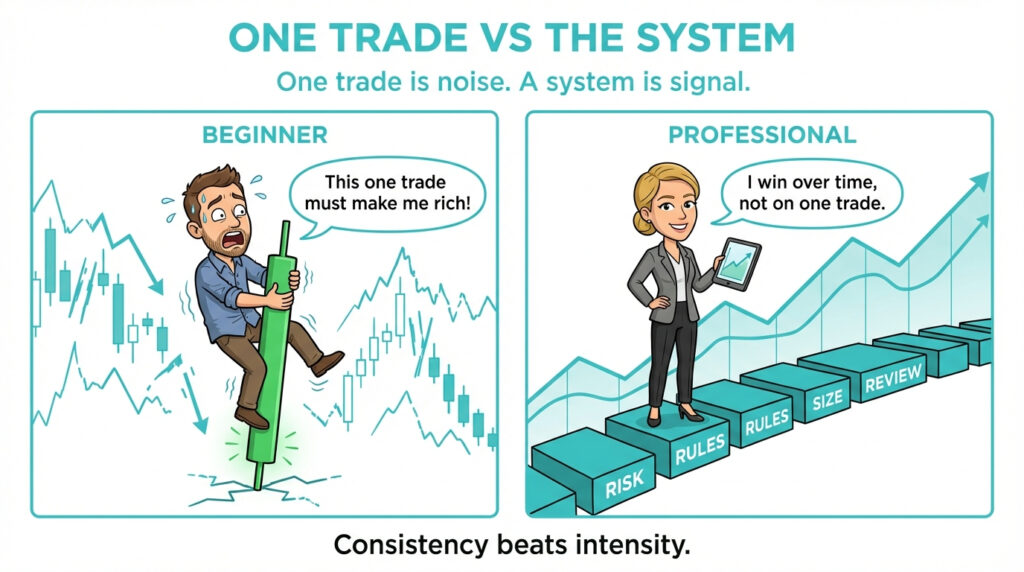
A structured investment approach involves making decisions within a broader financial plan rather than reacting to isolated market movements.
For long-term investors, this may include considering asset allocation, diversification, investment timeframes and periodic portfolio reviews.
For active traders, it may involve defined entry and exit criteria, position sizing and monitoring financial exposure.
However, individual decisions remain important. A single highly leveraged or concentrated position can create substantial financial losses.
A structured process can support consistency in decision-making, but it cannot guarantee profitable results.
Learn more about common behavioural and planning errors in Common Investing Mistakes Beginners Make.
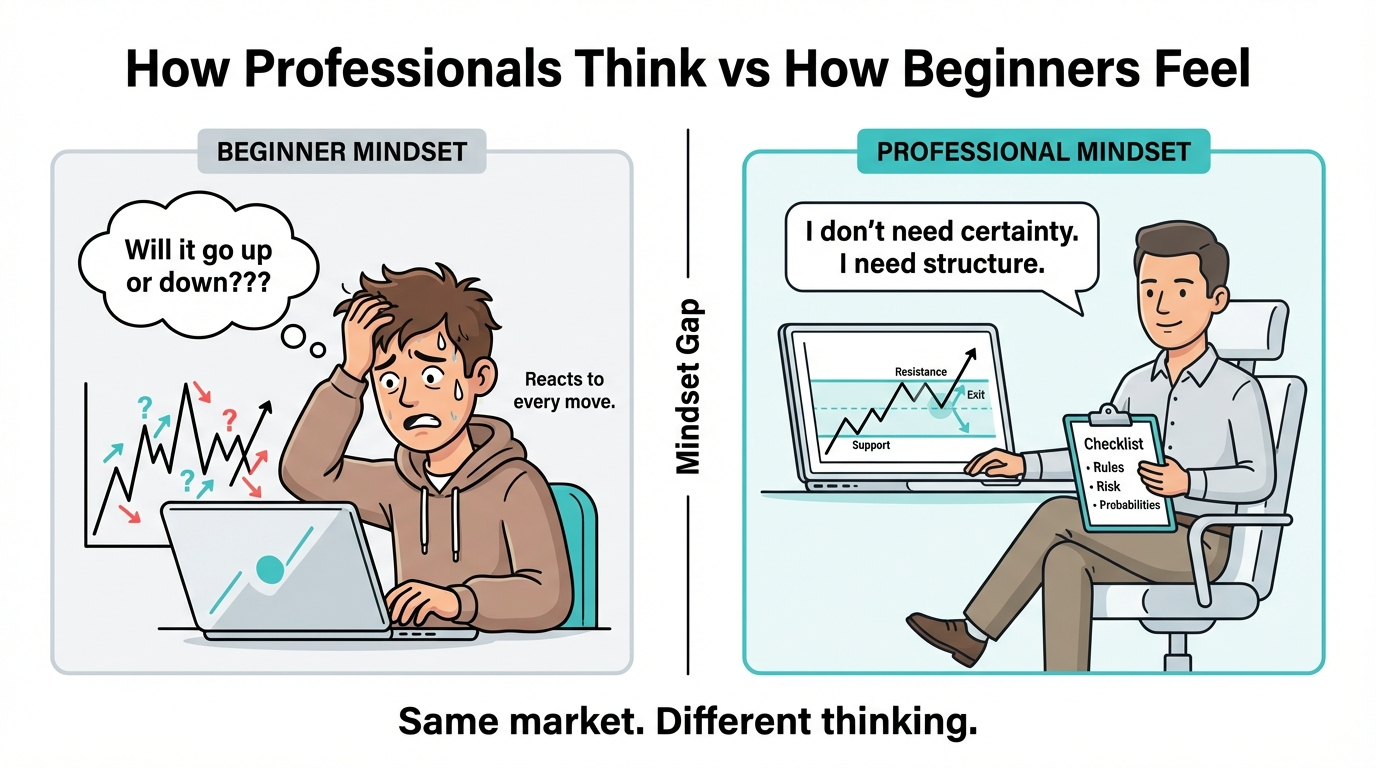
When rules exist, emotions have less control. When you're under pressure, you don't just make a decision; you carry out a plan you've already set up, which helps to mitigate stress by providing a clear course of action rather than relying solely on emotional responses.
They Consider Potential Losses Before Expected Returns
Evaluating potential returns is important, but investors should also consider the financial consequences of unfavourable outcomes.
Risk-management considerations may include:
- Choosing position sizes appropriate to financial circumstances.
- Understanding the risks of leverage.
- Avoiding excessive concentration in a single investment.
- Considering diversification where appropriate.
- Accounting for transaction costs and liquidity.
These measures can help investors assess and manage financial exposure, but they cannot eliminate investment risk.
Understanding investment risk is an important part of making informed financial decisions. The Financial Conduct Authority (FCA) provides educational guidance on investment risks and returns, helping beginners understand why potential rewards should be considered alongside the possibility of financial losses.
This thinking aligns with How to Manage and Reduce Investment Risk?, where risk is treated as something to control, not eliminate, emphasising that managing risk effectively can lead to consistent, smaller gains rather than relying on large, risky trades.
They Understand That Investment Costs Matter
Investment costs can affect net returns, particularly when transactions are frequent or positions are held for extended periods.
Depending on the financial instrument and service provider, costs may include spreads, commissions, platform charges, financing costs and other applicable fees.
Experienced investors may consider these expenses when evaluating investment opportunities and comparing strategies.
Lower costs can reduce the expenses associated with investing, but they do not guarantee favourable investment performance.
This is laid out in the section What Are Spreads, Fees, and Commissions? where they state costs are just part of getting into the market, not a sneaky catch.
They Recognise Emotions Without Letting Them Dictate Decisions
Fear, greed and overconfidence can influence investment decisions regardless of an individual's experience.
A structured investment approach may help investors recognise these emotional responses and evaluate decisions more carefully.
For example, a trader may establish entry and exit conditions before opening a position, while a long-term investor may use predefined portfolio-review criteria.
This topic connects directly to Why Emotions Affect Investment Decisions?, where emotional responses are explained as natural reactions to uncertainty.
They Value Education and Practical Learning
Financial education can help beginners understand investment concepts, market risks and the tools used to make financial decisions.
For individuals interested in active trading, simulated trading environments may provide opportunities to practise order placement, explore platform features and review decisions without risking real trading capital.
However, demo trading cannot fully reproduce live-market execution conditions or the emotional pressure associated with real financial losses.
Successful simulated results do not guarantee readiness for live trading or future profitability.
A controlled environment on the VARIANSE trading account page allows beginners to observe market movements, order behaviour, and emotional reactions without incurring financial damage.
Structured progression is then supported through the VARIANSE Academy education page, where learning is organized in the correct order.
Conclusion: Successful Investing Is Preparation, Not Prediction
Understanding how successful investors think involves recognising the importance of financial knowledge, risk awareness and structured decision-making.
Experienced investors may consider different market scenarios, evaluate potential losses, account for investment costs and review their decisions over time.
They also recognise that emotions can influence financial behaviour and that even carefully considered investments may produce losses.
No mindset or investment strategy guarantees favourable returns.
For beginners, developing realistic expectations and learning to evaluate financial decisions thoughtfully can provide a useful foundation for understanding investing.