


Market gaps and slippage are execution risks that traders may encounter when buying or selling financial instruments.
Many new traders think that once they set a buy or sell order, a stop loss, or a profit target, the trade will always go through at that exact price. In real markets, you can't always pull it off.
This is despite the fact that the market has been analyzed well enough and the risks involved have been managed. This is because trading depends not on fixed prices, but on liquidity, volume, and trader activity.
Grasping these execution risks is key in Trade Mechanics & Execution Basics: How Trades Really Work, as traders learn how platforms handle real-time market conditions.
Understanding market gaps and slippage helps traders recognise execution risks and develop more realistic expectations about trading outcomes.
What Are Market Gaps
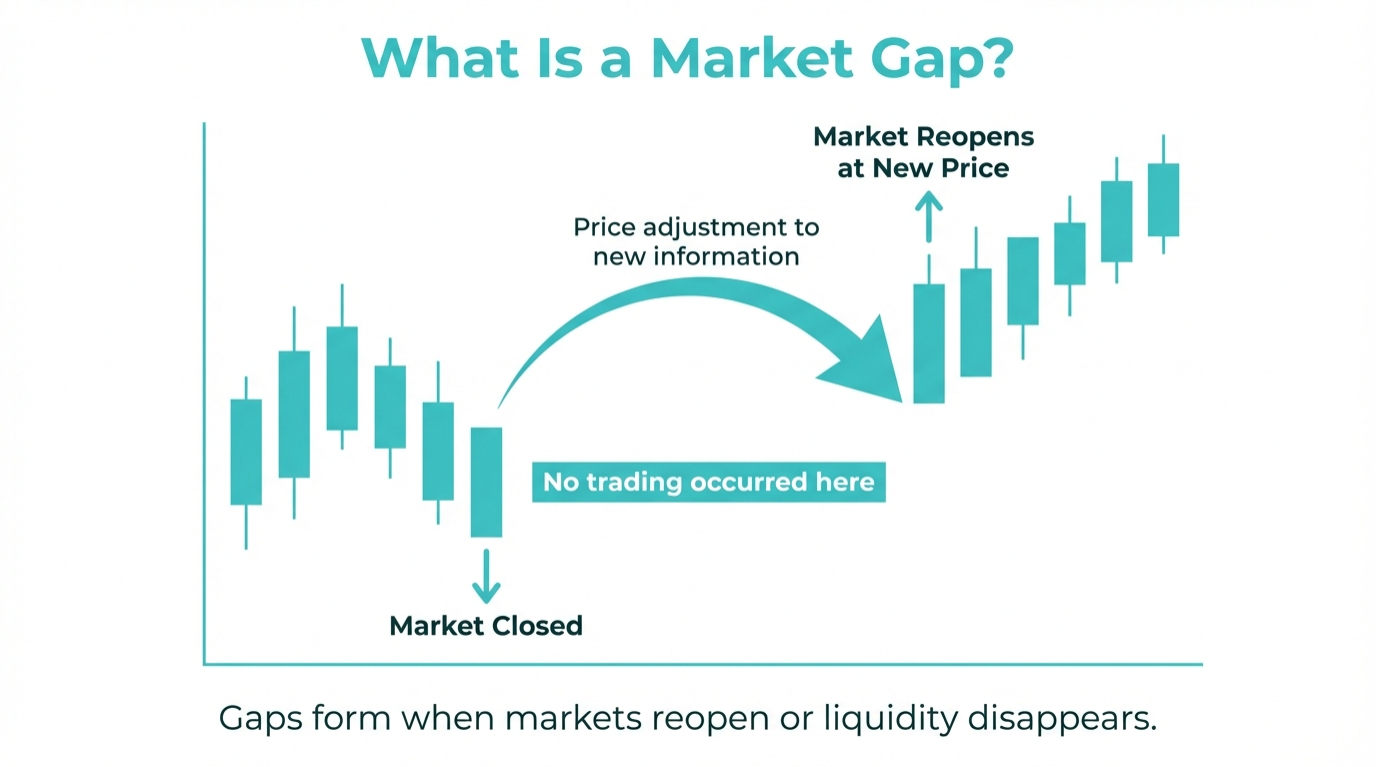
A market gap refers to a situation where the price of a financial security shifts from one level to another without any transaction taking place at the intermediate levels in the particular market.
In the case of a price chart, it is depicted by an observable gap between two consecutive periods of trade.
They may happen due to sudden changes in information in the market or lack of liquidity in the market.
For example, if a stock closes at £100 and opens at £105 the following session, the £5 difference represents an upward opening gap. A gap can also occur in the opposite direction.
However, a visible chart gap does not necessarily mean that no trading occurred anywhere in the wider market.
Why Market Gaps Occur
When new information becomes available, it can change our perception of an asset's worth more quickly than orders can catch up. This frequently occurs when markets reopen following a shutdown or when unexpected news alters people's preconceived notions.
Forex markets shut down over the weekend. When markets reopen, prices quickly adjust to reflect the latest global news.
This adjustment reflects the same supply-and-demand mechanics explained in Financial Market Foundations, where price moves based on positioning and expectations rather than smooth continuity.
Common Situations Where Market Gaps Occur
Various market conditions give rise to distinct types of gaps. Grasping the situation helps traders foresee potential risks.
Weekend Gaps
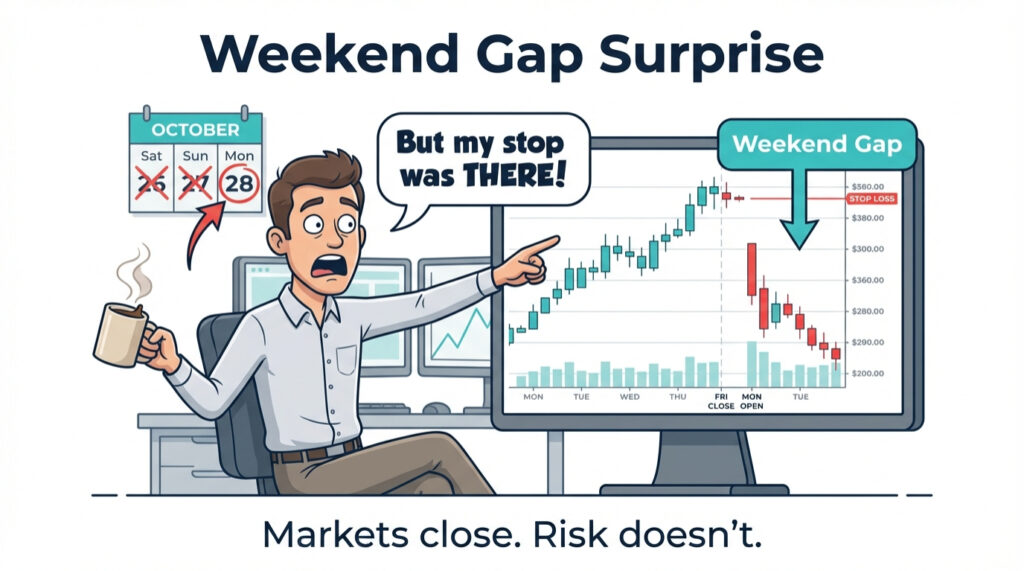
Weekend gaps arise when the Forex or CFD market opens after a weekend closure. Due to the political, economic, or global developments, the price can make an abnormal move either up or down from the last closing point.
Weekend gaps are especially significant for traders having positions during the weekend period.
News-Driven Gaps
Major economic news, central bank moves, or geopolitical shake-ups can trigger rapid price moves.
This shows how people in big institutions quickly shift things around, a topic we dive into in Who Really Moves the Stock Markets. The key takeaway is that every trader should understand this phenomenon. Large-scale financial transactions can quickly change prices.
Low-Liquidity Gaps
With a limited number of participants, prices may fluctuate between the available options. This happens more frequently with less active stocks or during off-peak trading hours.
Liquidity conditions significantly affect how well trades are executed, as outlined in the What Is Liquidity? section.
What Is Slippage in Trading?
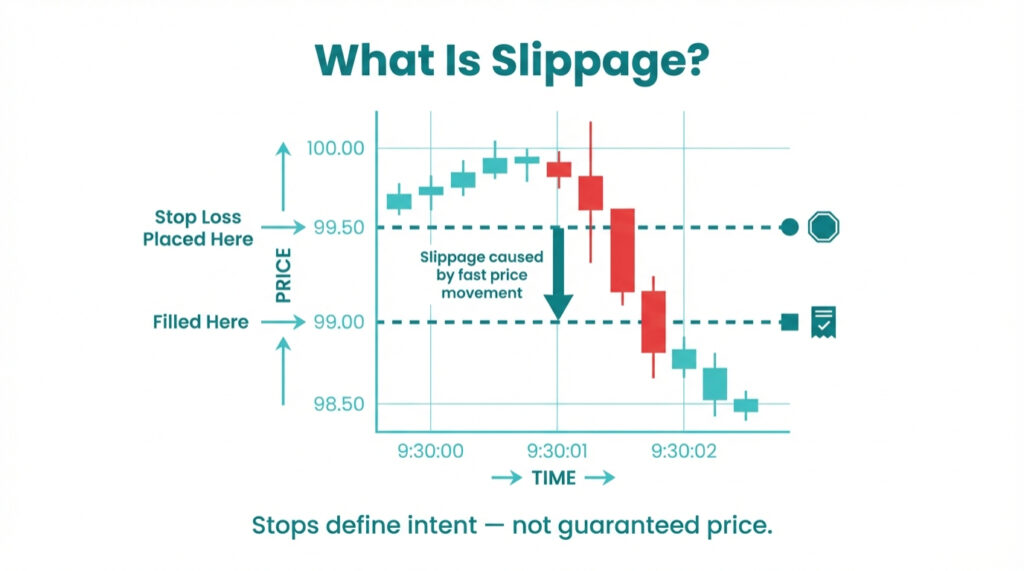
Slippage occurs when a trading order executes at a price different from the price expected when the order was submitted or triggered.
This can happen when market prices change rapidly or when sufficient liquidity is unavailable at the expected price.
Slippage may be positive or negative, depending on whether the actual execution price is more or less favourable than expected.
It can affect market orders and the execution of triggered stop-loss orders, particularly during volatile market conditions.
Slippage is different from the bid-ask spread, which represents the difference between the quoted buying and selling prices.
Slippage ties in with the bid-ask spread, showing the prices you can buy or sell at in teh market. This connection is laid out in Bid-Ask Spread Explained, showing that spreads are all about how liquid and active the market is
Positive vs Negative Slippage
Slippage can work in either direction. Slippage happens when you buy or sell at a price that's worse than you thought it would be. Positive slippage happens when you buy or sell at a better price than expected.
Both outcomes show real market stuff, not just tech issues.
Why Stop-Loss Orders Cannot Guarantee Exact Prices
Many beginners assume that a stop-loss order guarantees a position will close at a specified price.
However, a standard stop-loss order does not guarantee either execution or the final execution price.
For example, suppose a trader buys a stock at £100 and places a stop-loss at £95.
If the stock opens at £90 following unexpected news, the stop-loss may be triggered, but the resulting order could execute at approximately £90 or another available price, depending on market conditions.
This means actual losses may exceed the amount originally planned.
Stop-loss orders can support risk management, but traders should also consider position sizing, liquidity, leverage, and potential market gaps.
That's why you've got to pair stop losses with smart position sizing, as detailed in Take Profit & Stop Loss Explained: The Foundation of Risk Control, where exit orders just set the risk but don't guarantee the trade will go through smoothly.
Understanding this distinction prevents unrealistic expectations.
When Are Market Gaps and Slippage Most Likely
Execution risk increases when things change quickly or when not enough people are involved.
High-Risk Market Conditions
Slippage and gaps tend to happen more often when big economic news drops, during the start and end of the trading day, on weekends when the market reopens, and when things are really unpredictable.
These periods involve a rapid imbalance in order flow, where liquidity may temporarily disappear.
This underscores the need to pick order types wisely, as detailed in Market Orders vs Limit Orders: What’s the Difference, where market orders are about getting in fast and limit orders are about keeping the price in check.
Timing and liquidity directly influence execution outcomes.
How Market Gaps and Slippage Affect Forex and CFD Traders
The forex and CFD markets usually are quite liquid, though this may differ at various points in time, for certain assets, and against the background of world events.
It is most likely that the execution will be smooth for major currency pairs, though certain exotic instruments and unexpected situations could cause widening spreads and slip. Trading in a demo environment allows traders to observe market behavior without using any real funds.
Execution behavior is one of the major aspects of the trade process cycle, from inception to termination. While planning trades, it is necessary to make reasonable assumptions regarding fills and risks.
How Professional Traders Manage Execution Risk
Professional traders know that you can't always avoid gaps and slippage. They reduce risks through planned risk management strategies.
They concentrate on liquid assets, getting the right size for their investments, and steering clear of risky moves when things are shaky.
Position sizing matters a lot since smaller trades mean less money lost when things don't go as planned. This is laid out in Risk Per Trade Explained, where you manage your risk before you even make the trade. Execution discipline protects long-term survival.
Common Beginner Mistakes With Market Gaps and Slippage
Beginners may underestimate execution risk when they assume that trading orders will always execute at expected prices.
Common mistakes include opening excessively large positions during volatile market conditions, ignoring liquidity, overlooking wider spreads and assuming that stop-loss orders guarantee specific exit prices.
Another mistake is failing to consider how market gaps and slippage can increase losses beyond the amount initially planned.
Understanding these risks can help traders make more informed decisions, although it cannot eliminate unexpected execution outcomes.
These slip-ups can lead to early account losses, as the article Why Traders Fail? points out, with not knowing what's happening during trades being a big deal. Understanding execution reduces preventable losses.
How Market Gaps and Slippage Affect Trading Psychology
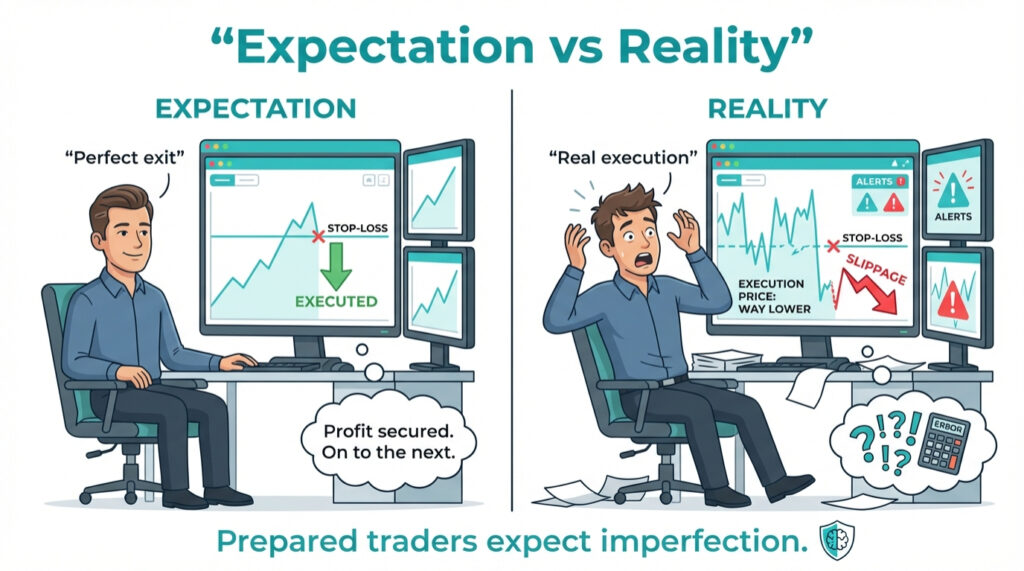
Unexpected actions can lead to feelings of annoyance, anxiety, or rash choices.
When traders understand that slippage and gaps are inherent in the trading process, they tend to relax more. This boosts discipline and consistency.
Psychological stability plays a key role in the growth of structured trading, as detailed in Trading Psychology Explained, where having realistic expectations helps keep emotions in check. Preparation builds confidence.
Conclusion: Understanding Market Gaps and Slippage
Market Gaps and Slippage are the types of execution risk that should be considered prior to executing any orders.
Market Gaps are created when prices jump from one level to another without having any activity at intermediate prices on the specific market's data.
Slippage is the difference between the expected and actual price of executing the order.
Both Market Gaps and Slippage can become a problem during volatile periods, low liquidity or unexpected market events.
Stop loss orders cannot be guaranteed to execute at the set prices, and well-prepared trades may result in losses higher than expected.
Such understanding of these restrictions will allow traders to evaluate the size of the positions and execution conditions to have more realistic expectations.
Trading risk management does not provide certainty but provides more informed trading decisions.








