


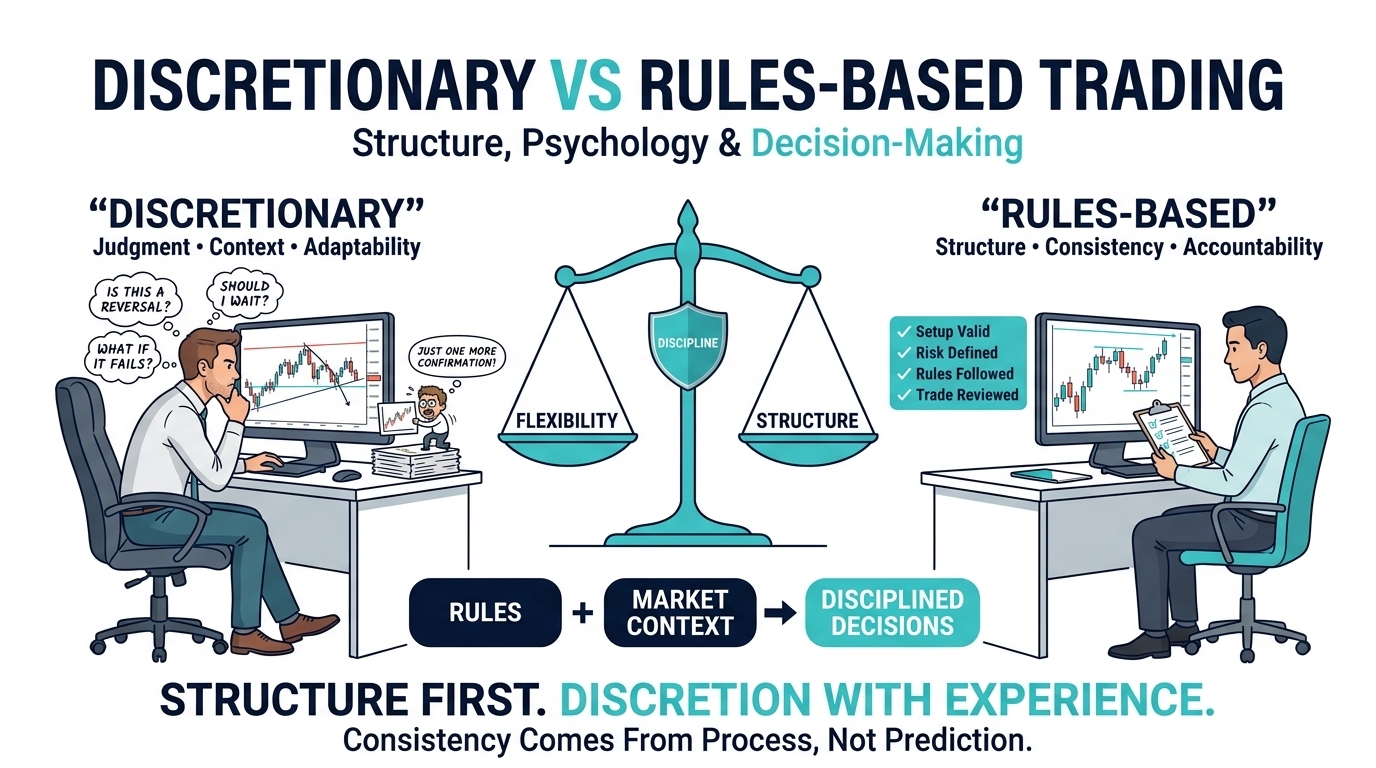
Most traders don’t fail because they chose the wrong strategy. They fail because they picked the wrong decision framework
At the heart of this issue is one key question
Should you trade using discretion, or should you follow a rules-based trading system?
Understanding discretionary trading vs. rules-based trading is key to staying steady, lasting, and in control, especially when the Forex and CFD markets are all over the place.e
This guide explains both methods in a straightforward, sincere, down-to-earth way, without exaggeration or dogma.
What Is Rules Based Trading?
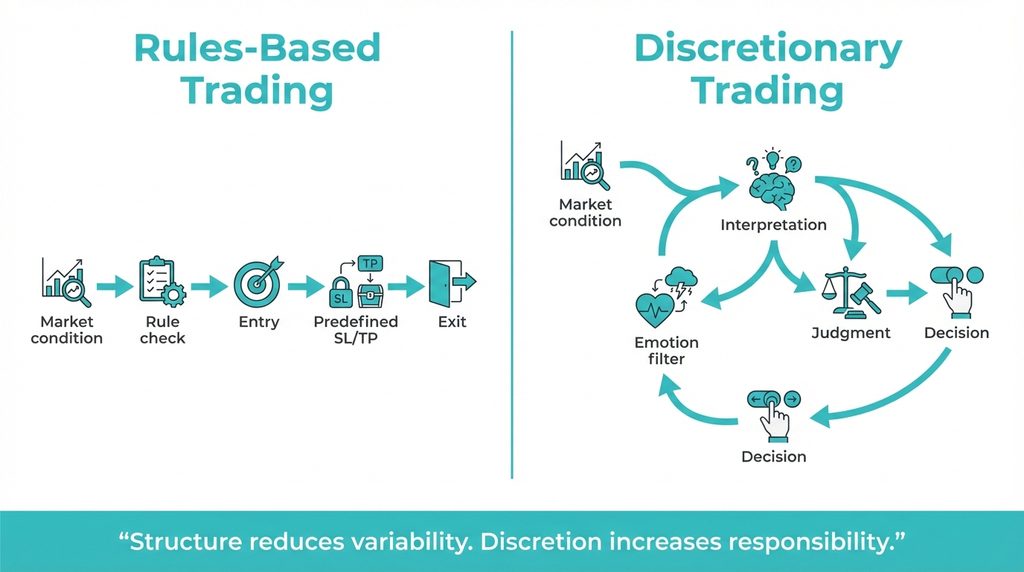
A rules-based trading system means clear rules define every trading decision.
Written rules govern entries, exits, stop-loss placement, position size, and trade filters. The trader’s role is to execute orders, not guess their meaning. This structure lets you review, measure, and repeat trades across large samples, which is why a rules-based trading system aligns naturally with Trading Performance Explained.
Core Characteristics of Rules-Based Trading
- Fixed entry and exit criteria
- Predefined risk per trade
- Consistent position sizing
- Repeatable execution
- Results measured over large samples
Rules-based trading systems reduce emotional noise and improve execution consistency. They also boost journaling’s effectiveness, as detailed in the Trading Journal Guide.
What Is Discretionary Trading?
Discretionary trading relies on human judgment and interpretation.
The trader bases their choices on the market situation, layout, how prices move, and what they’ve learned, often without rigid predefined rules.
Being careful can help you adjust, but it can also introduce personal opinions. It’s tough to separate talent from prejudice without tracking performance. That’s why discretionary trading needs structured reviews, like those in R-Multiple Trading Explained.
Core Characteristics of Discretionary Trading
- Context-driven decisions
- Flexible trade selection
- Greater reliance on experience
- Adaptability to changing conditions
- Higher emotional involvement
- Discretionary trading can make a real difference, but it depends on self-control and discipline.
Discretionary Trading vs Rules-Based Trading — Clear Comparison
The key difference between discretionary trading and rules-based trading lies in how traders make, execute, and evaluate decisions. Rules-based traders prioritize predefined criteria and repeatability, while discretionary traders rely more on market interpretation, experience, and flexibility. Both approaches have strengths and limitations, especially around risk management, trading psychology, and execution consistency.
Rules-Based Trading
- Objective decision-making
- Easier to backtest and review
- Lower emotional load
- Better for beginners
- Easier performance tracking
Discretionary Trading
- Subjective interpretation
- Harder to measure statistically
- Emotionally demanding
- Requires experience
- More vulnerable to bias
Neither method is automatically better. A trader’s self-awareness, discipline, and review process drive success. This behavioral difference closely aligns with trading psychology.
Why Beginners Struggle With Discretionary Trading
Most beginners believe discretion gives them freedom.
In reality, it often gives them confusion.
Without rules, every setup feels tradable, losses feel personal, confidence fluctuates wildly, and discipline collapses under pressure.
That’s why many traders who start with discretionary trading often switch to a trading system instead of refining their approach.
Rules create boundaries. Boundaries help keep things steady. Stability makes learning possible.
The Psychology Factor: That’s Where Most Traders Go Wrong
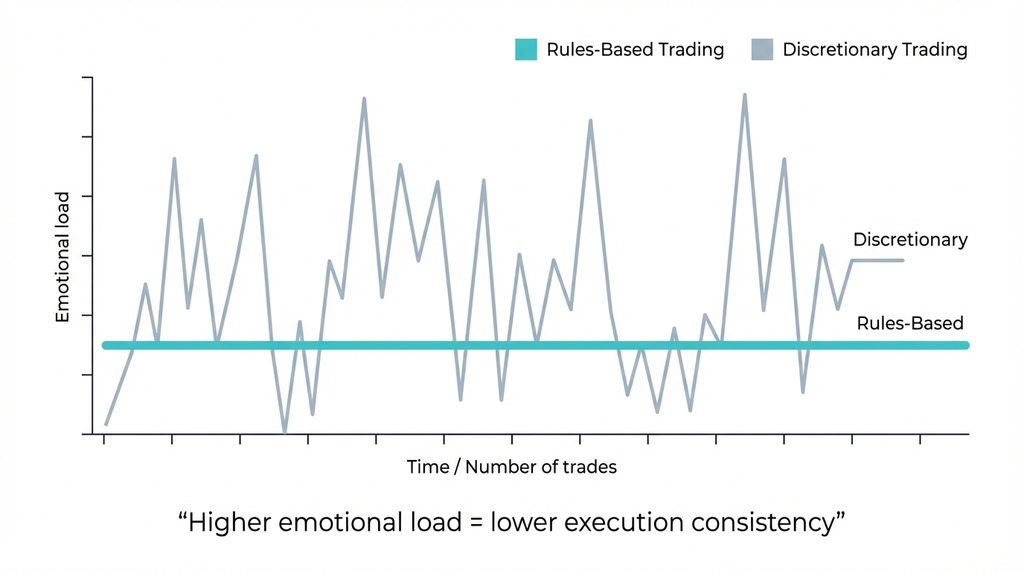
Trading success depends not only on analyzing markets but also on how traders respond to uncertainty, losses, and pressure. Discretionary trading demands greater emotional awareness because decisions rely heavily on personal judgment, while rules-based trading provides a structured framework that helps reduce impulsive reactions.
Understanding these psychological differences is essential for improving trading discipline, risk management, and execution consistency.
Discretionary Trading Risks
- Overconfidence after wins
- Hesitation after losses
- Confirmation bias
- Inconsistent risk application
Rules-Based Trading Benefits
- Reduced decision fatigue
- Fewer impulsive trades
- Stable execution under stress
- Easier emotional regulation
- Rules do not remove emotion — they contain it and improve consistency in execution.
Backtesting, Forward Testing & Accountability
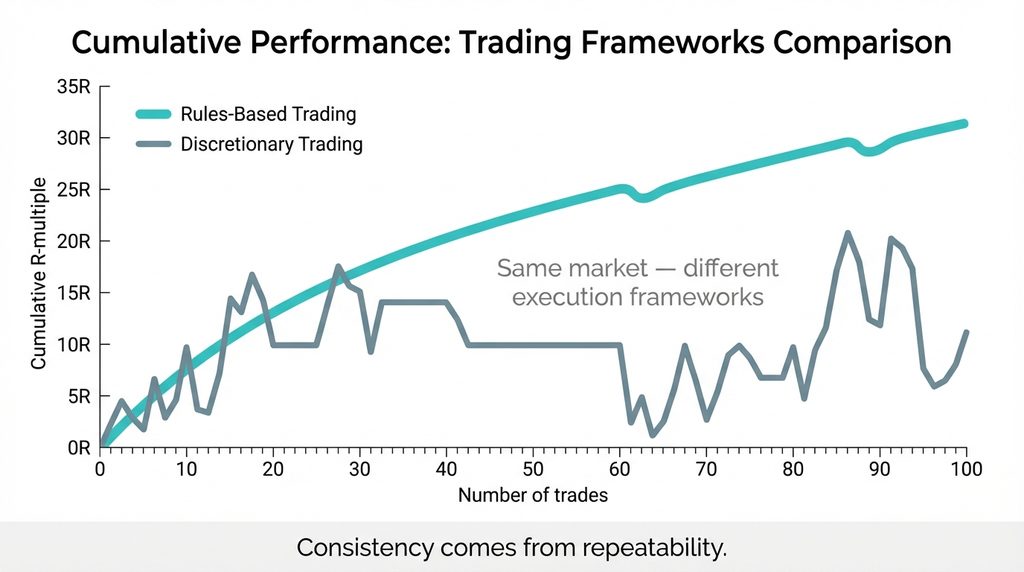
A rules-based trading system allows structured backtesting on historical data, live testing, and statistical performance reviews.
Discretionary trading makes this harder since decisions can change with mood and context, and it’s tough to repeat the same moves or pinpoint errors.
If you can’t measure your choices within a structured decision framework, it’s more like shooting in the dark than doing smart engineering.
That’s why both styles hinge on keeping a trading journal and doing a structured review.
The Hybrid Approach: How the Experts Really Trade
Most professional traders do not operate at extremes.
They follow a rules-based trading system for execution and risk, and use discretionary trading for context and filtering.
For example:
- Rules define when a trade is valid.
- Discretion decides whether today’s environment supports participation.
- This hybrid model blends structured trading systems with flexibility. It also helps maintain execution consistency.
Which Approach Is Right for You?
Choosing between discretionary trading and rules-based trading depends on your experience, trading style, emotional discipline, and ability to make consistent decisions under pressure. While rules-based trading offers structure and clear guidelines, discretionary trading provides greater flexibility to adapt to changing market conditions.
The right approach aligns with your strengths, supports effective risk management, and lets you measure and improve your trading performance over time.
Rules-Based Trading Is Better If You
- Are a beginner
- Struggle with emotions
- Want consistency
- Prefer structure
- Trade part-time
Discretionary Trading Fits Better If You
- Have significant screen experience
- Understand market structure deeply
- Can control emotions under pressure
- Keep detailed journals
- Accept accountability
Honest self-assessment matters more than ambition. Many traders underestimate how much trading psychology affects their performance.
Common Mistakes Traders Make
- Jumping to a conclusion too early
- Over-optimizing rules instead of executing them
- Switching styles after short losing streaks
- Confusing flexibility with lack of discipline
Consistency comes from process, not cleverness. Traders who jump from one trading system to another too often mess up their own data.
Conclusion — Discretionary Trading vs. Rules Based Trading
The debate between Discretionary Trading vs Rules-Based Trading often misses one truth:
- Traders don’t fail because of their approach.
- They fail because their decision framework lacks structure.
- Rules give you a foundation.
- Discretion earns its place over time.
The aim is to build measurable, reviewable decision-making that improves execution consistency.








