


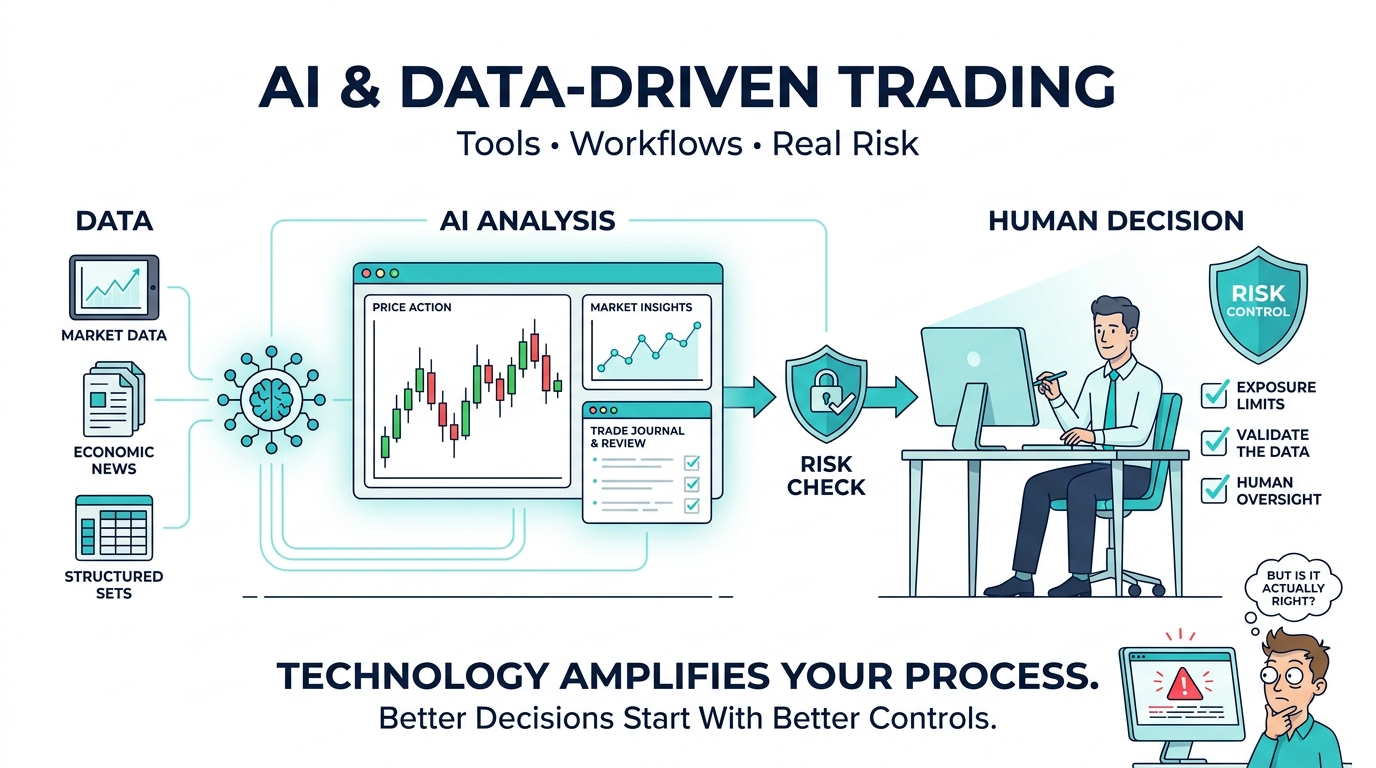
AI and Data Driven Trading for Forex and CFDs is super popular these days, but many people get it wrong when they expect it to work.
They think “better tech” equals “better outcomes.” But tech doesn’t eliminate the guesswork. It reduces resistance, and when friction disappears, both good execution and bad mistakes happen faster.
The purpose of this parent guide is simple: to give traders a clear map of what AI and data-driven tools actually do, where they fail, and how to integrate them into a workflow that protects capital.
You don’t need automation to turn a profit, but without risk structure, AI often accelerates losses rather than reducing them.
This guide also links the complete learning journey with the supportive child lessons below, allowing traders to dive deeper when they need to
What AI and Data Driven Trading for Forex and CFDs Really Means
AI & Data-Driven Trading for Forex and CFDs isn’t just about driving. A range of strategies and processes can help traders manage information, test ideas, and stick to their game plan. In simpler terms, this means using AI to structure thinking, review behavior, and reduce bias.
- Applying data analysis to check ideas before putting money on the line
- Analyzing sentiments to grasp big-picture stories and spot potential risks
- Using APIs and automation to reduce execution errors and enforce rule-based systems.
- Implement ethical and governance checks to ensure AI doesn't become a hidden risk.
If you want the foundation that explains what AI can and cannot do before going deeper, start here: AI Trading Explained.
The Core Principle That Keeps Traders Safe
AI and data-driven trading tools can help traders analyze market conditions, identify patterns, and support decision-making. However, even advanced technology cannot eliminate uncertainty or guarantee profitable outcomes.
The key is to use AI as a support tool while keeping control of trading decisions, risk management, and execution. Tools support decisions. They must never replace responsibility.
Overreliance on AI can lead to excessive confidence, overtrading, inadequate risk assessment, and unquestioning trust in automated signals. Maintaining human oversight is essential to responsible Forex and CFD trading.
This is why a process-oriented trading mindset matters more than relying on platform features alone. Understanding how to evaluate decisions, manage risk, and maintain discipline is fundamental to using trading technology responsibly. These principles are explored further in Process Oriented Trading.
AI and data-driven trading can improve how financial information is processed, but advanced technology also introduces risks that require careful oversight. Research from the Bank for International Settlements (BIS) examines the opportunities and challenges associated with artificial intelligence in financial and economic systems. For Forex and CFD traders, this reinforces the importance of understanding model limitations, independently validating data and maintaining appropriate risk controls rather than assuming that more sophisticated technology guarantees better trading outcomes.
Where AI Helps Forex and CFD Traders Most
AI is most useful when it improves structure, reduces bias, and strengthens reviews. Top-notch use cases usually cluster into four main areas
1) Analysis Structure and Scenario
Clarity: AI helps traders organize macro narratives, compare scenarios, and stress-test logic before execution. It boosts clarity, not forecasting. ing If you’re using AI for written reasoning, trade planning, and review, the most practical guide is ChatGPT Trading Explained.
2) Chart Interpretation as a Second Opinion
AI can describe market structure from a static chart image and reinforce objectivity, but it cannot see live liquidity, broker flow, or intent. It’s ideal when it’s all about describing, and the trader calls the shots. hots For the safe workflow and boundaries, use AI Chart Analysis for MT4 & cTrader.
3) News, Macro, and Risk Context Filtering
Forex and CFD markets usually shift based on expectations, not just the news. AI sentiment tools help traders understand narrative tone and risk-on/risk-off conditions so they avoid trading into chaos.
For the full sentiment framework, read AI Sentiment Analysis for Trading.
4) Behavioral Review and Journaling
One of AI's most underrated advantages is its ability to help traders summarise journals, spot behavioral patterns, and turn vague emotions into objective rules. This builds self-control and reduces repeated mistakes.
The Data Side of “Data-Driven Trading”
Data-driven trading isn’t just about crafting intricate models, validating ideas, and understanding risk mathematically before putting money on the line
Python and Research Workflows
Python’s great for crunching market data, testing strategies, and making sure they work as planned.d This can show us where a plan might break, where we see a bunch of drops, and how we expect things to change in different tri.es. Python can also increase the risk of overfitting if traders get too aggressive with their optimization.
If you’re looking for a solid rundown of what Python can and can’t do for forex trading, check out: Python for Forex.
Automation and APIs: Execution Power With Real Danger
Automation isn’t just a tool; it can intensify execution. APIs let traders connect their strategies to brokers, so they can manage orders, stop-losses, trade sizes, and track everything automatically. This keeps things consistent and reduces mistakes, but it removes the natural breaks in the flow.w When automation’s done poorly, it’s like a domino effect; mistakes just snowball quicker
For the clean breakdown of how APIs work and how traders avoid blowing up from speed, use: Trading API Explained.
AI Trading Agents: When AI Meets Workflow Design
AI trading agents combine multiple steps data intake, context evaluation, risk validation, execution checks, order placement, monitoring, and human override. This isn’t a robot. It’s about managing workflows.
Agents can become risky when traders don’t assess risks, set limits, or use a safety stop. A system that can’t keep itself in check will eventually harm the account.
For the full agent workflow and required guardrails, read: AI Trading Agents Explained.
Ethics and Governance: Part Traders Ignored Until It Hurt
The biggest failures in AI trading are often ethical failures in disguise: hidden risk, black-box decisions, automation bias, and accountability gaps. Ethics really matters ’cause it pushes traders to think about the big questions that keep us all safe.
- Do I understand the logic?
- Can I audit a losing decision?
- Do I control risk independently of the model?
- Can I stop the system instantly?
For the full ethical framework on bias, transparency, drift, and accountability, use: Ethical Issues of AI in Trading.
A Safe AI & Data-Driven Workflow for Forex & CFDs
The aim isn’t to use every tool available. The aim is to create a process where tools enhance performance without raising the risk of unseen vulnerabilities
Step 1 — Human Analysis First
Make sure you do your own analysis and lay out your trade idea clearly before you start using any tools. Keeping the thinking in-house
Step 2 — AI’s Role: Challenger, Not Just a Checker
Use AI to stress-test: check your assumptions, point out what you might’ve missed, and consider other outcomes. Avoid “tell me if this trade is good.”
Step 3 — Data Validation Before Confidence
Make sure to use Python or backtesting to check if your concept works well over a significant number of trials
Step 4 — Risk Rules Before Automation
If automation’s in the mix, make sure to set up risk limits like a boss: cap the daily loss, limit open trades, set correlation caps, have a time-based kill-switch, and keep a manual override handy
Step 5 — Take A Closer Look At Actions, Not Just The Numbers
Use AI to summarise journals, detect repeated mistakes, and convert emotional errors into objective rules.
If you’re looking for the risk foundation that supports everything above, drop in the platform learning layer here VARIANSE Risk Management Guide and VARIANSE trading account page.
Common Mistakes Traders Make With AI & Data-Driven Trading for Forex and CFDs
The same old hiccups keep popping up in nearly every tool:
- Using AI outputs as signals
- Treating confident language as accuracy
- Overfitting backtests until they look perfect
- Automating execution before proving manual consistency
- Ignoring correlation exposure and total risk caps
- Believing technology can replace discipline
Conclusion — AI and Data Driven Trading for Forex and CFDs
AI and data-driven trading can make traders more consistent, more objective, and more risk-aware but only when used within strict limits. The edge does not come from automation or models. It comes from disciplined process, controlled risk, and behavior that survives uncertainty.








