


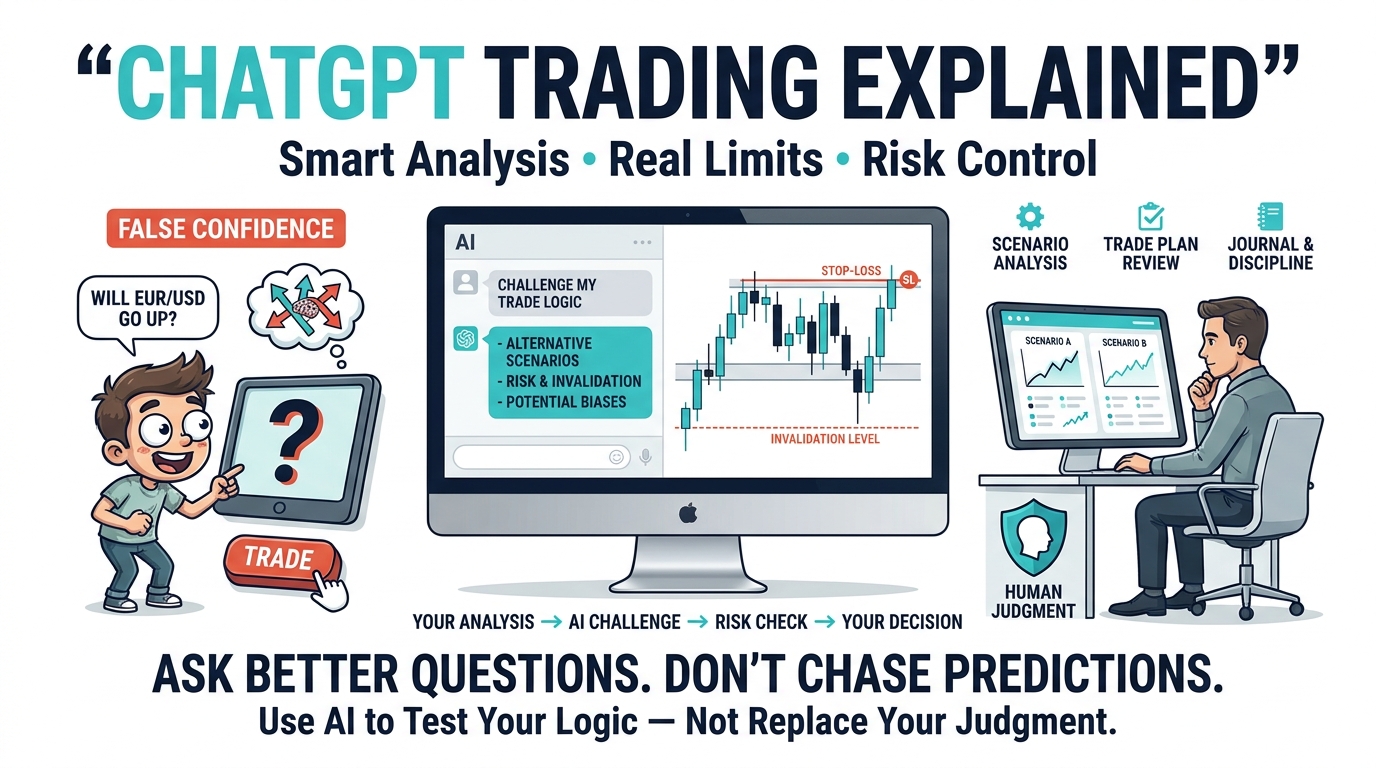
The ChatGPT trading scene has been booming, especially among forex and CFD traders looking for an edge. Some believe AI can predict markets, while others fear it will replace human traders.
The reality sits firmly in the middle.
Used properly, ChatGPT can sharpen your AI trading analysis, organize your decision-making, and reduce emotional errors. Used incorrectly, it can make you feel like you’re on top, overtrade, and speed up the money going down. ChatGPT does not remove uncertainty from markets. Traders’ thinking gets shuffled around, but it doesn’t change price action.
This guide breaks down what ChatGPT can and can’t do in trading, and shows how disciplined traders actually use it.
What ChatGPT Actually Is (And Why That Matters for Trading)
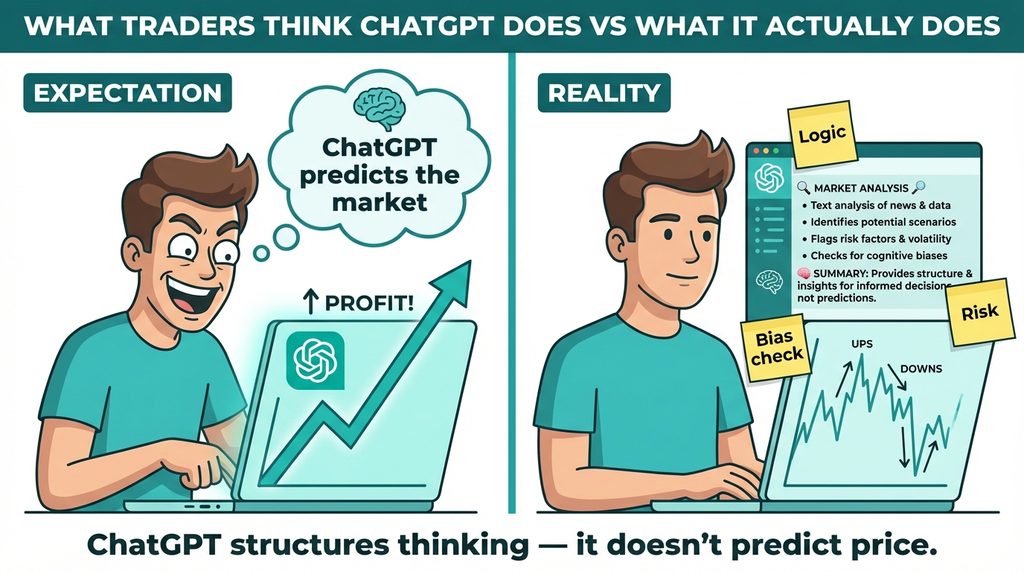
ChatGPT’s a language model, not a stock trading tool or a crystal ball for forecasts. It does not:
- See live prices
- Access broker feeds
- Read order flow
- Predict market direction
- Execute trades
It does:
- Process written information
- Structure complex ideas
- Explain financial concepts clearly
- Highlight logical inconsistencies
- Assist traders in analyzing their own reasoning
Treating ChatGPT like a signal generator is somewhat risky. If you treat it as a helpful analytical buddy for AI trading analysis, it can be pretty handy.
What ChatGPT Can Assist With in Forex & CFD Trading
ChatGPT can help Forex and CFD traders organize market research, understand trading concepts, and develop a more structured analysis approach. From explaining technical indicators to reviewing trading plans and identifying potential risk factors, it can support more informed decision-making.
However, use ChatGPT as an analytical assistant, not a source of guaranteed trading signals or financial predictions. Its responses may be inaccurate or based on outdated information, so traders should independently verify market data and maintain control over their trading decisions.
Structuring Market Analysis
ChatGPT helps organize thoughts before execution. Traders frequently employ it for ChatGPT market analysis.
- Break down macroeconomic themes
- Compare bullish and bearish scenarios
- Map alternative outcomes
- Stress-test trade logic
- Clarify invalidation points
This is especially useful for traders who struggle to stay clear-headed or let gut feelings sway them when they’re about to jump into trades.
Improving Risk & Trade Planning
ChatGPT can support planning in trading with AI by helping traders:
- Define entry, stop-loss, and invalidation logic
- Calculate R-multiple scenarios
- Identify emotional triggers before execution
- Clarify conditions for “no trade” decisions
It does not choose trades. It helps traders think more structurally about them.
Trading Journals & Post-Trade Reviews
One of ChatGPT's highest-value uses in trading is behavioral analysis. It can:
- Summarise journal entries
- Detect recurring behavioral mistakes
- Highlight discipline breakdowns
- Translate emotions into actionable rules
This strengthens long-term consistency and backs up the behavioral discipline talked about in Process Oriented Trading.
What ChatGPT Cannot Do (And Never Will)
ChatGPT can support trading research and analysis, but traders must understand its important limitations before relying on its responses. It cannot guarantee accurate market forecasts, account for every factor driving price movements, or replace real-time market data and professional risk assessment.
Understanding these limitations helps Forex and CFD traders avoid overconfidence, verify AI-generated information, and maintain control over their trading decisions. It cannot predict price.
Markets move because of:
- Liquidity flows
- Institutional positioning
- Policy and interest-rate shifts
- Human behavior and sentiment
- Sudden volatility expansions
ChatGPT does not see these in real time. Anyone claiming AI in trading “Predicts Forex” is selling certainty, not probability.
It Cannot Replace a Trading Edge
A trading edge is built through:
- Repetition
- Risk control
- Statistical expectancy
- Discipline under pressure
AI in trading can support a structure. Experience gained from facing losses, learning from them, and refining our behavior can’t be substituted by anything; it’s the same kind of endurance we talk about in Trading Resilience.
ChatGPT Trading vs Algorithmic Trading and Institutional AI
ChatGPT, algorithmic trading systems, and institutional AI serve different purposes. While ChatGPT can support market research, explain trading concepts, and help structure decisions, algorithmic systems execute predefined instructions.
Specialized institutional AI may go further by analyzing complex market data, supporting execution, and automating certain risk-management processes.
| ChatGPT for Retail Traders | Algorithmic & Institutional Trading Systems |
|---|---|
| Text and research analysis | Market microstructure modelling |
| Trading scenario development | Order-flow analytics |
| Decision-making support | Algorithmic execution |
| Trading journal analysis | Integration with real-time market data feeds |
| Trading plan development | Automated risk monitoring |
| Market concept explanations | Quantitative modeling and strategy testing |
Institutions use AI in trading primarily for execution efficiency and risk control, not directional guessing. Retail traders really get the most out of ChatGPT trading when it helps them make better choices, not just faster ones.
Key distinction: ChatGPT is primarily a general-purpose analytical assistant, while algorithmic trading systems are designed to follow programmed rules. Some institutional systems also use AI and machine learning to analyse data, support execution and manage risk.
Why So Many Traders Flop With ChatGPT (Hard Truth)
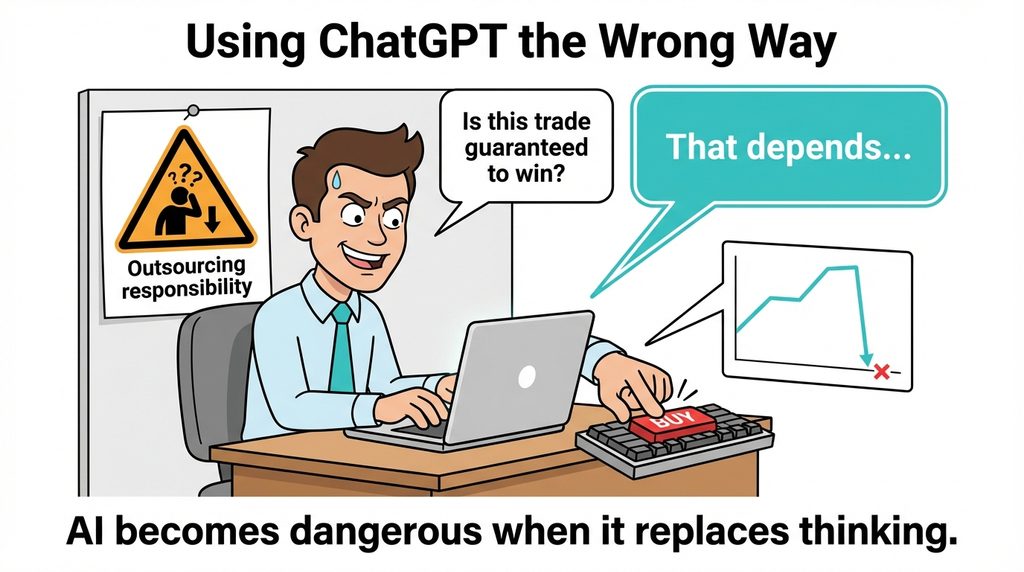
The problem is rarely AI itself. The problem is that traders are attempting to:
- Outsource responsibility
- Avoid uncertainty
- Skip the learning curve
- Seek validation instead of discipline
Using ChatGPT for trading requires independent judgement, particularly when evaluating AI-generated market analysis or trading recommendations. FINRA's investor guidance on artificial intelligence and investment fraud highlights the risks of misleading AI-related investment claims. Forex and CFD traders should independently verify market information, question unrealistic performance promises and maintain predefined risk management rules rather than relying solely on AI-generated responses.
ChatGPT trading can get risky when traders stop questioning logic and start asking
“Is this trade good?”
instead of
“Is my reasoning structured and risk-controlled?”
This kind of shift in behavior often reflects the overconfidence patterns we see in trading, like those discussed in the article Overconfidence in Trading.
Safe & Effective ChatGPT Trading Workflow
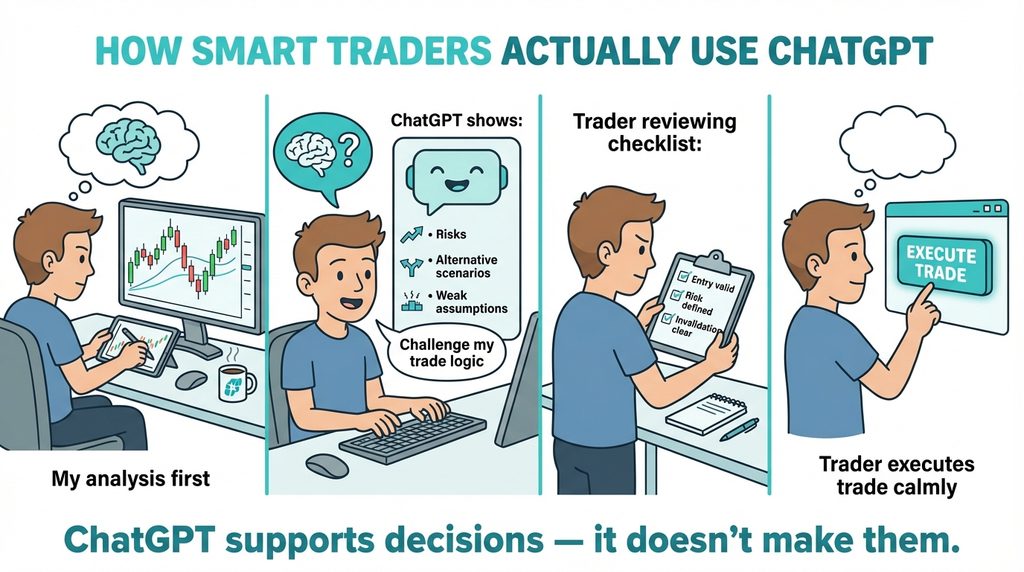
Using ChatGPT in Forex and CFD trading requires a structured approach that combines AI-assisted analysis with independent verification and disciplined risk management.
Instead of relying on AI-generated signals or predictions, traders should use ChatGPT to organize research, evaluate scenarios, and identify risks before deciding.
A clear workflow can reduce emotional decision-making, prevent overreliance on AI, and keep trading decisions guided by a predefined strategy rather than automated suggestions.
A Practical, Low-Risk Process
A structured workflow reduces behavioral risk in trading with AI:
- Conduct an independent ChatGPT market analysis first
- Ask ChatGPT to challenge your logic
- Compare alternative scenarios
- Define risk and invalidation clearly
- Execute decisions independently
- Review results behaviourally, not emotionally
- Reality Check: Not to say that being confident with your words means you’re always right in the market
- Language fluency is not predictive of power.
Example Prompts Traders Actually Use
Effective prompts improve AI trading analysis rather than price direction:
- “Challenge the bearish thesis for EUR/USD based on macro factors.”
- “Spot flaws in this trade strategy from a risk perspective.”
- “Summarise my last 20 trades and highlight behavioral mistakes.”
- “Let’s rephrase this trading guideline to make it more straightforward and impartial.”
Strong prompts improve the quality of thinking, not signal generation.
ChatGPT, Bias & False Confidence
ChatGPT reflects:
- User assumptions
- Language framing
- Embedded bias
- Question structure
When questions point a certain way, answers often back those ideas up.
Disciplined traders use AI in trading to disagree with them, not validate them a behavioral safeguard aligned with Trader Burnout & Overtrading.
Conclusion: ChatGPT Trading Explained
ChatGPT can be a useful tool for Forex and CFD traders, but its value lies in supporting better decision-making rather than predicting market movements or guaranteeing profits.
Traders should not rely on ChatGPT as:
- A guaranteed trading signal generator
- A reliable price prediction engine
- A shortcut to profitability
Instead, it can serve as:
- A thinking partner to explore trading scenarios
- A journaling assistant to review trading decisions
- A logic stress-tester to identify weaknesses in trading plans
- A behavioral mirror to recognize emotional patterns and potential biases
AI-assisted trading analysis cannot guarantee profitability. However, when used responsibly, ChatGPT can help traders develop greater clarity, strengthen discipline, and improve self-awareness.
The goal is not to let AI make trading decisions for you, but to use it to make your own decision-making process more structured and informed.








