
If you’ve ever been curious about how traders automate their trades, handle several positions at once, or link charts to their trading systems, it’s typically through a trading API.
A trading API (Application Programming Interface) is a bridge between your trading logic and your broker AP. Using a trading API, software can automatically handle buying and selling, keep an eye on market info, set up trades, manage risks, and keep track of all the deals.
Api trading for Forex and CFD traders isn’t just about making money quicker. They focus on accuracy, uniformity, and cutting down mistakes made by people.
This lesson breaks down the ins and outs of trading API, showing where they shine and where they stumble, and how savvy traders harness trading automation without sacrificing control.
Trading API vs Manual Trading — What Actually Changes?
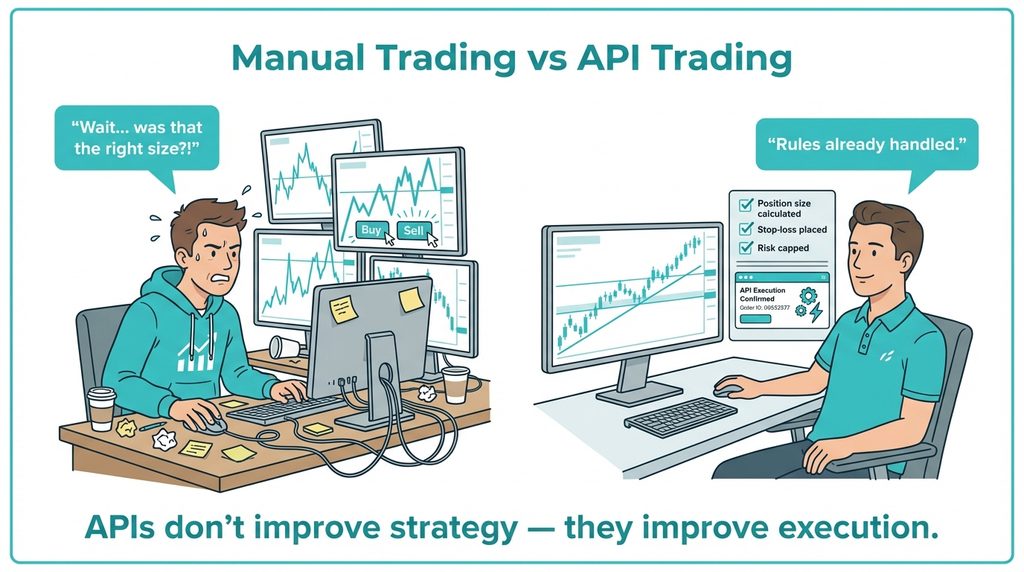
Manual trading and API trading differ primarily in how trading decisions are executed, monitored and recorded.
Manual Trading Relies On:
- Visual analysis: Interpreting charts and market conditions
- Manual execution: Placing trades directly through a trading platform
- Human judgement: Making decisions that may be influenced by emotions
- Experience and memory: Applying previously learned trading strategies
API Trading Relies On:
- Predefined rules: Establishing conditions for trade execution
- Programmatic execution: Sending orders automatically through a trading API
- Repeatable workflows: Applying consistent trading procedures
- Automated logging: Recording trading activity for performance analysis
Automation does not automatically improve a trading strategy. Its main advantage is the potential for more consistent execution and reduced manual intervention.
A properly configured API trading can help:
- Execute entries: Submit orders when predefined conditions are met
- Manage stop-losses: Place protective orders according to programmed rules
- Calculate position sizes: Apply predefined risk parameters consistently
- Record trades: Maintain systematic trading records for review
However, execution remains subject to latency, slippage, market liquidity and technical failures.
This structured approach supports the principles explored in Process-Oriented Trading.
Key takeaway: Trading APIs can improve execution consistency, but they cannot guarantee better trading results or eliminate market risk.
How Trading APIs Actually Work (Simple Breakdown)
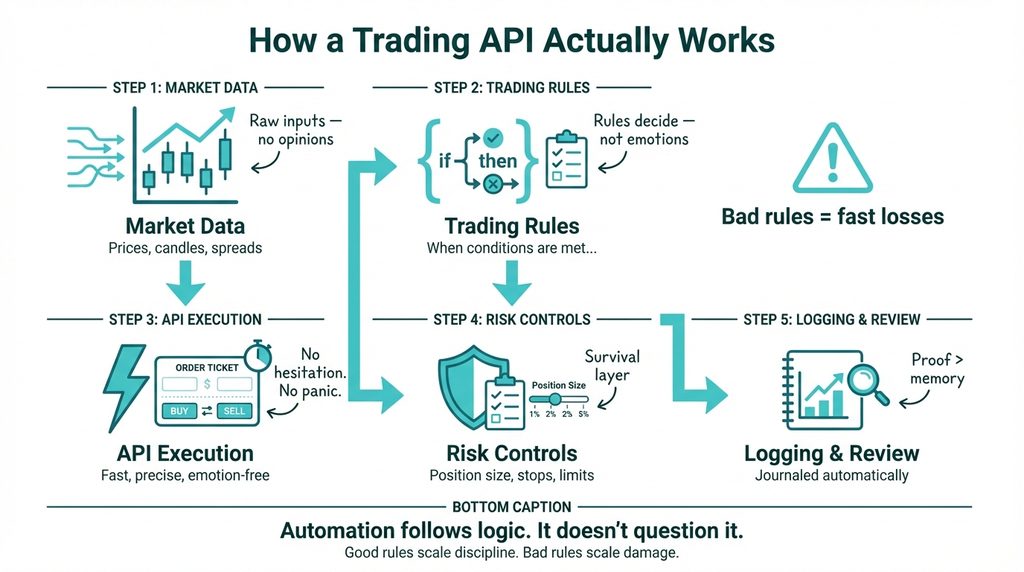
A trading API connects trading software with a broker or trading platform, allowing supported market data, orders and account information to be exchanged programmatically.
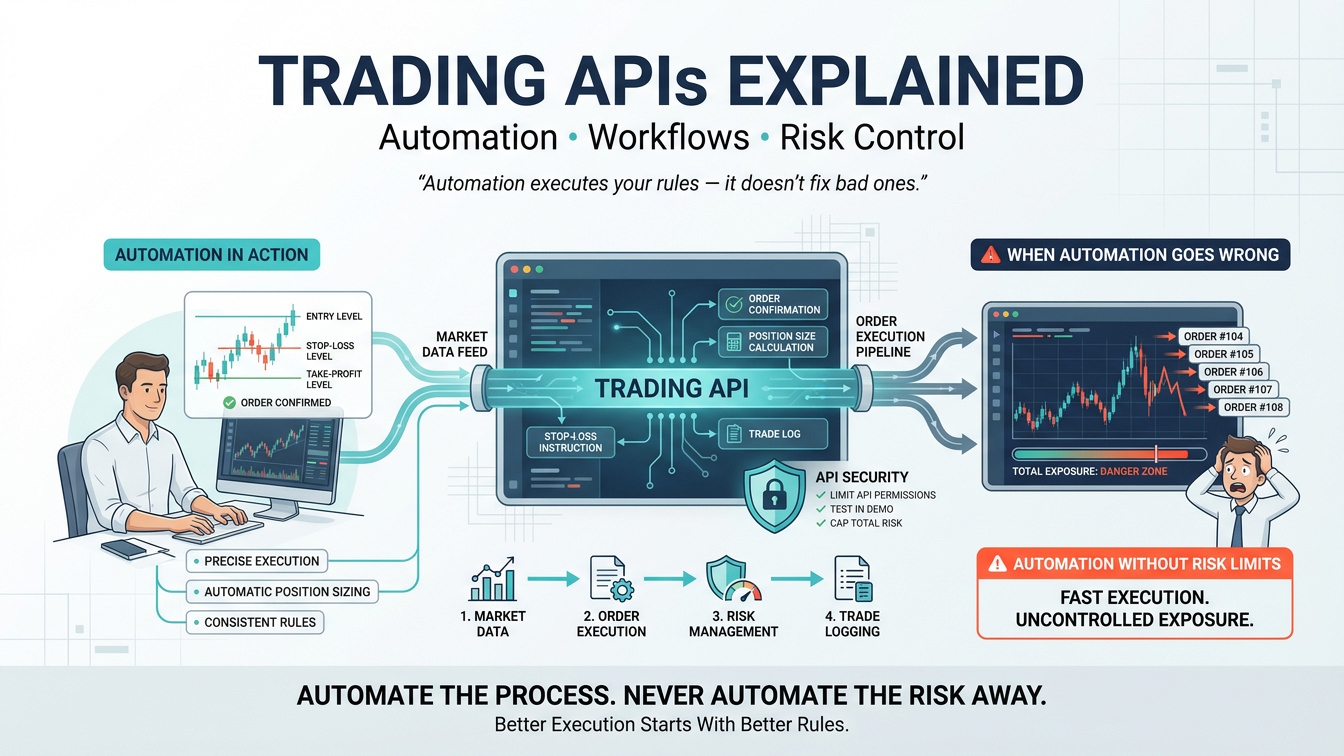
Depending on the trading API and its configuration, it can support four core functions:
1. Market Data Access
A trading API can retrieve:
- Live market prices: Available bid and ask quotes
- Candlestick data: Historical and current price movements
- Spreads and liquidity information: Available market data, where supported
This information supports market analysis and automated trading decisions. However, faster data access does not guarantee better decisions.
2. Order Execution
When predefined conditions are met, a trading API can submit:
- Market orders
- Limit orders
- Stop-loss and take-profit orders
Automated execution reduces manual intervention and can improve consistency. However, orders remain subject to latency, slippage, liquidity and execution conditions.
3. Risk & Position Management
A properly configured trading workflow can help:
- Calculate position sizes based on predefined risk limits
- Control exposure by applying maximum risk parameters
- Prevent duplicate orders through programmed safeguards
However, automation cannot eliminate trading losses. Poorly designed rules can increase risk or repeat costly mistakes.
Understanding drawdowns and account exposure is essential, as explored in Equity Curve Management.
4. Logging & Monitoring
A trading API can support automated recording of:
- Entry conditions: Why a trade was triggered
- Risk parameters: Position size and predefined exposure
- Exit conditions: How and when positions were closed
- Trade results: Execution details and profit or loss
These records support trading journals, performance reviews and the identification of recurring mistakes.
Key takeaway: A trading API can improve workflow consistency and reduce manual tasks, but its effectiveness depends on the strategy, system design and risk controls behind it.
Real-World Example — When Trading Automation Goes Wrong
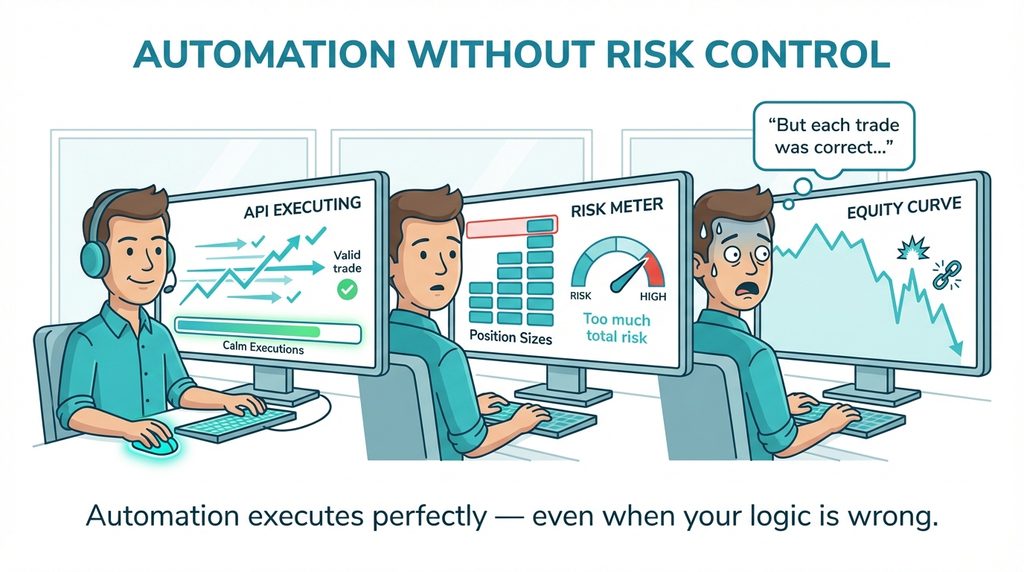
A common account-destroying mistake:
- A trader sets up a trading automation system to automatically execute trades, but overlooks setting a limit on how much they can lose.
- During periods of high volatility, the trading API places multiple valid orders within seconds.
- Individually, each trade is acceptable.
- Collectively, they exceed total risk control limits.
Result:
- Perfect execution
- Terrible survival math
- Trading automation without boundaries speeds up the rate of loss — the same kind of overreach in trading behavior that’s talked about in the link Overconfidence in Trading.
REST APIs vs WebSocket APIs — What Traders Need to Know
Trading APIs use different communication methods depending on the platform and its capabilities.
REST APIs
- Request-based communication: Software sends requests and receives responses
- Account management: Commonly used to retrieve balances, positions and order history
- Order execution: Can support submitting, modifying and cancelling orders
WebSocket APIs
- Real-time streaming: Receive continuous price and market updates
- Lower update delays: Reduce the need to repeatedly request new data
- Live monitoring: Useful for tracking market conditions, orders and account activity
Key takeaway: REST and WebSocket APIs serve different purposes. Many trading systems use both, depending on the broker's infrastructure and available features.
Trading APIs Are Not Algorithmic Trading Strategies
A trading API connects software to a trading platform. An algorithmic trading strategy defines the rules used to make trading decisions.
The API itself does not create a profitable trading advantage.
If a strategy involves:
- Overtrading: Executing too many unnecessary trades.
- Poorly defined rules: Entering positions without clear conditions.
- Inconsistent risk management: Applying unsuitable position sizes or exposure limits.
- Unreliable signals: Acting on strategies without sufficient testing.
Automation may repeat these weaknesses more quickly and consistently. A more structured approach involves defining trading rules, testing their performance and evaluating risks before enabling live execution.
This supports the principles explored in Reducing Risk Trading Strategy.
Key takeaway: Automation improves how a strategy is implemented, not necessarily how well it performs.
Who Should Consider Using a Trading API?
Trading APIs can benefit traders with clearly defined strategies and the technical knowledge needed to manage automated systems.
A Trading API May Be Suitable If You:
- Follow rule-based trading strategies.
- Understand position sizing and risk management.
- Regularly review trading performance.
- Can test, monitor and troubleshoot automated systems.
A Trading API May Be Less Suitable If You:
- Frequently change strategies without testing.
- Rely heavily on emotional trading decisions.
- Ignore drawdowns or overall account exposure.
- Expect automation to generate guaranteed profits.
Key takeaway: Trading APIs are most useful when supported by clear rules, appropriate technical safeguards and disciplined risk management.
Security & Risk Controls Every Trading API Trader Needs
Connecting a trading API introduces technical and financial risks. Appropriate safeguards are essential before enabling automated execution.
Important precautions include:
- Restrict API permissions: Use read-only access where possible during initial testing
- Protect API credentials: Store keys securely and separate access permissions where supported
- Set order limits: Apply maximum order sizes and position limits within the trading system
- Test before live trading: Use demo or paper-trading environments where available
- Control total exposure: Monitor combined positions, not just individual trade risk
- Establish emergency controls: Include monitoring, error handling and a mechanism to stop automated execution
Trading API security is essential when connecting automated systems to Forex and CFD trading accounts. The OWASP API Security Project provides guidance on common API security vulnerabilities and the importance of appropriate authentication, authorisation and access controls. Traders using automated execution should protect API credentials, restrict permissions where supported and implement safeguards to reduce the risk of unauthorised access or unintended trading activity.
Important: Automated trading can execute unintended orders quickly. Technical failures, programming errors and unexpected market conditions can still result in significant losses.
How Trading APIs Fit into the Trading Process
A structured trading workflow combines market analysis, predefined rules, execution controls and ongoing performance reviews.
A typical workflow follows:
Market Analysis → Trading Rules → Risk Checks → API Order Execution → Monitoring & Trade Logging → Performance Review
Trading APIs can also integrate with:
- Risk-management systems: Monitoring exposure and applying predefined limits.
- Backtesting frameworks: Evaluating strategies using historical data.
- Performance analytics: Measuring trading results and execution quality.
- Trading journals: Recording decisions and identifying recurring mistakes.
This structured approach supports the long-term discipline discussed in Trading Resilience.
Key takeaway: A trading API is one component of a broader trading system. Consistent monitoring, testing and risk management remain essential.
Conclusion: Trading APIs Are Tools, Not Shortcuts
A trading API is not a shortcut to profitability. It is a tool that can improve execution consistency, support risk management and reduce manual intervention.
When used correctly, trading APIs can:
- Reduce manual errors through predefined execution rules
- Support risk control by applying programmed limits
- Improve consistency across trading workflows
- Strengthen accountability through automated trade logging
When used incorrectly, they can:
- Accelerate losses by repeatedly executing flawed strategies
- Reinforce poor trading habits through excessive automation
- Create false confidence in untested systems
Key takeaway: Trading automation supports disciplined execution, but it cannot replace a sound strategy, human oversight or effective risk management. Technology improves the process, not the probability of success.