


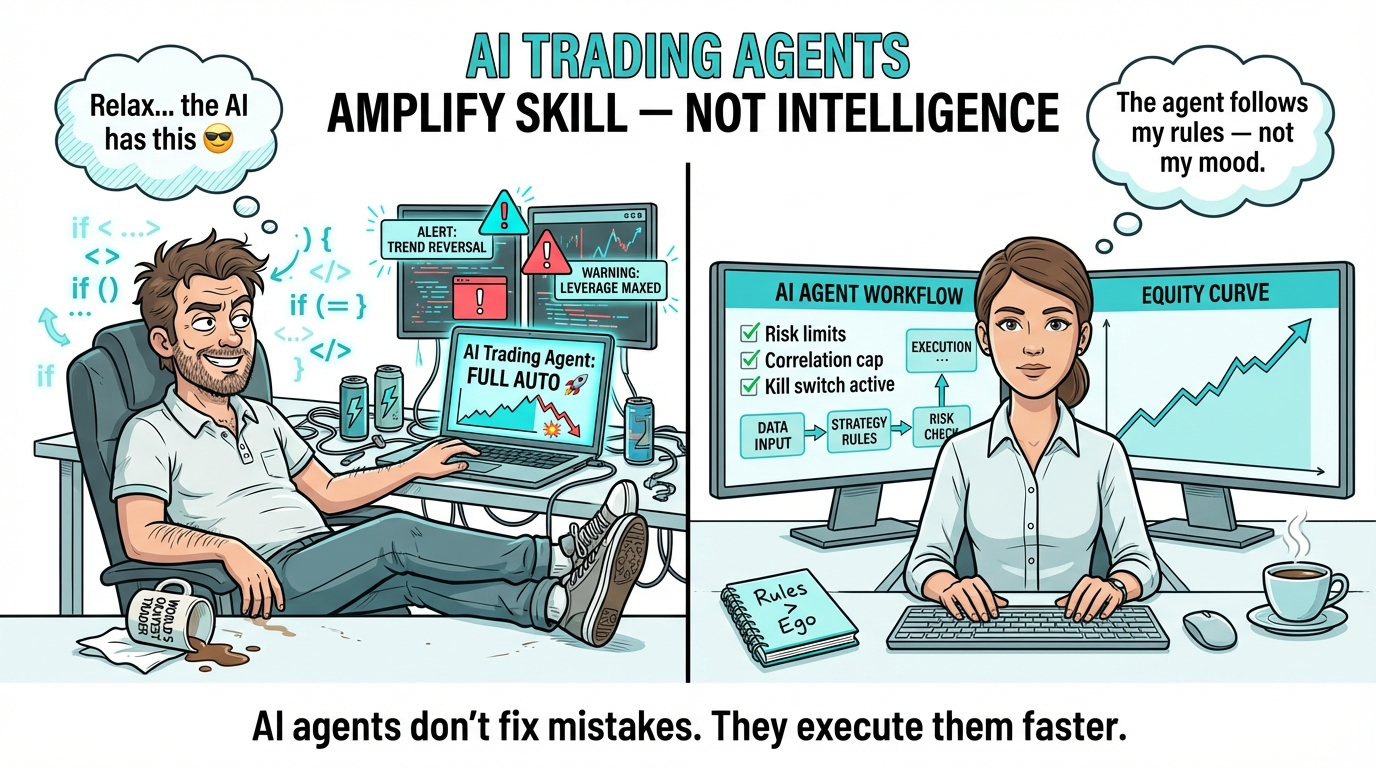
AI trading agents are rapidly becoming popular, yet most traders do not fully understand what they are, how they function, or where they fail. Many people think robots are taking over jobs that require skill. In real life, trading automation just makes our strengths and flaws more obvious. A trader who doesn’t stick to a plan tends to mess up more often, but a trader who’s got a solid strategy usually does things the same way every time.
AI trading agents are not shortcuts to profits. They are workflow systems that execute logic, enforce rules, and connect analysis to brokers through a trading API.
When used properly, they boost discipline and reduce mistakes. Unthinkingly using them can accelerate losses and give a false sense of security. Grasping this difference is more crucial than mastering any sign or tactic.
What Are AI Trading Agents (And What They Are Not)
AI trading agents are decision-making systems, not forecasting tools. They combine market data inputs, predefined logic, risk parameters, and broker connectivity through a trading API. Unlike simple bots that trigger single actions, agents evaluate multiple conditions before acting and can pause, escalate, or restrict behaviour based on rules.
But they often get things mixed up. They’re not your one-way ticket to riches, not something you can just leave on autopilot, and definitely not stand-ins for managing risks or dealing with the nerves of trading.
Most trading automation hiccups are actually due to people messing up rather than tech issues. This kind of mental twist is similar to what happens when someone gets too cocky in trading, leading them to take bigger risks than they should.
AI Trading Agents Vs Traditional Trading Bots
Traditional trading bots follow fixed instructions. They make entries or exits when a single condition is met. Their power lies in simplicity, but their downfall is inflexibility. When market conditions shift, fixed-rule bots often fail because they cannot adapt.
AI trading agents operate differently. They evaluate context, combine multiple variables, and manage workflow integration rather than operate in isolation. They can tweak their actions, hit the pause button, or activate safety measures when they’re getting hit with more stuff. The difference isn’t about being smart versus easy it’s about managing workflow integration versus doing things one step at a time.
Without psychological control, however, complexity becomes dangerous. Many traders go overboard with automation; they trade nonstop, which can burn them out, as discussed in the Trading Burnout article.
The Role of Trading API in AI Automation
A trading API is the bridge between your trading logic and the broker’s execution system. It allows software to pull live price data, place or cancel orders, monitor exposure, and automatically enforce predefined limits. Trading API cuts down on manual hassle, which boosts accuracy but also increases risk and speed.
Manual trading naturally slows decision- making. Trading API cuts down on that lag time. While this boosts how well things get done, it also means errors pop up right away if we don’t have the right protections in place.
That’s why when you use algorithmic trading without a solid exit plan, it can get out of hand, leading to risky trading sessions. This issue is tackled in the article Trading Exit Strategies.
A Real AI Trading Agents Workflow
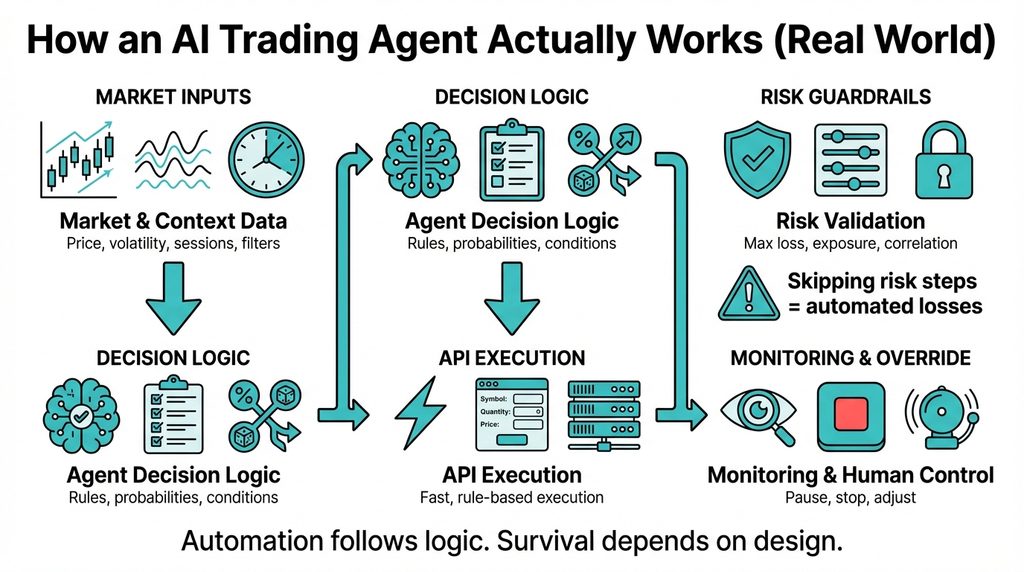
Here’s what a safe, real-world workflow looks like:
- Data intake (price, volatility, session, news filters)
- Context evaluation (trend, regime, correlation)
- Risk validation (max loss, exposure, correlation limits)
- Execution check (spread, slippage, liquidity)
- Order placement via trading API
- Post-trade monitoring
- Human override or escalation if conditions change
A safe AI trading agent's workflow is structured and sequential rather than impulsive. It kicks off with gathering info like price, how much it swings, and what kind of sessions you’re looking at.
After this, we look at the context to figure out the trend, the current government’s policies, and how things are related.
Next up, we’re making sure we’re playing it safe by sticking to the limits on how much we can lose and how much risk we’re taking on automated execution kicks off with these checks.
We hit the trading API, and after that, we keep an eye on the trades, with the option for a human to step in if needed.
Skipping risk checks or monitoring turns trading automation from helpful to harmful. Equity curve shakiness usually follows, which is discussed in Equity Curve Management.
Live Trading Risks Vs Backtesting Illusions
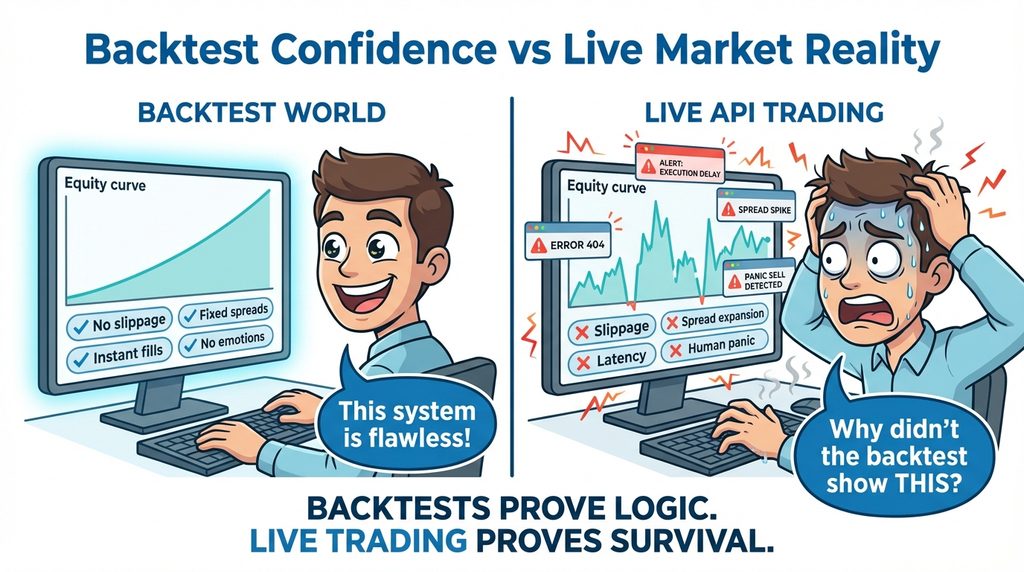
Backtesting checks logic in ideal conditions, but live trading puts it through the real-world grinder. Historical simulations often omit slippage, spread expansion, latency, partial fills, or broker execution limits. A plan that looks perfect in programming may fail in the real market.
This gap between expected and actual outcomes shows why process adherence is more important than chasing quick results. Traders who detach their sense of self from immediate gains and focus on actions rather than profits as in Process Oriented Trading adapt better to algorithmic trading systems.
Risk Guardrails Every AI Trading Agent Must Have
Trading automation without boundaries eventually harms accounts. Key risk guardrails involve daily max loss limits, trade quantity caps, exposure to market moves limits, time-triggered shutdowns, and the ability to manually control things. These systems aren’t profit-reducers; they protect the account.
NIST provides guidance on identifying, assessing and managing risks associated with artificial intelligence systems, including the importance of monitoring and human oversight.
Automation boosts efficiency but also increases risk. Long-term traders know survival mindset matters more than jumping in, as discussed in Trading Resilience.
What AI Trading Agents Cannot Do
AI trading agents cannot predict black swan events, eliminate drawdowns, replace discipline, or fix weak strategies. They don’t remove emotional risk for the trader, nor do they promise an edge. Markets remain uncertain, and automation just smooths execution, not outcomes.
Should Beginners Use AI Trading Agents
New traders can experiment with automation but should proceed slowly and with small, controlled positions. Start with paper trading, use read-only APIs, automate journaling first, and go live only after thorough testing. Discipline must precede curiosity.
Conclusion — Trading automation Rewards Structure, Not Speed
AI trading agents are powerful tools, but power without structure destroys accounts. Successful traders using trading automation aren’t the ones with the most complicated models. They’re the ones who have straightforward processes, set risk guardrails, have sensible goals, and keep a close eye on things.
Trading automation doesn’t give you an advantage. It conveys the same thing. When discipline, psychology, and risk control are already stable, AI trading agents become a consistency enhancer. When those foundations are weak, AI trading agents become a form of financial leverage against the trader.








