


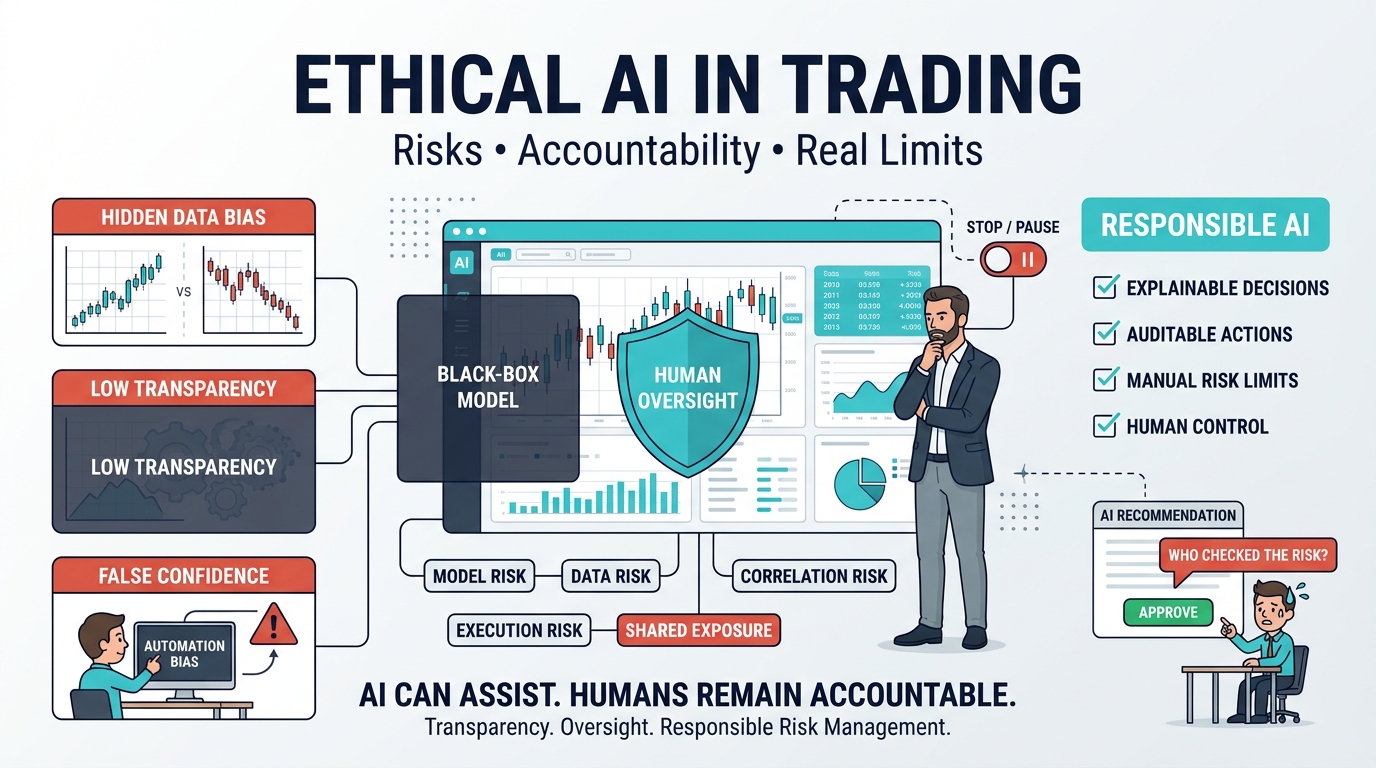
AIs are popping up everywhere in trading these days. From sentiment scanners to automated strategies and “AI trading bots,” the promise sounds simple: smarter decisions, faster execution, fewer mistakes. But here is the reality most platforms avoid saying out loud AI does not remove risk. In many situations, it piles up danger in spots traders might not monitor.
This lesson explains the ethical issues of AI in trading. Financial risk from a trader’s perspective: responsibility, transparency, hidden exposure, and real-world survivability. This isn’t just theory or hype. It’s smart for Forex and CFD traders to use today’s tech for AI trading risk management.
To ground the basics of what AI can and cannot do before you evaluate ethics, start with AI Trading Explained.
Why Ethics Matter in AI Trading More Than Performance
Most traders judge AI by one question: Does it make money? That’s not the right place to start, since trading ethics aren’t just theoretical ideas. They’re handling the fallout and taking responsibility.
Ethical AI use in trading means you can answer four uncomfortable questions clearly: who is responsible when the model fails, who bears the losses, whether the decision can be explained, and whether risk was knowingly increased without full understanding. If you cannot answer these questions, you are not using AI responsibly you are outsourcing accountability.
This is also why AI tools should sit inside a structured process rather than replace it. If you’re looking to avoid outsourcing your thinking, take another look at Process Oriented Trading.
Core Ethical Issues of AI in Financial Trading
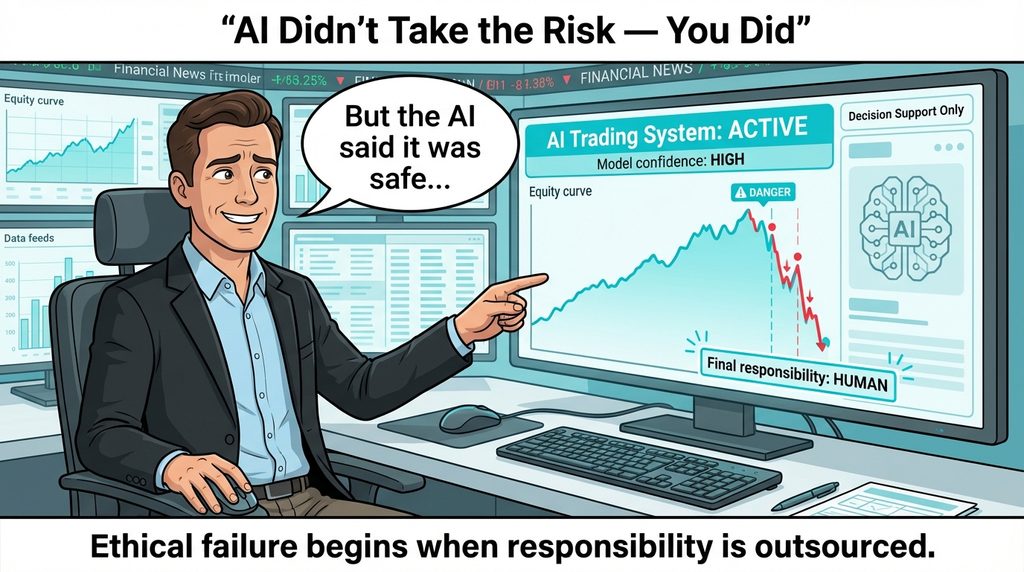
Ethical risks in AI trading usually fall into predictable categories. These problems aren’t just one-offs. They are the default failure modes when traders treat AI as certain rather than probabilistic.
Bias Hidden Inside Models
AI systems learn patterns from historical data. Markets change. Data won’t give you a heads-up when it’s no longer useful. Bias isn’t always about politics or society; it’s usually about market-regime bias.
Sometimes we mess up by training on the hottest markets, forgetting about the slow times, and making models that only work for one type of investment or market mood. When things change, the model acts like everything’s still the same as before.
That’s why traders often mix up a strategy’s past success with its actual advantage. Check out this link for a hands-on look at the difference between research and real-world trading: Python for Forex Trading.
2. Black-Box Decisions and Zero Transparency
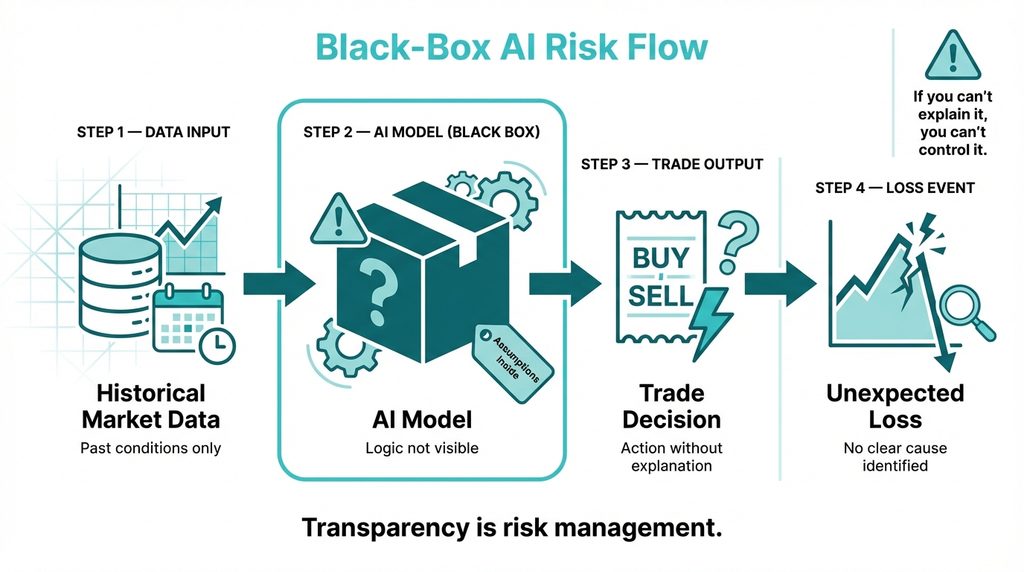
Many AI trading systems cannot explain why they took a trade. It becomes an ethical problem because not being open about things makes it hard to assess the risks.
If you can’t get the logic, you can’t check if you’re exposed, figure out what’s going wrong, or make better habits safely. Traders keep making the same error again, feeling more sure-footed because the system seemed clever, not because it was actually responsible.
Black- When automation steps in, a black box of risks becomes a bigger problem, because machines can fail faster than we can react. If you plan to connect AI to execution, you must understand the workflow risks described in: Trading API Explained.
3. False Confidence and Automation Bias
One of the most dangerous ethical issues of AI in financial risk is psychological, not technical. Traders often trust AI output more than their own risk rules. They just go with what the model says, don’t second-guess it, and act like being sure is the same as being right.
That’s automation bias trusting a system just because it’s high-tech. It’s like overconfidence sneaking in and taking over, and traders might not see the damage to their investments until it’s too late.
If you’re looking to understand the behavior behind this pattern, check out: Overconfidence in Trading.
4. Model Drift and Silent Degradation
AI models can decay without an obvious warning. Things that did well last quarter might not hold up with new market ups and downs, fresh policy changes, or shifting relationships between investments. The real issue isn’t that drift is happening; it’s that traders usually don’t monitor it, and sellers don’t make it obvious enough.
Trading gets really risky when people keep pumping up their bets since the early wins were solid. Survival’s the name of the game here, not just hoping things will turn out okay.
Check out this link for insights on psychological survival in trading: Trading Resilience.
Ethical Issues Of AI In AI Trading Risk Management
Artificial intelligence is transforming how traders analyse markets, manage exposure and automate decisions. However, ethical AI trading risk management goes beyond improving efficiency or reducing human error. It requires transparency, accountability and responsible oversight of automated systems.
When traders rely too heavily on AI without understanding its limitations, they risk creating a false sense of security. Responsible AI trading means recognising hidden risks, questioning automated decisions and ensuring that human oversight remains central to protecting capital.
Risk Does Not Disappear, It Moves. AI Does Not Remove Risk
AI does not remove risk. This moves risk into areas traders usually don’t monitor, like model risk (bad assumptions), data risk (poor inputs), execution risk (slippage, delays), and correlation risk (hidden exposure).
When traders stop monitoring these risks manually, losses behave nonlinearly. A system might seem steady for a while, but it can suddenly crash when things shift.
Correlation risk often gets overlooked as an “ethical” issue since it tends to mask exposure and concentrate losses.
If you’re looking for a practical rundown, check out this link: Correlation & Risk Management.
Why AI Risk Is Harder to Detect Than Manual Errors.
Human errors are usually visible: a missed connection, a payback deal, a size error. AI errors can scale silently. A single mistaken assumption can mess up many trades, different financial tools, or even the entire investment mix.
This is why ethical AI demands human-in-the-loop oversight rather than blind automation.
If you are already seeing fatigue or decision degradation, AI tends to amplify it rather than fix it. That’s how Burnout and Overtrading Affect Discipline.
How AI Trading Fails Retail Traders in Practice
AI failures in retail trading rarely occur because “AI is bad.” They happen because traders apply institutional-style complexity without institutional controls.
Common failure patterns include copying advanced AI workflows without risk infrastructure, ignoring execution costs and spreads, using AI signals without sizing logic, and treating AI as a strategy rather than a tool. AI magnifies what already exists: good structure becomes consistent execution, weak structure becomes faster destruction.
When putting together automation layers, it’s crucial to grasp workflow design, not predict the future. The practical agent-based workflow context is explained in: AI Trading Agents Explained.
Regulation, Accountability, and AI Governance
Regulators focus on ensuring systems are accountable, transparent, auditable, and protect consumers—not just profitability. The modern regulatory direction is simple: humans remain responsible even when machines act.
From a trader’s perspective, the most practical view isn’t about legal theory. If you can’t explain what your system does and why it fails, you’re responsible for the fallout
This is also why having smooth processes is more important than picking the right tools
If you want the AI workflow boundaries explained for retail traders specifically, revisit: ChatGPT Trading Explained.
Responsible AI trading requires more than evaluating model performance. The NIST AI Risk Management Framework provides guidance on identifying, assessing and managing risks associated with artificial intelligence systems. Although the framework is not specific to Forex or CFD trading, its principles emphasise transparency, accountability, ongoing monitoring and human oversight. These considerations are particularly important when AI trading systems influence financial decisions or execute trades automatically.
AI vs Rule-Based Systems
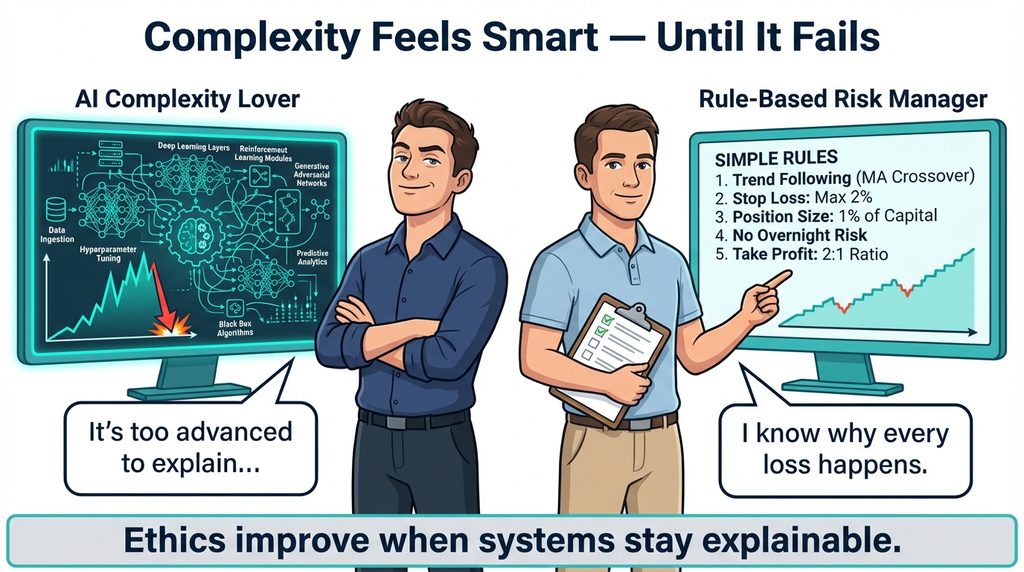
These systems tend to be more straightforward, easier to fix, and have clearer risks. AI-based systems often reduce explainability and increase hidden risk, especially when traders do not understand feature selection, training assumptions, or regime dependency. AI is not unethical by default. Uncontrolled complexity is a real headache. The ethical risk rises when the trader can’t monitor or shut down the system smoothly.
If you are mixing AI inputs with technical structure, be cautious about turning “analysis help” into “execution authority.” That boundary is explained in: AI Chart Analysis for MT4 & cTrader.
Ethical Use of AI in Trading
AI can be used responsibly when it stays in the right role: decision support, structure, and monitoring not as an autonomous authority.
Appropriate Uses
AI fits well for market research, data summarization, sentiment clustering, scenario framing, and journaling insights. These applications enhance understanding without trying to foresee the future.
If you are using AI for news and macro context, keep it as a filter not a trigger.
The right usage is detailed in: AI Sentiment Analysis for Trading.
Dangerous Uses
Unsupervised automation, sizing up staff, playing with leverage, and “set it and forget it” systems are the usual ethical red flags. These spots are where traders think they’ve improved their game, but they’re actually slipping up.
If automating executions, your first job is to set up safety nets. Check out this study: Understanding Trading APIs.
Internal Risk Framework Before You Use AI
Before using any AI trading system especially one connected to execution ask 4 questions:
- Do I understand the logic clearly enough to explain it?
- Can I explain a losing trade?
- Do I still control risk manually and structurally?
- Can I stop the system instantly?
If you’re not ready, then the answer to any of these is a big “no at that moment, it’s smart to beef up the AI trading risk management first.
You may want to review structured risk education such as Risk Management guide.
Conclusion — Ethical Issues Of AI In Trading
The ethical issues of AI in financial risk do not come from machines. People seem to dodge their duties. AI’s got power, but it’s not exactly wise It just doesn’t get the hang of dealing with uncertainty, survival, or long-term risks like a disciplined trader does.
Traders who survive do not ask:
“Can AI trade for me?” They ask:
“How can AI help me think better without increasing risk?”
That difference determines longevity.
If you want the full “AI + workflows + Forex/CFD reality” parent guide that connects every tool together, use: AI & Data-Driven Trading for Forex and CFDs.








