


Most traders don’t lose money because their strategy isn’t that bad. They lose because they don’t get what’s driving the market’s moves.
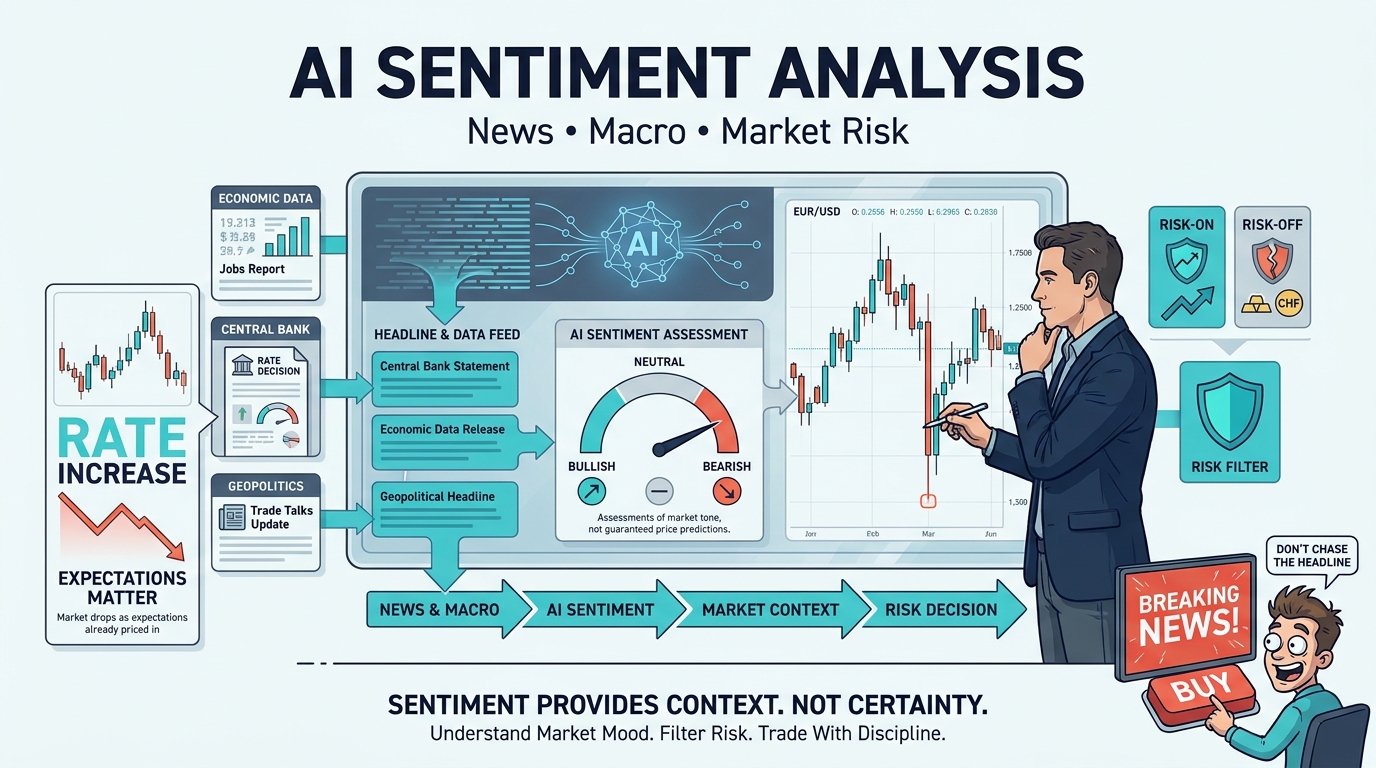
Economic news, central-bank announcements, and market moves move faster than charts can show, especially when bank news, global politics, and risks affect everyone. This is where AI Sentiment Analysis for trading becomes useful not as a signal generator, but as a context engine. AI Sentiment Analysis for trading does not tell you what to buy or sell.
It explains why volatility rises, why trends pick up speed, and why the market sometimes doesn’t follow the usual patterns.
This lesson explains how AI Sentiment Analysis for trading actually works, what it can and cannot do, and how disciplined traders use it without falling into false confidence or headline chasing.
What Is AI Sentiment Analysis for Trading
AI Sentiment Analysis in trading uses machine learning and natural language processing (NLP) to evaluate large volumes of text and classify overall tone as bullish, bearish, or neutral.
Instead of manually reading hundreds of articles or social posts, AI scans:
- Financial news
- Central-bank statements
- Economic commentary
- Analyst notes
- Market headlines
The output is structured sentiment data, not opinions or predictions.
Key takeaway: AI Sentiment Analysis for trading does not forecast price. It gauges the market’s vibe and the flow of the storyline.
This mood awareness really kicks into high gear when you pair it with some solid discipline in execution — the same kind of behavioral groundwork we talked about in Process Oriented Trading.
Why Sentiment Matters More Than Headlines
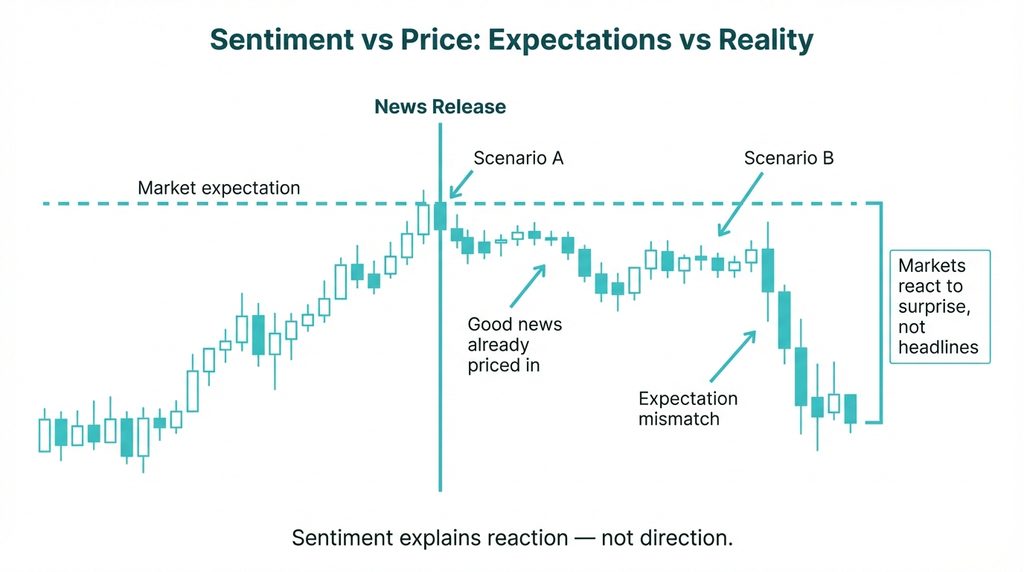
Markets rarely move because of news alone. They move because expectations clash with reality.
Example — Expectation vs Reaction
A rate hike occurs → the market falls. Why? Because the market had already priced in the hike. AI Sentiment Analysis for trading helps traders understand:
- Whether the news is a shock or just a foregone conclusion
- Whether feelings are already pretty intense
- Whether risk appetite is growing or shrinking
In Forex and CFD markets, sentiment analysis and broader macro factors usually beat day-to-day technical analysis. Traders who overlook this dynamic often end up over-trading, a pattern we’ve seen in the Reducing Risk Trading Strategy.
Types of Sentiment AI Analyses
AI-powered sentiment analysis can help Forex and CFD traders understand how market participants react to news, economic developments, and changing market conditions. By analyzing large volumes of text and other relevant data, these tools can identify shifts in positive, negative, or neutral sentiment that may influence market behavior.
Different types of sentiment analysis provide different insights. However, market sentiment does not reliably predict future price movements and should be considered alongside technical analysis, fundamental factors, and risk management.
News sentiment trading
News sentiment trading uses AI to analyze financial news, economic announcements, and geopolitical events to assess overall market sentiment. By identifying positive, negative, or uncertain language, AI tools can help traders understand how developments may influence market expectations.
AI can evaluate:
- Economic releases: Inflation reports, employment data, and central bank announcements.
- Political developments: Elections, government policies and regulatory changes.
- Global risks: Geopolitical tensions, economic uncertainty and unexpected international events.
Central Bank & Macroeconomic Language Analysis
AI-powered sentiment analysis can help Forex and CFD traders identify changes in central bank communication, monetary policy expectations, and broader economic sentiment. By analyzing official statements, speeches, and policy announcements, AI tools can detect subtle language shifts that may influence market expectations.
AI can analyze communications from:
- Federal Reserve (Fed): US interest rates, inflation and economic outlook
- European Central Bank: (ECB): Eurozone monetary policy and economic conditions
- Bank of England (BoE): UK interest rates, inflation and growth expectations
- Bank of Japan (BoJ): Japanese monetary policy and economic developments
Even small wording changes can signal a shift toward a more hawkish or dovish monetary policy stance.
However, these language changes do not guarantee future price movements. Their market impact depends on how they compare with existing expectations and broader economic conditions.
The key benefit of AI is identifying potential shifts in macroeconomic sentiment, not predicting exactly how markets will react.
Central bank communication is an important source of information for AI sentiment analysis in Forex trading. Official announcements published by the European Central Bank (ECB) provide primary-source information on monetary policy decisions and economic developments. Traders can use these communications to verify AI-generated sentiment assessments, identify changes in policy language and evaluate market expectations without treating sentiment as a guaranteed price prediction.
Market Risk Sentiment
AI-powered sentiment analysis can help Forex and CFD traders assess broader market risk appetite by identifying shifts in investor confidence, market volatility, and demand for defensive assets. This provides additional context beyond individual currency pairs or technical chart patterns.
AI can analyze indicators such as:
- Risk-on vs risk-off sentiment: Whether investors are generally seeking higher-risk assets or moving towards more defensive investments
- Equity-market stress: Changes in stock market volatility, uncertainty, and investor confidence
- Safe-haven demand: Shifts in demand for assets such as the US dollar (USD), Japanese yen (JPY), and gold, which may behave defensively during periods of market uncertainty
However, these relationships are not fixed. Safe-haven assets don't always rise during uncertainty, and correlations can shift as market conditions evolve.
Understanding broader risk sentiment can help traders spot overlapping exposures across positions, rather than analyzing each trade in isolation. This connection is explored further in Correlation & Risk Management.
Retail Sentiment vs Institutional Positioning
Market sentiment is not a single opinion shared by every participant. Retail traders and institutional investors may respond differently to the same market conditions, depending on their objectives, exposure, and risk-management requirements.
Understanding these differences helps Forex and CFD traders interpret sentiment data more effectively, rather than assuming all market participants are positioned in the same direction.
Retail Sentiment
Retail sentiment reflects the positioning and expectations of individual traders, often measured through broker positioning data or sentiment indicators.
Common characteristics include:
- Crowd positioning: The proportion of retail traders holding long or short positions.
- Emotional reactions: Trading decisions may be influenced by fear, greed, or recent price movements.
- Extreme positioning: Heavily one-sided sentiment can indicate crowded positioning, but it doesn't guarantee a market reversal.
Institutional Sentiment
Institutional positioning reflects the market exposure and trading activity of participants such as investment funds, banks and asset managers.
Their activity may involve:
- Market exposure: Positions based on investment objectives, economic expectations or portfolio strategies.
- Hedging flows: Transactions designed to manage existing currency or market risks.
- Risk rebalancing: Adjusting positions as volatility, portfolio exposure or market conditions change.
Institutional activity does not always indicate a directional market forecast. Some positions are established primarily for hedging or liquidity-management purposes.
AI sentiment analysis for trading can help identify differences between retail positioning, institutional activity, and broader market conditions. However, the available data may be incomplete or delayed, and AI cannot reliably determine the intentions behind every trade.
Key takeaway: Market sentiment depends on context. Retail traders and institutional participants may hold different positions for different reasons, and neither group is consistently correct about future price movements.
When AI Sentiment Analysis for Trading Works — and When It Fails
AI sentiment analysis can help traders understand market expectations and changing risk appetite. However, its reliability depends on data quality, timing, and market conditions.
When It Can Be Useful
- Strong market trends: Assessing whether sentiment supports the trend
- Major economic events: Identifying shifts in market expectations
- Trend continuation: Monitoring changes in market confidence
- Risk management: Highlighting uncertainty before execution
When It Becomes Less Reliable
- Low liquidity: Sudden price movements may not reflect broader sentiment.
- Unexpected events: Markets can react faster than AI models update.
- Delayed data: Sentiment may lag behind price movements.
- Standalone signals: Sentiment alone cannot reliably determine entries or exits.
Critical warning: Using AI Sentiment Analysis for trading as a buy/sell trigger is one of the fastest ways to accelerate losses a behavioral mistake closely linked to Overconfidence in Trading.
Short-Term vs Long-Term Sentiment
AI sentiment analysis for trading can examine market sentiment across different timeframes, helping Forex and CFD traders understand immediate reactions and broader market expectations.
- Short-term sentiment: Reflects immediate reactions to news, economic releases, and volatility.
- Medium-term sentiment: Helps identify developing market expectations and whether sentiment supports an existing trend.
- Long-term sentiment: Focuses on broader macroeconomic factors, including monetary policy, economic growth, and global risk appetite.
Key takeaway: Sentiment can differ across timeframes. A short-term reaction may conflict with the broader market outlook, so traders should interpret AI sentiment analysis for trading data within the relevant market context.
Common Mistakes Traders Make with AI Sentiment Analysis
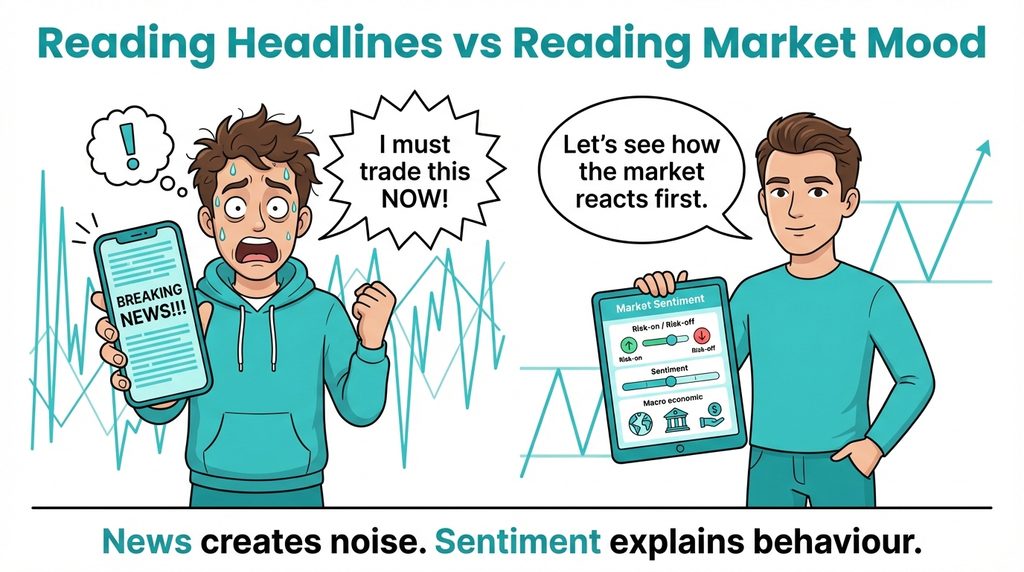
AI sentiment analysis for trading can support trading decisions, but relying on it incorrectly can lead to unnecessary risk and poor judgment.
Common mistakes include:
- Treating sentiment as a trading signal: Assuming positive or negative sentiment guarantees price direction.
- Ignoring market structure: Relying on sentiment without considering price action, trends, or key levels.
- Overreacting to news: Making impulsive decisions based on a single headline.
- Neglecting risk management: Trading without predefined stop-loss levels or appropriate position sizing.
- Ignoring sentiment reversals: Failing to recognize how quickly market expectations can change.
Key takeaway: AI tools can amplify the impact of trading decisions, but they cannot correct poor judgment or eliminate market risk. Effective use requires independent analysis, discipline, and risk management.
How Traders Actually Use AI Sentiment Analysis for Trading
AI sentiment analysis for trading can help Forex and CFD traders assess market conditions, manage risk and make more informed decisions rather than relying on market sentiment alone.
Common applications include:
- Filtering trades: Identifying unfavorable market conditions before entering positions.
- Managing exposure: Reducing risk during periods of heightened uncertainty.
- Adjusting position sizes: Considering market volatility and sentiment alongside predefined risk limits.
- Avoiding emotional decisions: Using structured analysis instead of reacting impulsively to market movements.
- Improving trade journals: Recording sentiment conditions and reviewing their influence on trading decisions.
AI sentiment analysis provides context, not trading decisions. For a more structured approach, traders can combine it with:
- Technical analysis: Evaluating price action, trends, and market structure.
- Risk management: Defining position sizes, stop-loss levels, and exposure limits.
- Trade journaling: Reviewing decisions and identifying patterns over time.
Key takeaway: AI sentiment analysis for trading is most useful when integrated into a disciplined trading process, rather than treated as a standalone trading strategy.
This layered strategy is right on teh money with the stability principles laid out in Trading Resilience.
What AI Sentiment Analysis Cannot Do
AI sentiment analysis for trading can help traders identify shifts in market expectations and investor confidence, but it has important limitations. It cannot eliminate market uncertainty, replace a structured trading strategy or guarantee profitable outcomes.
AI sentiment analysis:
- Cannot reliably predict price movements.
- Cannot automatically maintain a profitable trading strategy.
- Cannot prevent trading losses.
- Cannot guarantee accurate or timely signals.
Key takeaway: Be cautious of AI tools marketed as guaranteed “win-rate boosters”. Sentiment analysis supports informed decision-making, but its effectiveness depends on data quality, market conditions, and disciplined risk management.
Conclusion — AI Sentiment Analysis for Trading
AI sentiment analysis for trading is a supporting tool, not a shortcut to profitable trading. When used effectively, it can help traders:
- Understand market psychology and shifts in investor sentiment
- Identify uncertain market conditions and avoid unnecessary exposure
- Recognize broader market trends and changing risk appetite
- Reduce emotional decisions through structured analysis
However, overreliance on AI can lead to overconfidence, excessive risk-taking, and poor trading decisions.
The real value comes from combining AI insights with disciplined execution, a structured trading process, and effective risk management.
Technology supports better decision-making. It does not replace trader judgment or responsibility.








