


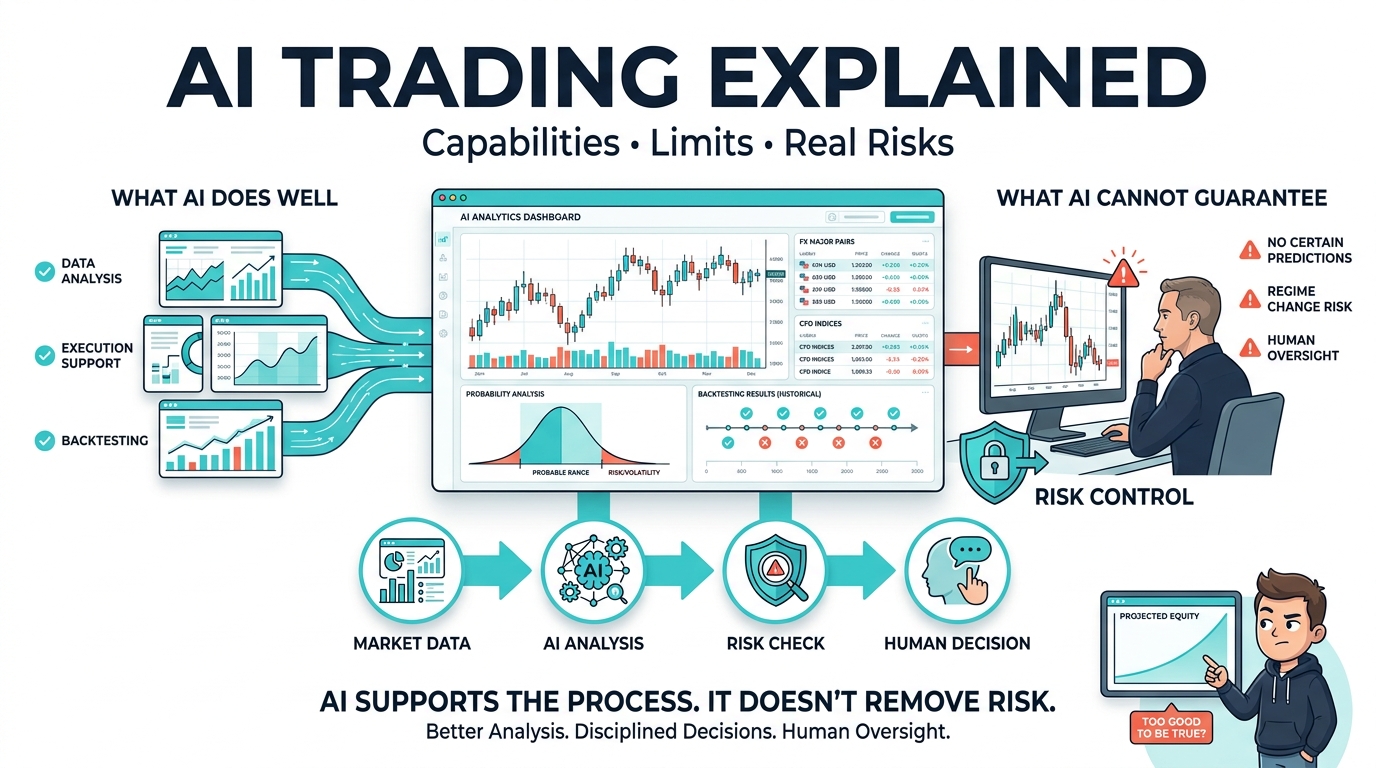
AI trading is often promoted as a shortcut to consistent profits. In reality, it is neither magic nor useless.
Used correctly, machine-learning AI in trading can speed analysis, improve execution accuracy, and strengthen behavioral discipline. Using AI trading blindly can lead to overconfidence, overfitting, and faster losses.
AI trading does not remove uncertainty from markets. It alters the way we handle info, not the way risk behaves in algorithmic trading
This guide explains what AI trading actually does, what it cannot do, and how serious traders should integrate it responsibly into a structured trading process rather than treating it as an automatic solution.
What AI Trading Actually Means (Reality Check)
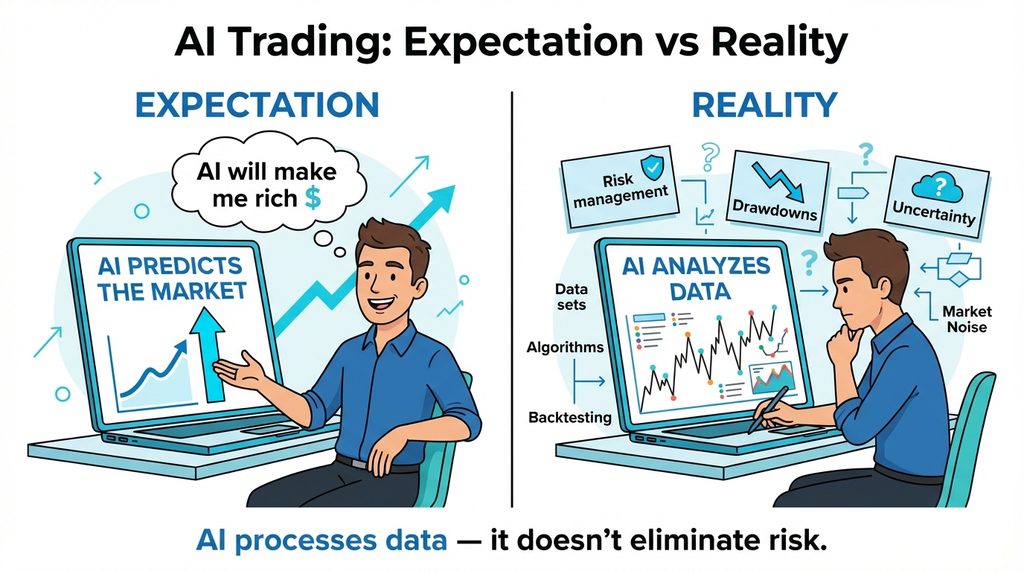
AI trading uses machine learning models, algorithms, and data-processing systems to support decision-making or automate specific trading tasks.
It does not mean:
- Predicting markets with certainty
- Eliminating losses
- Replacing risk management
- Removing human responsibility
At its core, AI trading is more like a helper for making choices and getting things done, not the entire game plan on its own.
The trader still defines rules, risk limits, and behavioral structure.
What AI Trading Can Do Well
AI trading tools can support traders by analyzing market information, identifying patterns, and improving the efficiency of technical analysis. By processing data faster than manual analysis, these tools help traders spot opportunities and monitor changing market conditions.
However, their greatest value lies in supporting research and structured decision-making, rather than replacing human judgment or guaranteeing profitable trading outcomes.
Process Large Volumes of Market Data
AI trading excels at scanning and organizing:
- Historical price datasets
- Volatility regimes
- Asset correlations
- Market microstructure behavior
- Pattern frequencies across long samples
Humans aren’t great at handling this much data all at once or consistently.
Key takeaway: AI trading improves analysis speed and breadth, not certainty or prediction accuracy.
Improve Trade Execution & Consistency
AI trading systems in algorithmic trading can:
- Execute orders faster than manual input
- Reduce hesitation and emotional delay
- Apply predefined rules consistently
- Minimize mechanical execution errors
This comes in handy when dealing with numbers or computer systems in algorithmic trading
Key takeaway: AI trading strengthens discipline and precision, not strategic judgment.
Assist With Backtesting & Scenario Analysis
AI trading can run thousands of simulations in machine learning trading to:
- Test ideas across multiple market phases
- Identify structural weaknesses
- Evaluate regime sensitivity
- Measure risk distribution patterns
But the simulation's quality hinges on data accuracy and your assumptions.
Key takeaway: AI trading reveals patterns and probabilities, not guarantees.
What AI Trading Cannot Do (Where Traders Get Burned)
AI trading tools can analyze large amounts of market data, recognize historical patterns, and generate trading signals. However, their capabilities have important limitations that traders need to understand before relying on them.
AI-generated signals can seem convincing, but they don't guarantee future market behavior. Recognizing these limitations helps traders avoid overconfidence, manage risk more effectively, and make informed decisions rather than blindly following automated recommendations.
AI Cannot Predict the Future
Markets are influenced by:
- Unpredictable human behavior
- Policy and interest-rate decisions
- Geopolitical shocks
- Liquidity disruptions
- Sudden volatility spikes
No model in AI trading, algorithmic trading, or machine learning trading can predict these variables with absolute certainty.
Reality check: Predicting isn’t a guaranteed advantage.
AI Cannot Adapt Like a Human in Real Time
AI trading systems often struggle when:
- Market regimes shift abruptly
- Liquidity dries up
- Correlations break down
- Volatility expands beyond historical norms
Machine-learning trading models trained in calm settings often struggle when things get tense.
Reality check: Live performance rarely mirrors backtest performance.
AI Cannot Replace Trading Psychology
AI trading systems do not:
- Manage your emotional reactions
- Decide when to stop trading
- Enforce discipline after losses
- Prevent overtrading or revenge behavior
- Human behavior still determines outcomes.
A system that’s solid tech-wise in AI trading can still fail if the trader lets emotions take over. It’s the same kind of risk discussed in the link about Trader Burnout & Overtrading.
The Hidden Danger — Black-Box AI Systems
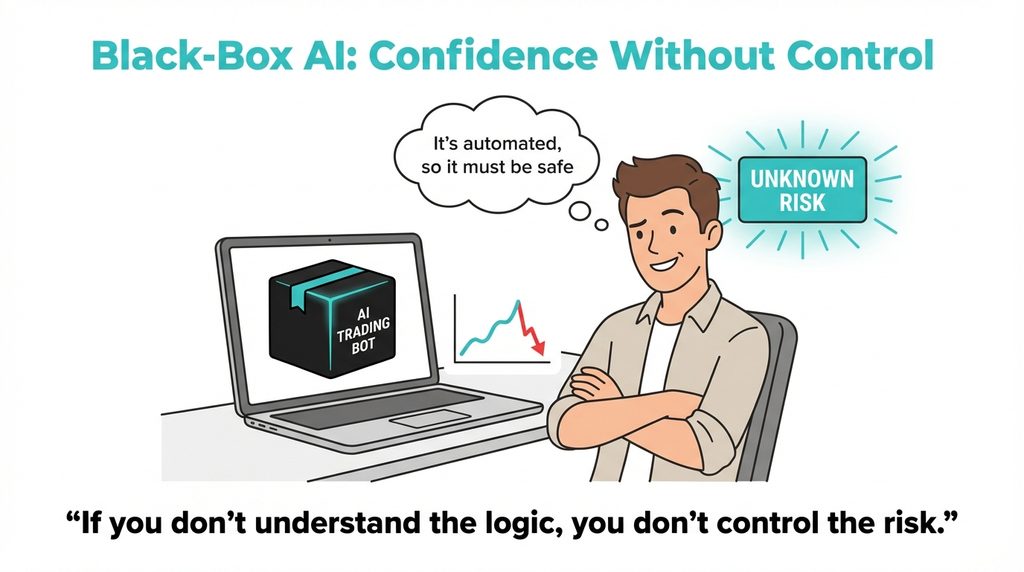
Many AI trading tools operate as “black boxes,” meaning:
- Decision logic is hidden
- Risk exposure is unclear
- Failure causes are difficult to diagnose
- Behavior cannot be audited
- This gives a false sense of security, particularly after a few quick wins
- If the logic is invisible, risk is uncontrollable.
Blind automation in algorithmic trading can sometimes cause traders to fall into the same old habits, just like the Overconfidence in Trading.
AI trading systems can create a false sense of security when traders rely on automated recommendations without understanding their limitations. The U.S. Securities and Exchange Commission's investor guidance on AI and investment fraud warns investors about misleading claims involving artificial intelligence and investment opportunities. This highlights the importance of questioning unrealistic performance promises, evaluating automated trading systems carefully and maintaining independent risk controls.
Where AI Trading Actually Makes Sense
AI trading is most effective when used for:
- Trade execution
- Data filtering and screening
- Pattern validation
- Risk monitoring dashboards
- Backtesting support
- AI trading performs poorly when used for:
- Signal-selling schemes
- Fully automated “set-and-forget” strategies
- Constant strategy switching
- Emotional decision replacement
AI trading‘s role is to aid in a well-organized workflow, not to take over — a concept that’s aligned with Process-Oriented Trading.
How Professional Traders Use AI (Correctly)
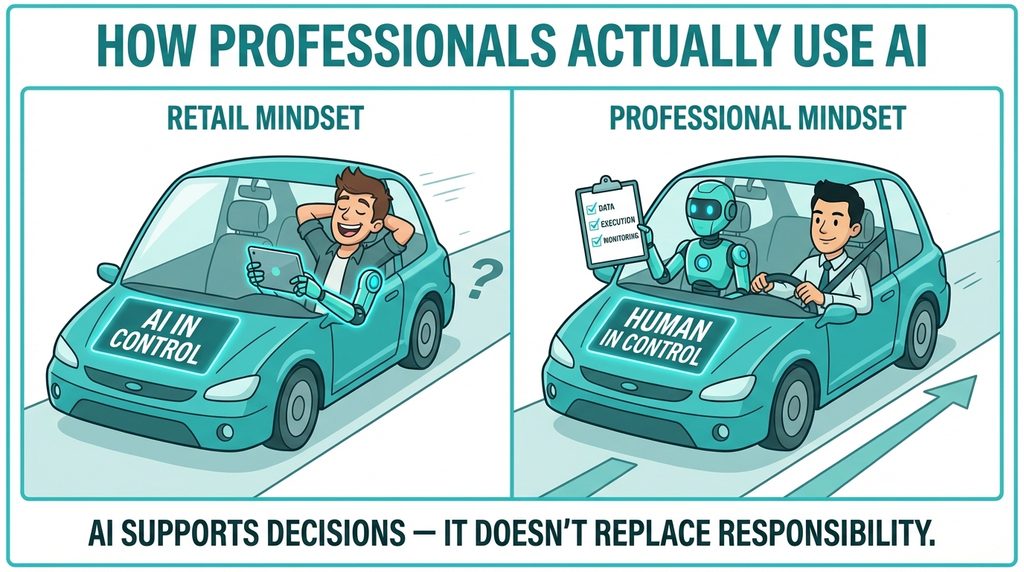
Professional traders treat AI trading as:
- A tool, not an edge
- A helper, not a decision-maker
- A risk amplifier if misused
They still rely on:
- Defined risk limits
- Position-sizing rules
- Market-context awareness
- Behavioural discipline
- Session-exit rules
- Technology in AI trading never replaces a survival structure.
This reflects the toughness and strategy plans talked about in the link for Trading Resilience: Long-Term trader Survival Psychology Explained.
The real question traders should not ask:
“Can AI trading make me money?”
but should ask: “Can AI trading improve my execution without increasing hidden risk?”
If the answer’s not clear, the AI trading system’s not ready yet.
Unclear systems in algorithmic trading can cause traders to hang around longer than they should Trading Exit Strategies
Conclusion — AI Trading Is a Tool, Not a Shortcut
AI trading is neither a scam nor a solution on its own. Used responsibly, AI trading enhances analysis and execution. Used blindly, AI trading accelerates mistakes and magnifies losses.
Traders who survive long-term understand that AI, algorithmic, and machine-learning trading technology does not replace self-control. It only exposes gaps in discipline.
Consistency comes from managing risks, staying steady in your actions, and sticking to a well-planned approach. AI trading only becomes valuable once those foundations are in place.








